Inside Nigeria’s Most Unbelievable ‘Non-Agency’ Scandal

Nigeria is jarring, everything about it.
What does it mean for a government to deny the existence of something that appears in its own budget, sits in its own offices, meets its own officials, and recruits staff under its own seals? At what point does fiction become administration or has Nigeria quietly been governed by paperwork that nobody is willing to fully recognise?
It sounds like folklore dressed as bureaucracy. But in a country where a JAMB clerk once claimed a snake swallowed N36 million in cash from a government vault, even absurdity has precedent. Still, nothing quite prepares the public for a structure that may be more unsettling than a missing snake: a full-fledged federal entity allegedly erased from existence while leaving behind footprints across state institutions.
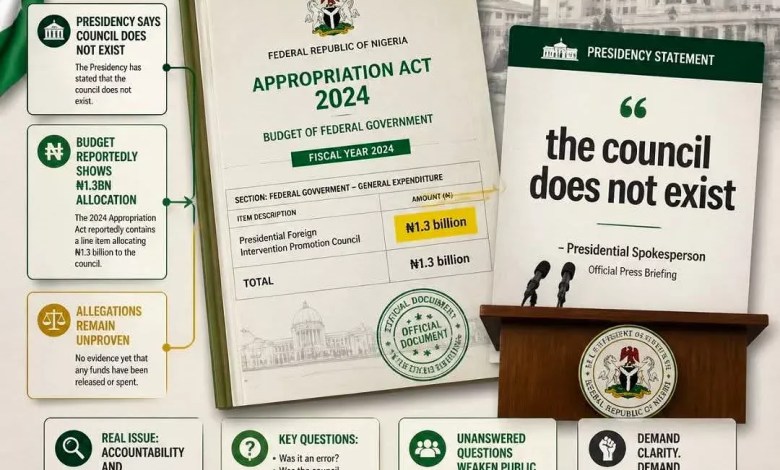
At the center of the storm is the Presidential Foreign Intervention Promotion Council (PFIPC), an organisation the presidency now insists never existed. Yet, for something that “never existed,” it reportedly had an office within the Federal Secretariat, a budget running into billions, accounts linked to the Central Bank of Nigeria, recruitment approvals for hundreds of staff, and a steady stream of official engagements that reached the highest levels of government.
So the question becomes unavoidable: how does a ghost attend meetings?
The first official crack in the story appeared on June 11, when the Chief of Staff to President Bola Tinubu, Femi Gbajabiamila, issued a striking disclaimer. He denied any knowledge of the PFIPC and distanced the presidency from the appointment of Adeniyi Adeyemi as its head, insisting no such office exists under the current administration.

But denials, in this case, did not close the file. They opened it wider.
Adeyemi, the man at the center of the controversy, pushed back almost immediately. At a press briefing in Abuja, he insisted the PFIPC was real in both structure and function. According to him, it had approval from the Office of the Head of Civil Service, operated bank accounts with the CBN, and had even secured clearance to recruit over 300 personnel. Its mission, he said, was simple: to support President Bola Tinubu’s administration in attracting foreign intervention and investment.
Then came the figure that complicated everything further, N1.3 billion. According to the 2026 appropriation act, the PFIPC was allocated that amount, broken down into personnel, overhead, and capital expenditure.
How does a non-existent agency get a budget line?
If the presidency’s position is accurate, another layer of contradiction emerges. Special Adviser to the President on Information and Strategy, Bayo Onanuga, later stated that the Chief of Staff had alerted the Department of State Services (DSS) and the police as early as October 2025 over alleged fraudulent operations linked to the PFIPC. Forged appointment letters bearing official signatures were reportedly used to lend credibility to the structure.
But that timeline raises its own discomforting puzzle: if the agency was already under security investigation in late 2025, why did it still appear in the 2026 national budget approved months later?
Between official rejection and official allocation lies a gap that is difficult to explain without raising deeper questions about institutional coordination, or institutional blindness.
Even more puzzling is how visible the PFIPC had become before the controversy erupted.
Long before the presidency’s denial, Adeyemi had built an active public presence. He had met senior lawmakers, including Deputy Speaker Benjamin Kalu, where discussions reportedly centred on collaboration with the National Assembly. He had also visited the Economic and Financial Crimes Commission (EFCC), meeting its leadership to explore institutional partnerships.
Traditional rulers received him. Lawmakers acknowledged him publicly. Social media pages documented official-looking engagements with diplomatic undertones. In one widely circulated post, the council claimed presidential approval for recruitment, state offices across Nigeria’s 36 states, and over 100 international offices, claims that, if true, would place it far beyond a minor administrative unit.
Yet no alarm was publicly raised at the time.
Even more startling is correspondence attributed to a Senate committee on anti-corruption and financial crimes, which reportedly invited the PFIPC to participate in a policy exchange programme in London. The letter addressed the council as an “esteemed organisation,” directing communication to its director-general.
At what point does recognition become endorsement? And if the PFIPC was fraudulent, how many layers of government validation did it pass through unchecked?
The contradictions deepen when placed against Nigeria’s institutional history. The country once operated a Presidential Economic Advisory Council (PEAC), dissolved in 2022. Confusion between defunct, rebranded, or newly created advisory structures is not unheard of in Nigeria’s complex governance architecture. But confusion does not typically extend to budget allocations and security investigations running in parallel.
Then there is the man at the center of it all.
Authorities have now labelled Adeyemi a serial impostor, citing previous claims including leadership of a so-called World Youth Organisation allegedly linked to the United Nations system, an organisation for which no verified UN record exists. Questions have also been raised about other foundations and affiliations attributed to him, none of which have been independently verified.
But even if every allegation against him holds, another uncomfortable question remains: how did one individual allegedly gain access to so many gates of state without triggering institutional alarms?
Because the PFIPC scandal may not be about one man alone. It may be about how easily legitimacy can be simulated inside government systems, through signatures, seals, budgets, correspondence, and silence.
And so the bigger questions persist, hanging over the bureaucracy like unresolved echoes:
Who verifies what exists inside government? Who audits recognition before it becomes expenditure? And how many other “non-existent” agencies might currently be operating in plain sight, waiting only for a disclaimer to make them vanish?
Until those answers arrive, one unsettling possibility remains: the PFIPC may not be the anomaly. It may be the symptom.