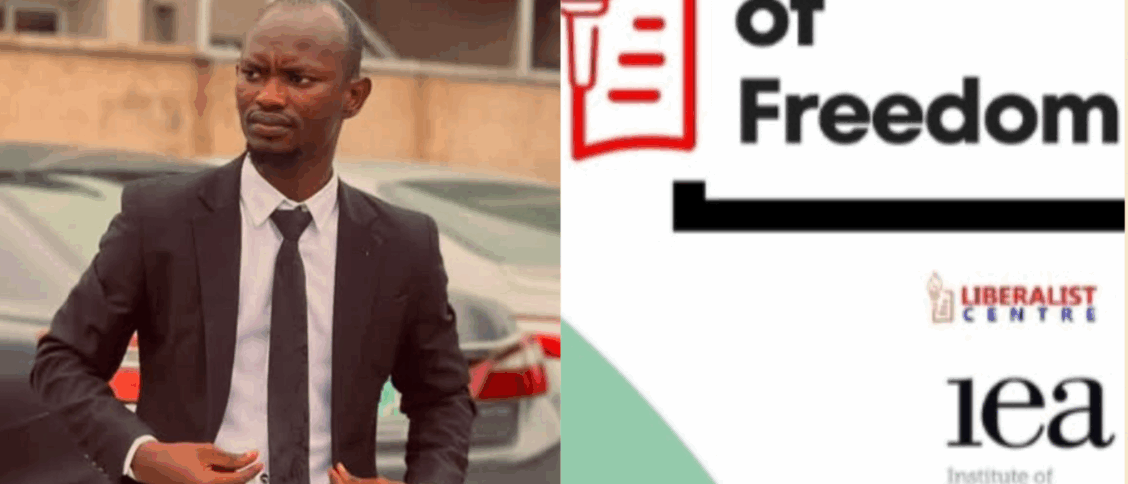

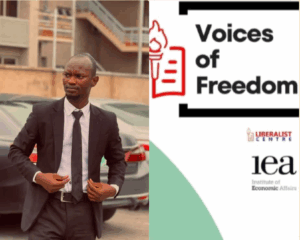
As more Nigerians shift their work, social lives, and political engagement into the digital space, questions of privacy, freedom, and rights online are moving to the heart of the country’s democratic debate. This was the focus on Voices of Freedom, podcast feature on Adamimogo 105.1FM, where a journalist and digital rights advocate Abdulwasiu Olookoba explored how liberty in the digital era is under pressure.
“The rights we know offline, life, privacy, freedom of expression, must equally be respected online,” Olookoba said. Yet, he warned, Nigeria still lacks a comprehensive law that explicitly secures those freedoms in the digital domain.
He recalled the Digital Rights Protection Bill, which between 2017 and 2019 passed both chambers of the National Assembly but never received presidential assent under Muhammadu Buhari.
“We are still pushing for that bill to become law,” he noted. Until then, online freedoms remain vulnerable to arbitrary restrictions and state overreach.”
Still, the absence of that legislation does not leave Nigerians completely unprotected. The constitution enshrines freedom of expression, though its application in the digital age has grown more complicated.
“You can speak your mind on X, Facebook, or Instagram, but that freedom has legal limits,” Olookoba said.
He pointed out how Nigeria’s Cybercrime Act of 2015, amended in 2023, criminalized forms of defamation once treated as civil matters. Today, a social media post accusing someone of theft, for example, must be backed with proof or risk prosecution.
The discussion also highlighted an often-overlooked concern: personal data. Nigerians, Olookoba warned, are leaving vast amounts of information online, feeding an ecosystem where media companies and third parties profit from what people share. “Once your information is online, it can be used against you,” he cautioned, urging citizens to exercise discretion and ask: what benefit do I get by putting this information out, and what risk am I creating for myself?
For Olookoba, the question of digital rights cannot be separated from Nigeria’s wider democratic journey. In 1999, when civilian rule returned, social media barely existed.
Today, political debates, protests, and even intimate personal exchanges take place on digital platforms. “If we don’t secure freedom in the digital space, we can’t say we are truly free in the physical one,” he argued.
What emerges from these concerns is a picture of a democracy facing its next frontier. Protecting digital rights in Nigeria is not simply a legal or technical question; it is a democratic imperative. Whether in parliament, on the streets, or on the screens of millions of citizens, the struggle for freedom is increasingly fought in code, clicks, and algorithms.