
8 of the World’s Most Colourful Buildings That Turn Architecture Into Art

Architecture can influence the way we think and feel, and colour can be just as powerful. When combined thoughtfully, the two can transform ordinary structures into extraordinary works of art.
“Colour is the crucial ingredient that elevates a building to otherwise unachievable heights of resonance and delight,” designers Adam Nathaniel Furman and Kate Mazade write in Chromatic Architecture – the Craft of Colour in Design.
Their book explores how architects have used bold colours, intricate patterns and vivid materials to give buildings distinctive identities.
Here are eight remarkable examples from around the world.
1. Sri Ranganatha Swamy Temple, Tamil Nadu, India
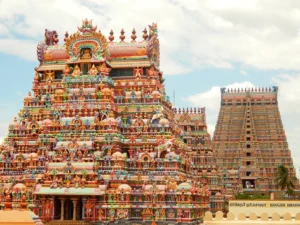
Tamil Nadu has a centuries-old tradition of using colour in architecture, and the Sri Ranganatha Swamy Temple at Srirangam is one of its most spectacular examples.
Construction began in the 1st Century AD and continued under successive dynasties until the late 20th Century. The sprawling religious complex covers more than 150 acres and is surrounded by 21 monumental gateways, known as gopurams.
Their three-dimensional sculptures are covered in vivid pigments, creating an extraordinary visual spectacle.
Furman describes the site as a place where spiritual life is made visible through colour, drawing visitors and worshippers away from everyday life and towards contemplation and wonder.
2. Palau de la Música Catalana, Barcelona, Spain
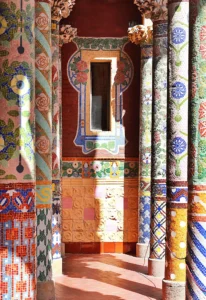
Built in 1908, the Palau de la Música Catalana became a symbol of Catalonia’s growing industrial wealth and distinctive cultural identity.
Designed by Lluís Domènech i Montaner, the concert hall combines Art Nouveau with Romanesque and Gothic Revival influences, as well as Moorish and Valencian elements.
For Furman, virtually every part of the building carries symbolic meaning. From its stonework and columns to its light fittings and decorative details, colour and ornamentation work together to create an almost fairytale-like atmosphere.
3. Guardian Building, Detroit, Michigan, USA
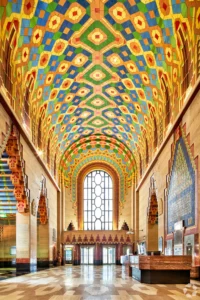
Completed in 1929 and designed by Wirt C. Rowland, the Guardian Building is one of the world’s outstanding examples of Art Deco architecture.
Known locally as the “Cathedral of Finance”, the building uses colour to celebrate Detroit’s industrial and commercial heritage.
Nearly two million orange-toned bricks and terracotta tiles cover its exterior, while the main lobby features a spectacular three-storey vaulted ceiling decorated with colourful tiles.
According to Mazade, the building’s bold design reflected Detroit’s commercial success at the time and remains a vivid reminder of the city’s architectural ambition.
4. De Bijenkorf Department Store, Eindhoven, Netherlands
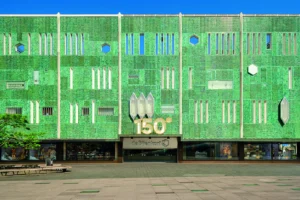
Designed in 1969 by Italian architect, designer and artist Gio Ponti, De Bijenkorf department store demonstrates how colour can transform an otherwise imposing structure.
Ponti is reported to have drawn inspiration from the patchwork appearance of Dutch farmland viewed from above.
Instead of leaving the large, windowless building as a monotonous concrete block, he covered it in a striking green grid.
Furman describes the result as a “vast, glittering field of emerald wonder”, transforming what could have been an unattractive blank façade into a major piece of modern urban art.
5. Reversible Destiny Lofts, Tokyo, Japan
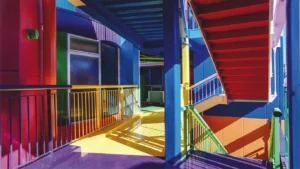
Completed in 2005, the Reversible Destiny Lofts were designed by artist Arakawa and poet Madeline Gins as a tribute to disability advocate and writer Helen Keller.
The nine colourful apartments resemble a futuristic collection of cylinders, cuboids, spheres and other unusual architectural forms.
But the unusual design was more than an aesthetic experiment. Arakawa and Gins deliberately used irregular floors, spherical rooms and intense colours to challenge residents physically and mentally.
They believed that an environment capable of disrupting sedentary lifestyles could potentially encourage people to live longer.
6. Maishima Waste Incineration Plant, Osaka, Japan
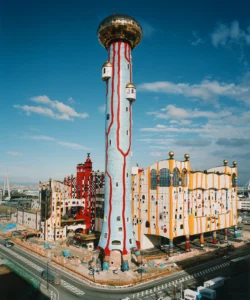
Few industrial facilities look as unusual as the Maishima Waste Incineration Plant in Osaka.
Designed by Austrian artist and architect Friedensreich Hundertwasser, the facility rejects the rigid appearance traditionally associated with industrial architecture.
The building resembles an eccentric, colourful castle, with yellow stripes appearing to drip down its walls and a tall cylindrical tower decorated with red patterns.
Rounded structures, colourful blocks and unusual architectural forms complete the unconventional design.
Hundertwasser believed architecture should behave more like a living organism than a machine, and the Maishima plant embodies that philosophy.
7. Leganés Central Library, Leganés, Spain
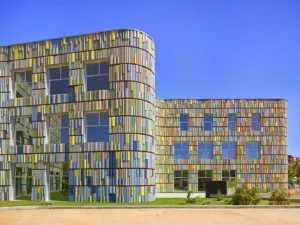
Built in 2019 by BN Asociados Arquitectos, the Leganés Central Library and municipal archive uses colour as a visual representation of its contents.
Large pastel-coloured ceramic tiles cover the building’s rounded façade, creating an impression of layers of books and pages.
The design also gives the relatively new neighbourhood a distinctive cultural landmark.
As sunlight moves across the scalloped ceramic surfaces, the soft colours and matte textures create an effect reminiscent of paper.
8. Croydon Colonnade, London, UK
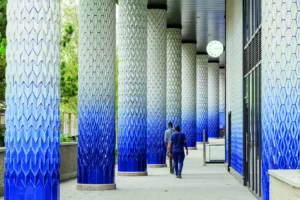
The Croydon Colonnade brings an explosion of colour to East Croydon.
Completed in 2023 and designed by Adam Nathaniel Furman, the 50-metre pedestrian space consists of 16 giant columns and two large walls covered in thousands of handmade porcelain tiles.
The tiles feature a rich translucent glaze, moving from deep blue at the bottom to creamy white towards the top.
The design draws inspiration from the long history of blue-and-white architectural ceramics found in monumental buildings across regions including Egypt, Portugal, Turkey, Iran and Babylon.
For Furman, colour immerses pedestrians in a rich and sensory environment while connecting a contemporary London project with thousands of years of architectural history.


