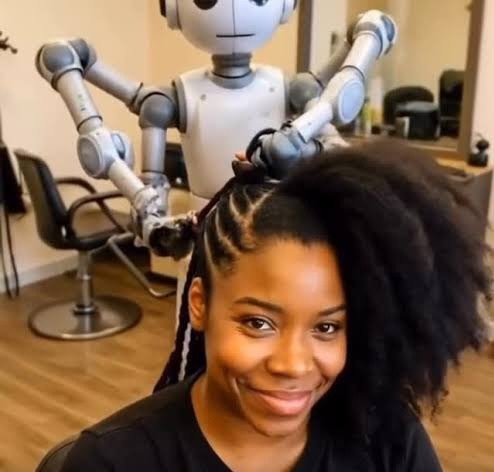
HaloBraids Could Transform Hairstyling industry Forever

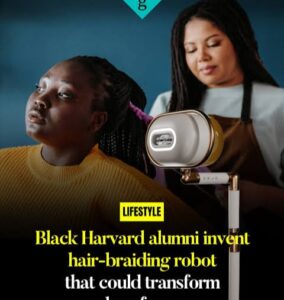
Nigerian-American engineer and Harvard graduate Yinka Ogunbiyi is taking on one of the beauty industry’s most time-consuming tasks with HaloBraid, a robotic system designed to assist professional hairstylists in braiding textured hair.
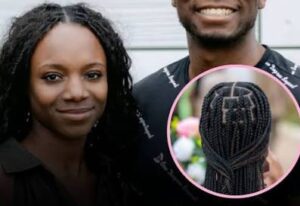
Ogunbiyi, a biomechanical engineer who holds a joint Master of Science and Master of Business Administration from Harvard’s Engineering School and Business School, developed the technology after experiencing firsthand the physical demands of traditional hair braiding.
Recalling the first time she attempted to braid her own hair, Ogunbiyi said the process took four days, an experience that made her realise she was not alone in struggling with a time-intensive hairstyle practised by millions of people.
“Hair braiding is now the most popular hairstyle for 20 million Americans who experience this miserable process every eight weeks. And yet braiding hasn’t seen innovation since braiding was invented 5,000 years ago,” she said.
Her pitch, originally delivered during the 2025 Harvard Innovation Challenge, recently resurfaced online after the US Mission in Nigeria highlighted her work on social media, sparking renewed interest in the technology.
Ogunbiyi and her co-founder, David Afolabi, spent more than 18 months developing HaloBraid, producing over 450 prototypes and testing the technology on thousands of braids, including on Ogunbiyi’s own hair.
The company describes HaloBraid as a patent-pending braid-assist robot designed to work alongside human hairstylists rather than replace them.
Instead of attempting to automate the entire salon experience, the technology is intended to perform repetitive and physically demanding aspects of braiding, potentially reducing appointment times and the strain placed on stylists.
The company says its broader mission is to develop technology that makes textured haircare “faster, easier, more comfortable, and more joyful.”
HaloBraid has raised $7 million in seed funding to take the technology towards commercial production.
The funding round was led by Seven Seven Six, the venture capital firm founded by Reddit co-founder Alexis Ohanian, with participation from AlleyCorp and Bling Capital.
The company plans to use the investment to develop salon partnerships, conduct further stylist testing and prepare the device for manufacturing.
More than 7,000 professional salons have reportedly joined the company’s waiting list as it prepares for commercial availability.
HaloBraid is expected to officially launch later in 2026, with the company ultimately aiming to make the technology available internationally.
Robotic hair braiding represents an emerging intersection between engineering, artificial intelligence and the beauty industry.
For hairstylists, the technology could potentially reduce the physical toll associated with spending several hours performing repetitive hand movements. For customers, it could mean shorter appointments and a more consistent braiding process.
However, the company emphasises that HaloBraid is intended to be a stylist’s assistant rather than a replacement for human professionals. Human stylists would continue to provide the creative direction, consultation and finishing touches that are central to the salon experience.
The development also highlights a growing effort within technology to address challenges specific to textured hair, an area that has historically received relatively little attention from mainstream consumer technology.
Ogunbiyi’s background has given her a distinctive path into the sector. Before developing HaloBraid, she worked on connected smart-home appliances and consumer electronics.
Her journey has now taken that engineering experience into a very different arena: the salon.
HaloBraid is not alone in exploring automated hair styling. Other technology companies, including Braidant, are also developing salon-oriented robotics and AI-powered systems aimed at making braiding faster and more precise.
The emerging competition suggests that robotic assistance could become an increasingly important part of the future of professional haircare.
For Ogunbiyi, however, the idea began with a much more personal problem, the exhausting experience of doing her own hair.
What started with four days of braiding has evolved into a technology company backed by millions of dollars in venture capital and thousands of salons waiting to test the machine.
If HaloBraid succeeds, one of the world’s oldest beauty practices could soon receive one of its biggest technological upgrades.


