

When you hear tiny tourism, what immediately comes to your mind?
Well, Tourism can be exciting and boring at the same time. There is also the rush to move from one attraction to another, keep an eye on the clock, follow the itinerary and make sure you have seen everything considered “worth seeing.” Sometimes, in the process, travel becomes less about experiencing a place and more about completing a checklist.
This is where “tiny tourism” comes in.
Tiny tourism is a travel mindset that focuses on small, everyday experiences rather than constantly chasing major attractions. It is about noticing the seemingly insignificant details that make a destination feel authentic: a local grocery store, a neighbourhood bakery, a park bench, a train ride, a pharmacy shelf, a corner shop, a morning market or a quiet residential street.
These are not usually the places that appear on postcards. They may not even make it into conventional travel guides. Yet they can reveal far more about how people actually live.
As a tiny tourist, you become something of a pseudo-inhabitant. Instead of simply passing through a destination as a visitor, you temporarily live like the people who call the place home. You shop where they shop, walk where they walk, eat what they eat and observe the rhythms of everyday life.
Supermarket shopping may sound like an unusual way to spend part of a holiday, but that is precisely the point of tiny tourism. The concept was coined by the UK-based creative platform It’s Nice That as a counter-trend to overcrowded tourist attractions and increasingly predictable “bucket-list” travel.
Its principle is simple: if it feels like something a tourist would obviously do, perhaps try something else.
The idea emerged from an observation by Liz Gorny, lead editor of It’s Nice That Insights. She noticed that after returning from holidays, her colleagues rarely talked about the grand monuments or famous attractions they had visited. Instead, they remembered a particular café, something they discovered in a grocery store or an unexpected encounter in a neighbourhood.
“It felt like people were always talking about this cafe they went to or what they found in a grocery store,” she told the BBC. “This is the stuff that feels exciting.”
That observation formed the basis of the Tiny Tourist report, released in April 2026, which encouraged travellers to look beyond the obvious and seek out experiences that cannot easily be replicated or found on every tourist’s itinerary.
It could mean finding a beach without a Google Maps pin, discovering a neighbourhood restaurant with no social media following, buying a local hot sauce or simply sitting somewhere and watching the morning unfold.
The appeal of tiny tourism is also connected to a growing backlash against overtourism. Popular destinations are increasingly struggling with overcrowding as social media turns particular streets, restaurants, beaches and landmarks into must-visit locations.
Tiny tourism offers an alternative. Instead of following the crowd, the traveller deliberately wanders away from it.
For some travellers, this approach may actually produce more lasting memories. A famous landmark can be spectacular, but thousands of other people may have taken almost exactly the same photograph before you arrived. A chance conversation with a shopkeeper, an unusual snack discovered in a supermarket or a morning train ride through an unfamiliar neighbourhood can feel much more personal.
Tiny tourism also builds on travel habits that have been gaining popularity. Visiting foreign pharmacies, exploring convenience stores in Japan and wandering through local supermarkets have all become attractions in their own right.
Opodo’s 2026 Traveller Hacks poll, for instance, found that visiting supermarkets had become as normal for British holidaymakers as eating at restaurants.
So how does one become a tiny tourist?
It begins with abandoning the idea that every moment of a holiday must be spectacular.
Ask residents where they go when they are not entertaining visitors. Take a walk without a particular destination. Use public transport. Visit a neighbourhood market. Go for a morning run. Sit in a local café. Buy something ordinary from a corner shop. Browse a bookstore. Visit a pharmacy. Do your laundry. Have lunch somewhere without checking whether it has gone viral online.
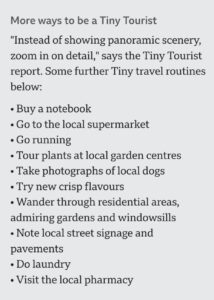
In other words, temporarily stop behaving like a tourist.
Another important rule is to resist social media’s travel instructions. A restaurant with millions of views may be worth visiting, but the viral video itself should not determine your itinerary. Sometimes, the best discovery is the place that nobody has told you to visit.
But tiny tourism should not become an excuse to ignore environmental responsibility.
One particularly questionable suggestion associated with the trend is taking pebbles from beaches as souvenirs. That may seem harmless, but removing stones, shells and other natural materials can contribute to environmental degradation, particularly in fragile ecosystems.
In Greece, for example, taking pebbles from certain beaches can attract significant fines because of the damage caused to protected environments.
The best souvenir from such places remains a photograph, a memory or, if you insist on taking something home, a wet swimsuit.
There is, however, a limit to how far the anti-tourist philosophy should go.
Tiny tourism does not mean pretending famous attractions do not exist. On one occasion, travellers following the concept found themselves at Trinity College in Dublin, walking through its historic grassy quads, where literary giants such as Samuel Beckett, Jonathan Swift and Oscar Wilde once walked.
The experience was a reminder that famous attractions became famous for a reason.
Visiting Dublin without seeing its major attractions, the experience suggested, was like eating only the side dishes at a restaurant. Something important was still missing.
And that may be the real lesson of tiny tourism.
It is not about abandoning the Eiffel Tower for a supermarket, ignoring the pyramids for a pharmacy or refusing to visit a famous museum because tourists go there.
It is about doing both. See the landmark. Take the photograph. Walk through the famous square. Visit the museum. Then step away from the crowd. Find the snack aisle. Take the side street. Ride the morning train. Sit in the quiet park. Walk into the small shop. Watch how people live.
Because sometimes, the most memorable part of travelling is not seeing something extraordinary. It is experiencing something completely ordinary in a place that is new to you.
So, on your next holiday, go tiny.


