
The President is expected to assent to the proposed amendment at a formal ceremony after reviewing it in consultation with the Attorney-General of the Federation.
The Chief of Staff to the President, Femi Gbajabiamila, announced the development in a statement on Wednesday, saying the bill was presented to Tinubu by his Special Advisers on Senate and House of Representatives Matters, Senator Basheer Lado and Dr Wasiu Olanrewaju-Smart.
According to Gbajabiamila, the approval by all 36 state assemblies exceeds the constitutional requirement of at least 24 states, representing two-thirds of the federation, for an amendment of this nature to proceed under Section 9(2) of the 1999 Constitution.
The development followed the Senate’s resolution declaring that the legislative process for the proposed amendment had been completed.
The Senate reached the decision after considering a motion sponsored by its Leader, Opeyemi Bamidele, who informed lawmakers that the bill had secured the necessary approvals from the state assemblies.
Bamidele recalled that the Senate and the House of Representatives passed the bill on June 24 and July 23, 2026, respectively, with the required two-thirds majority before transmitting it to the 36 state assemblies for ratification.
He said every state had communicated its approval to the National Assembly, thereby satisfying the constitutional conditions for the amendment.
The Senate subsequently authorised the Clerk to the National Assembly to transmit the bill to the President for assent in line with the Acts Authentication Act, 2004.
The proposed legislation, known as the Constitution of the Federal Republic of Nigeria (Sixth Alteration) Bill, 2026, seeks to introduce State Police Services into Nigeria’s policing structure.
However, the completion of the constitutional amendment process is not sufficient on its own to bring state police into operation.
The Senate urged Tinubu to forward a National Policing Bill to the National Assembly to provide the legal and operational framework for the proposed system.
Gbajabiamila, who chairs the Presidential Working Group on State Police, said the group had completed nationwide consultations and engagements with relevant stakeholders towards developing the draft legislation.
He disclosed that the draft National Policing Bill had been submitted to the Federal Ministry of Justice for legislative drafting validation.
The working group, he added, would review the validated document before submitting it, alongside its report, to the President for consideration.
Tinubu also acknowledged the contributions of the Senate President, the Speaker of the House of Representatives, members of the National Assembly, state governors, lawmakers across the 36 states and Nigerians who supported the initiative.
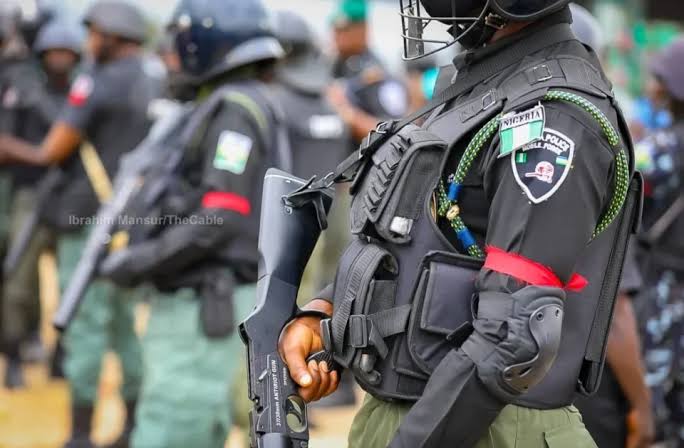
The proposed establishment of state police would mark a significant change to Nigeria’s centralised policing arrangement, under which the Nigeria Police Force operates primarily under federal control.
Calls for decentralised policing have persisted since the return to democratic rule in 1999, with state governors, security experts and civil society organisations arguing that a single federal police structure faces challenges in responding effectively to security threats across the country’s 36 states and 774 local government areas.
The debate has grown amid persistent attacks by armed groups, kidnapping, banditry and insurgency in different parts of the country.
Some states have introduced regional security initiatives to strengthen local responses to insecurity. In the South-West, for instance, the Amotekun Corps was established in January 2020 following concerns over attacks and criminal activities in the region.
The state police proposal gained renewed attention under the Tinubu administration as pressure mounted on the Federal Government to review the country’s security architecture.
An earlier constitutional amendment proposal on state police was passed by the National Assembly in May 2024, but failed to complete the ratification process at the state level.