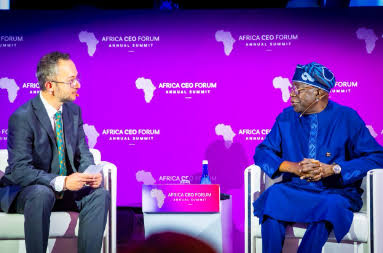

“They demand a lot but won’t pay tax” President Bola Tinubu ranted during the Africa CEO Forum in Kigali.
The President who is eyeing a second term in office next year, stressed the need for Nigerians to embrace taxation as a critical tool for national development, arguing that sustainable infrastructure and social services cannot be delivered without citizens contributing to government revenue.
He was furious that many citizens demand improved public services while remaining unwilling to bear the financial costs required to sustain them.
“Nobody wants to pay taxes. Taxation is not friendly to the wealthy, middle class, and to the poor,” the president said.
“Every human being expects development, but the question they don’t answer is how do you pay for it. You want a good highway, but you don’t want it to go through your land.
“You want good and well-equipped hospitals, and you don’t want to pay taxes. How do we care for the vulnerable? How do you protect the future of children? How do you even fund research and development?”
Tinubu linked taxation to broader questions of national development and economic sustainability, arguing that countries must establish reliable sources of revenue to support healthcare, infrastructure, education and innovation.
Playing back lessons from the COVID-19 pandemic, the president spotted the importance of research and pharmaceutical investments, saying governments must think strategically about funding priorities.
“Tax is a priority. A citizen who pays tax is a citizen, whether corporate or individual. If you are not a taxpayer and not exempted, then you are not a citizen,” he said.
The president also defended some of the key reforms introduced by his administration since assuming office, describing them as difficult but necessary decisions aimed at stabilising the economy and preventing a fiscal crisis.
According to him, Nigeria could no longer sustain policies that placed heavy burdens on public finances, particularly fuel subsidies, which he described as wasteful and vulnerable to abuse.
“It was very necessary to reset, recalibrate and reform the economy,” Tinubu said.
“It is a fake life to think you can, in a global economy, continue the subsidy that is wasteful. It encourages falsification of papers and smuggling.”
Tinubu said the country faced serious economic challenges before the reforms were introduced, noting that many state governments had struggled to meet salary obligations.
“When you look at the economic problem of the country, and you see that you are almost going bankrupt, of the 36 states, 27 of them were unable to pay workers’ salaries. Where is the money?” he asked.
He further questioned the sustainability of maintaining fuel subsidies despite Nigeria’s position as an oil-producing country with limited refining capacity.
“You are an oil producer, you are earning, you are giving fuel, you have no refinery that is functional. It is not possible to continue that trend,” he added.
Acknowledging the hardship associated with economic restructuring, the president compared reform measures to the pains of childbirth, suggesting that temporary sacrifice would eventually lead to positive outcomes.