
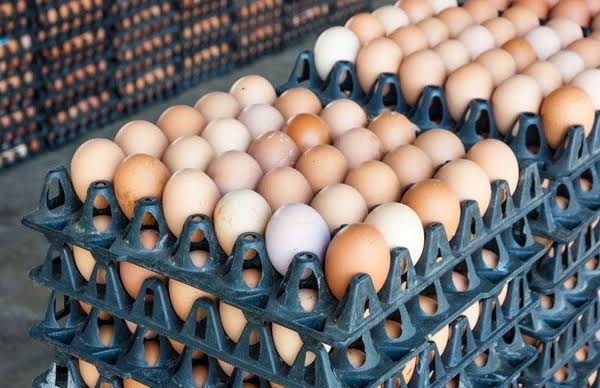

For millions of Nigerians, eggs were once the last affordable refuge in a collapsing food economy, a modest but dependable source of protein when meat, fish and dairy products drifted beyond the reach of ordinary households.
Today, even that safety net is fraying.
Across markets in Nigeria, the price of eggs has surged to record levels, deepening concerns about worsening food insecurity and raising fresh questions about the long-term social impact of President Bola Tinubu’s economic reforms.
With single eggs now selling between N200 and N300 depending on size, many low- and middle-income families are being forced to ration consumption or eliminate eggs entirely from regular meals.
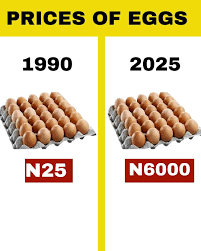
For a household of seven, what was once considered a basic nutritional staple is rapidly becoming a luxury.
Retail prices for a crate of eggs, which previously ranged between N6,000 and N6,500 in many parts of the country, have now climbed to between N7,000 and N8,500. Farm gate prices have also risen sharply, increasing from around N5,000 per crate in January to approximately N5,500, while supermarkets and grocery chains push prices even higher due to transportation and operating costs.
The development places eggs in an uncomfortable category within Nigeria’s food hierarchy, still cheaper than beef, chicken or fish, yet increasingly unaffordable for struggling families already burdened by inflation, transport costs and stagnant incomes.
Nutrition experts warn that the consequences may extend beyond hunger alone.
Poor nutrition, particularly among children, has long-term implications for cognitive development, learning capacity, public health and workforce productivity. As protein-rich foods disappear from household menus, concerns are growing about the broader social and developmental consequences for a country already grappling with widespread poverty.
At the centre of the current crisis is Nigeria’s poultry industry, one of the largest in Africa but increasingly strained by soaring production costs, supply shortages and financing difficulties.
Some say the immediate pressure stems from an acute shortage of day-old chicks (DOCs), a critical component in poultry production.
According to Mojeed Iyiola, chairman of the Poultry Association of Nigeria in Lagos State, the scarcity could soon push the price of a crate of eggs to N10,000 if urgent interventions are not implemented.
“The major reason for the current price hike and looming scarcity is that most old layers were sold off during the festive season, and poultry farmers currently have no access to day-old chicks,” he said.
He explained that obtaining DOCs has become increasingly difficult, with bookings taking as long as five months before delivery, followed by another five months before the birds begin laying eggs.
Also, data from the sector indicate that prices of day-old chicks have risen by about 67 per cent within just three months, intensifying fears over the sustainability of poultry production nationwide.
Despite the growing crisis, the Federal Government is pursuing ambitious plans to boost domestic protein production. Authorities are reportedly considering a $900 million investment aimed at producing up to six million eggs daily to bridge the country’s widening protein gap and improve food security.
However, experts say large-scale investment alone may not immediately resolve the structural problems affecting the industry.
Amaka Chukwudum-Ajide, founder of Amicable Mondiale Farms, argues that stronger government support, improved financing access and targeted agricultural interventions are urgently needed to stabilise production and reduce costs.
The crisis is unfolding against the backdrop of sweeping economic reforms introduced by the Tinubu administration, including fuel subsidy removal and exchange rate liberalisation. While government officials insist the measures are necessary for long-term economic recovery, critics argue that the immediate burden is falling disproportionately on ordinary Nigerians whose purchasing power continues to erode.
For many households, the debate over macroeconomic reforms is now being increasingly measured in the cost of basic survival, because families can no longer afford to place on the dining table.