

Osun State is set to decide its political future on Saturday, August 15, 2026, when voters across the state’s 30 local government areas will choose the next governor.
The election has attracted intense attention because Osun has historically been one of Nigeria’s most competitive governorship battlegrounds. Its political contests are rarely determined by party structures alone. Candidates’ personal popularity, grassroots organisation, governance records, political alliances and the ability to translate support into votes have repeatedly played decisive roles.
As preparations enter their final stretch, here are some of the key facts and dynamics that should help put the election in perspective.
1. Osun was created in 1991
Osun State was created on August 27, 1991, by the military administration of General Ibrahim Babangida. It was carved out of the old Oyo State, with Osogbo designated as its capital.
The state has since developed a distinct political identity and has experienced several changes in political leadership and party control.
2. It is one of the six states in the South-West
Osun is located in Nigeria’s South-West geopolitical zone and shares boundaries with Ekiti and Ondo states to the east, Kwara to the north, Ogun to the south, and Oyo to the west.
Its location places it within one of the country’s most politically active regions, where historical political networks and strong voter awareness often make elections highly competitive.
3. Osun has 30 Local Government Areas
The state is divided into 30 Local Government Areas and three senatorial districts: Osun East, Osun Central and Osun West.
Osogbo, the state capital, is also home to the Osun-Osogbo Sacred Grove, one of Nigeria’s most recognised cultural and heritage sites.
4. The population figure should be treated with caution
The Osun State Government has previously put the state’s population at about 4.7 million, based on a 2016 estimate.
However, that figure is not a recent national census count and should therefore not be presented as the state’s current population. The absence of a more recent official census figure makes precise population estimates difficult.
5. Ten people have governed Osun since its creation
Since 1991, 10 people have served as governor or military administrator of Osun State.
They are Leo Segun Ajiborisha, Isiaka Adeleke, Anthony Udofia, Anthony Obi, Theophilus Bamgboye, Bisi Akande, Olagunsoye Oyinlola, Rauf Aregbesola, Gboyega Oyetola and the incumbent, Ademola Adeleke.
The first civilian governor was Isiaka Adeleke, while Bisi Akande, Olagunsoye Oyinlola, Rauf Aregbesola, Gboyega Oyetola and Ademola Adeleke have governed during the Fourth Republic.
Ademola Adeleke became governor on November 27, 2022, after defeating the then-incumbent Gboyega Oyetola in the 2022 governorship election.
6. The 2026 race has narrowed into a major three-way contest.
Although candidates from 14 political parties are participating in the election, the contest has increasingly centred on three prominent candidates: incumbent Governor Ademola Adeleke of the Accord Party, Asiwaju Bola Munirudeen Oyebamiji of the All Progressives Congress (APC), and Dr Najeem Folasayo Salaam of the African Democratic Congress (ADC).
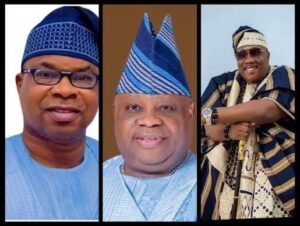
Recent campaign activities and political alignments have reinforced the perception that these three candidates are the major forces in the race, although the presence of other candidates means the election is not formally a three-party contest.
7. The three leading candidates come from Osun West
An unusual feature of this election is that Adeleke, Oyebamiji and Salaam all come from Osun West Senatorial District.
Adeleke is from Ede North, Oyebamiji from Irewole, while Salaam is from Ejigbo
That geographical concentration could make the election particularly interesting. None of the three can rely solely on support from their home areas. Their success will depend heavily on their ability to establish broad appeal across Osun East, Osun Central and the rest of Osun West.
8. Security remains a major concern
The Independent National Electoral Commission (INEC) has identified 385 security flashpoints and about 200 difficult-to-access locations across the state as part of its election risk assessment.
The assessment covered all 30 local government areas, with the findings shared with security agencies to guide their deployment and operational planning. INEC has also been conducting training for election personnel on peace and safety management.
The figures underline the security challenges that could confront election officials, voters and political parties on election day.
9. Vote buying remains a concern
Vote buying has featured prominently in discussions about Nigeria’s recent elections, and Osun is not immune to the problem.
The practice can influence voters at the point of decision-making and undermine the principle of free choice at the ballot box. Its impact is particularly concerning in an election where relatively small margins could determine the winner.
For political parties, observers and election monitors, tracking inducement and other forms of electoral malpractice will therefore be an important part of assessing the credibility of the poll.
10. Voter apathy could also determine the outcome
While political parties are investing heavily in mobilisation, voter turnout remains another variable that could reshape the election.
A low turnout can alter the balance between political parties because the strength of a candidate’s support base matters less if supporters fail to appear at polling units.
In a tightly contested election, mobilisation on election day could ultimately prove just as important as the size of campaign crowds witnessed in the weeks leading up to the poll.
11. Osun’s political history makes predictions difficult
The state’s political history offers perhaps the biggest warning against taking any outcome for granted.
Osun has changed political allegiance at different points, with successive elections demonstrating that established political structures can be challenged by strong candidates, shifting alliances and changing voter sentiment.
That history means the August 15 election cannot be reduced simply to a contest between party labels. The strength of each candidate’s grassroots network, campaign organisation, public perception, political alliances and record of governance could all influence the final result.
12. The real test begins after the campaigns
With campaign activities winding down, attention is shifting from rallies and political messaging to the actual mechanics of voting: voter mobilisation, security, logistics, accreditation, ballot integrity and the collation of results.
The most important question on August 15 will ultimately be whether voters are able to cast their ballots freely and whether those votes are accurately counted and transparently reflected in the final result.
For Osun, a state accustomed to close political contests, the election is more than a battle for the Government House in Osogbo. It is another test of the state’s political maturity and Nigeria’s broader capacity to conduct competitive elections in which citizens’ choices are protected.
On Saturday, August 15, Osun will decide. The campaigns may have produced the noise, but the voters will have the final word.


