

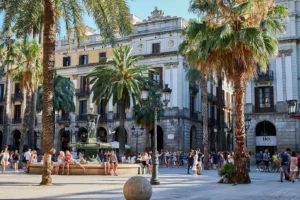
A stroll through a Spanish city can reveal just how commonplace the practice is. Middle-aged couples exchange kisses on busy streets, young lovers embrace on park benches, while revellers find moments for affection amid the excitement of public celebrations. Even in professional settings, the Spanish word besos, meaning kisses, frequently appears as a warm sign-off in personal correspondence.
Beyond romantic relationships, the familiar double-cheek kiss remains a common greeting among friends and acquaintances, reflecting a broader culture of physical expression.
Amparo Lasén, a professor of sociology at the Complutense University of Madrid, says Spaniards are generally more comfortable with physical displays of affection than people in some northern European countries.
She noted that the contrast is particularly noticeable when Spain is compared with countries such as England and those in the Nordic region.
However, the difference may not necessarily be that Spaniards are more affectionate, but that they are less inhibited about expressing affection in public. A kiss on the street does not always carry the weight of a grand romantic gesture. It can simply be an accepted expression of intimacy.
Living conditions may also contribute to the visibility of public affection. Approximately 65 per cent of Spain’s population lives in flats, the highest proportion among European Union countries. Meanwhile, rising property prices have made independent living increasingly difficult for younger adults, many of whom remain in their family homes.
Lasén suggests that the country’s housing challenges have encouraged people to socialise outside their homes, making public spaces important meeting points for friends and couples.
She explains that Spain’s housing situation means people are more accustomed to meeting in bars and restaurants than entertaining friends at home. For couples with limited privacy, a quiet corner or secluded park bench may offer an opportunity to spend time together.
However, she argues that the housing situation alone does not explain the country’s visible culture of affection. More significant is the relatively relaxed public attitude towards such behaviour.
When people do not expect condemnation or disapproving reactions from passers-by, expressing affection in public becomes easier.
For 28-year-old Isabel Nieto Tous, who returned to her parents’ home three years ago after living abroad, the absence of privacy can make dating particularly challenging.
She recalls having to tell her parents she was spending the night at a friend’s house rather than explaining that she was staying with someone she was dating.
Having lived in Japan, France, Germany and Tunisia, Tous believes romantic relationships in Spain often develop with a noticeable degree of physical familiarity.
According to her, people can become comfortable with touching, holding hands and displaying affection remarkably quickly, even when a relationship is still at an early stage.
But Spain’s present-day openness towards public affection represents a significant departure from its more restrictive past.
During the dictatorship of Francisco Franco, which lasted from 1939 to 1975, conservative Catholic values and strict social regulations shaped public conduct. Homosexuality was criminalised, while expressions of sexuality and public intimacy faced considerable restrictions. Couples could even be penalised for kissing in public.
The death of Franco in 1975 ushered in a period of profound cultural and social change. In Madrid, the countercultural movement known as La Movida Madrileña emerged as a celebration of individual freedom, artistic expression and sexual liberation.
Filmmakers, musicians and other creative figures, including Pedro Almodóvar, challenged the conservative social values that had dominated the dictatorship.
The growing visibility of alternative lifestyles and expressions of sexuality, however, was also the product of sustained activism, particularly by members of the lesbian, gay, bisexual and transgender community.
One defining moment came on February 23, 1987, when activists organised a public kiss-in at Madrid’s Puerta del Sol.
The protest followed the arrest of two women in the square the previous year for kissing in public. They were reportedly detained for two days under Spain’s Public Scandal law, known as Escándalo Público.
Their arrest prompted campaigners to organise a mass demonstration through which participants kissed publicly to challenge the law and demand greater freedom of expression.
The protest became a landmark in Spain’s struggle for greater social acceptance. From 1987 until the 1990s, Madrid’s annual Pride marches regularly ended with a mass kiss at Puerta del Sol, turning an everyday expression of affection into a symbol of resistance and equality.
The Public Scandal offence was eventually abolished in 1988.
Today, public displays of affection are a familiar part of Spanish life, although the freedom to express them is not always experienced equally. Older couples kissing in public may attract unexpected attention, while same-sex couples can still encounter greater scrutiny and prejudice.
Nevertheless, Spain’s relationship with public affection reflects a remarkable social transformation, from a period when a kiss could attract police attention to one in which couples routinely express intimacy in public.
Perhaps the most striking thing about kissing in Spain is not how frequently it happens, but how little attention it attracts. For many Spaniards, it is simply another part of being human.