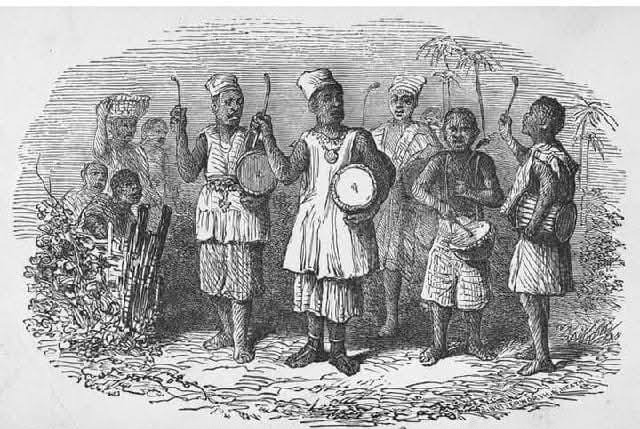

Ọba kìí pa onílù, the king does not behead the drummer.
In 2019, I wrote an article titled “In ‘Defence’ of Praise Singing,” where I reflected on a related saying: Ọba kìí pa olórin, the king does not behead the singer. In that article, I recalled what happened in 1983, after the election that saw the then Ondo State, now Ekiti and Ondo, go up in flames.
It was the lead drummer of the late Sikiru Ayinde Barrister, SAB, whose tune in their then-latest album, “dò dò dò mí re mí dò re dò, re dò re re mí”, was interpreted by some listeners as: “Shagari wọlé ẹ̀kejì, àwa kò ṣe ti Baba mọ́.” In loose translation: “Shagari has won a second term; we no longer follow Awolowo.”
SAB vehemently denied that interpretation and offered his own. According to him, what his lead drummer said was: “Ìyàwó ẹlẹ́sẹ̀ oṣùn, ìwọ nìkan ṣoṣo ni mo fẹ́” (the well-decorated wife, you alone are the one I love.)
Thankfully, it was not the era of social media. Who knows what could have become of his musical career? There was, however, an immediate shift to Talazo Fuji at the time.
In traditional Yoruba society, whatever the drummer says he has said with his drum holds. That is the basis of the saying that the king does not behead the drummer. The drummer’s art carried rhythm, poetry, ambiguity, insinuation, praise, warning, and sometimes mischief. Meaning could be suggested without being confessed. Offence could be taken, but denial could still be offered.
I used “singer” in my earlier article because of the controversy over who truly constituted the band leader. Drummers used to be band leaders, while vocalists were treated largely as backup singers. The modernization of Juju and Apala music altered that tradition, making vocalists the band leaders. Fuji musicians inherited that shift.
But the old order and the new order are not the same.
In the old order, the drummer’s ambiguity protected him. In the new order, the spokesperson’s contradiction exposes him. Yet, somehow, both enjoy immunity.
The drummer could plausibly say, “That is not what my drum said.” But the modern spokesperson is often forced to say, “That is not what I meant,” even when the internet has preserved the words, tone, video, date, audience, and context.
That old protection for the drummer has found a curious new home in Nigerian politics. Today’s political spokespersons enjoy a similar immunity. They may praise, attack, deny, reverse themselves, and still be protected by the very principals whose interests they serve.
In recent years, we have seen spokespersons make dramatic U-turns about public figures they once condemned or celebrated, even when recordings and written records say otherwise. Yesterday’s villain becomes today’s statesman. Yesterday’s saviour becomes today’s danger. Yesterday’s “fact” becomes today’s “misinterpretation.” And the public is expected to clap for every new performance.
Imagine Daniel Bwala struggling to defend or deny, in 2026, things he said around 2022 and 2023. Consider also the outspoken Reno, with his regular invitation to “fact-check me,” now accepting an ambassadorial position from a man he once called unprintable names during the election campaign.
The latest on the block is the living legend of Nollywood, Kenneth: the voluble lawyer who, in the past few weeks, has been “unspeaking” many of the great things he once said about his former principal.
In typical Nigerian fashion, we now have a WAZOBIA arrangement of political doublespeak: Daniel from the North, Kenneth from the East, and Reno, though a Deltan, with his unapologetic identification with the Lukumi of the South West not in doubt. We love and accept him, too.
Two are lawyers. One is a public commentator and self-acclaimed Gospeller. These “distinguished” Nigerians are brilliant, articulate, and skilled in public communication. Whether those skills serve the common good is another matter.
Two have been rewarded, and their previous degradation has been turned into praise-singing. The third, the latest “kid” on the block, is yet to be rewarded. Perhaps that is because his own case is an inverse relationship: praise singing before degradation. If his principal makes it to the podium, his reward may still be waiting. Otherwise, his reward awaits elsewhere.
In all this, have we seen any of their principals come out to caution or denounce them? Hardly. They are simply doing their jobs. They are immune to rebuke so long as they play their cards well.
And perhaps this is where the real danger lies. The problem is not merely that spokespersons contradict themselves. Human beings change their minds. Politics shifts. Alliances collapse. New facts emerge. The problem is when contradiction is sold as consistency, when opportunism is dressed as conviction, and when the public is asked to forget what it clearly remembers.
This is why digital memory matters. The old drummer performed in a world where meaning could dissolve into rhythm. The modern spokesperson performs in a world of screenshots, interviews, archived posts, video clips, and timestamps. Yet many still behave as if public memory can be beaten like a talking drum until it says something else.
Given the rise of these turncoat spokespersons, should we not begin to interrogate the role itself? Should there not be an acceptable standard that protects the sanity of the public from the constant supply of unethical narratives? Is there anything we can do to hold them accountable for the information they feed us?
Yes, they may be immune from correction by their principals. But the general public has a duty to hold them accountable. Principals may reward them. Parties may recycle them. Governments may rehabilitate them. But the public must not surrender its memory.
They should not be allowed to feed us whatever narrative suits the politics of the moment.
Should their immunity be sustained or challenged?
Let us hear your thoughts.
(The figure man who loves alphabets)