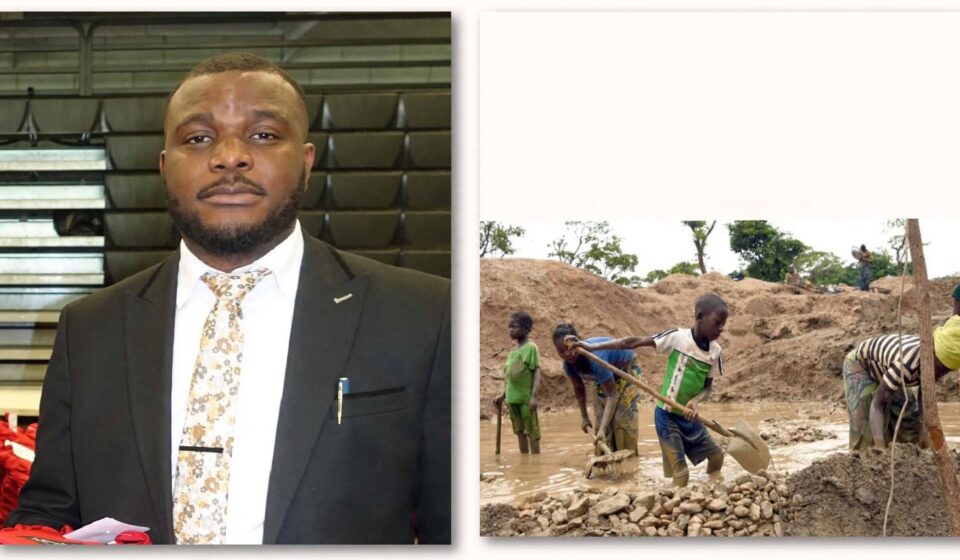
“A Generation Is Being Traded for Gold”: Policy Expert Warns Niger State’s Mining Crisis Threatens to Erase an Entire Cohort of Boys

The deaths of 37 young miners in custody in Niger State have exposed a deeper, slow-burning catastrophe that could see an entire generation of boys vanish from Nigeria’s classrooms, according to Gbolahan Charles Oloye, a researcher, educator and policy professional.
In a recent interview, Oloye warned that the tragedy is not an isolated incident but the visible tip of a systemic failure that has been building for years. “What happened in that cell is horrifying, but it is a symptom,” he said. “The real crisis is that we have created an economy where a 14-year-old boy believes his best chance at survival is to crawl into a mining pit instead of sitting in a classroom.”
Oloye, whose interdisciplinary background spans international relations, political science, African regional affairs, governance, security studies, education, public policy and strategic communication, argues that the crisis in Niger State is the product of a perfect storm: extreme poverty, the collapse of local livelihoods, and the glittering lure of artisanal gold.
“They Have Tasted the Money”
Governor Umaru Bago has repeatedly cited a UNICEF projection that by 2027, there will be no male children in JSS2 in Shiroro and other local government areas of Niger State. The governor noted that children “have tasted the mining money” and now see it as more lucrative than education.
Oloye says this is not hyperbole. “When a child can earn N50,000 to N150,000 a week in a mining pit, and his father is a struggling farmer earning a fraction of that, the economics of survival override every argument about the long-term value of education,” he explained. “You cannot tell a hungry child to wait ten years for a certificate when he can eat today.”
The same pattern is repeating across Nigeria’s mineral-rich regions. In Plateau State, officials have identified illegal mining as a major driver of the out-of-school crisis, with dropout rates exceeding 28 percent.
The government’s immediate response to the crisis has been enforcement. The Niger State Governor has called for an executive order to ban mining entirely in problematic areas, and security forces have conducted sweeping arrests.
Oloye argues this approach is dangerously short-sighted. “You cannot arrest your way out of a poverty crisis,” he said. “The arrest-and-detain model led directly to the deaths of 37 children. What does that tell us? It tells us that the system is broken at every level.”
Recall that Minister of Solid Minerals Development Dele Alake has himself acknowledged that while illegal mining must remain illegal, artisanal miners need a structured framework to operate legally and safely. A coalition of civil society organisations has echoed this, arguing that regulation must provide a legal pathway for people to work safely and responsibly.
Oloye agrees, but goes further. “Formalisation is not enough if it is not accompanied by genuine economic alternatives,” he said. “You can give a miner a licence, but if the formal sector cannot compete with the black market, he will go back to the shadows. The state must create an environment where legal mining is more profitable than illegal mining, and where the benefits actually reach the communities whose land is being extracted.”
Following the Money
The tragedy has also raised questions about who profits from the labour of children. The National Association of Seadogs has demanded the arrest of the owners of the illegal mining sites who employed the teenagers. ActionAid has called for investigations that follow the money beyond the “young man holding a shovel” to identify the “financiers, middlemen, smugglers and powerful interests benefiting from illegal mining.”
Oloye is blunt about this. “A 14-year-old boy in a mining pit is not an entrepreneur. He is cheap labour for someone else. We need to ask who owns that pit, who buys the gold, who exports it, and who protects them. Until we answer those questions, we are just recycling tragedy.”
He points to the structural neglect that makes children vulnerable in the first place. “Niger State has vast mineral wealth beneath its feet, yet 69.1 percent of its population lives in multidimensional poverty. That is not an accident. It is a policy choice. When communities see nothing from the resources extracted around them, they have no incentive to protect those resources or their children.”
The Long-Term Cost
Oloye warns that if the current trajectory continues, the consequences will extend far beyond Niger State. “We are talking about a lost generation,” he said. “Boys who should be in school are in pits. Girls are being married off or sent into domestic labour. The social fabric is being torn apart. In ten years, we will have a population of young adults with no education, no skills, and no prospects. That is a recipe for sustained conflict, crime, and instability.”
He argues that the response must be comprehensive and coordinated. “This is not just a mining problem. It is an education problem, a poverty problem, a governance problem, and a security problem. You cannot solve it with one ministry or one agency. It requires a whole-of-government approach that puts children at the centre.”
Oloye outlines three priorities. First, a transparent investigation into the deaths of the 37 miners, with accountability for those responsible for the conditions of their detention. Second, a human-centric formalisation of artisanal mining that creates legal, safe, and profitable pathways for miners while ensuring community benefits. Third, a massive reinvestment in education and local economic development in mining communities, so that children have a genuine alternative to the pits.
“The children who died in that cell were not criminals,” Oloye said. “They were victims of a system that failed them long before they were arrested. If we do not change that system, we will be having this same conversation in five years, and the death toll will be higher.”
He added: “The question is not whether we can afford to fix this. The question is whether we can afford not to. Because the cost of doing nothing is not just measured in lives lost. It is measured in a generation erased.”

Gbolahan Charles Oloye is a researcher, educator and policy professional with an interdisciplinary background spanning international relations, political science, African regional affairs, governance, security studies, education, public policy, programme implementation and strategic communication.