Robotic Surgery Is Rewriting Nigeria’s Healthcare Story at Redeemers Health Village

At a time when Nigerians routinely travel abroad in search of specialised medical care, a hospital tucked inside the Redeemed Christian Church of God’s sprawling Redemption City is seeking to demonstrate that some of the country’s most sophisticated procedures can be performed at home.
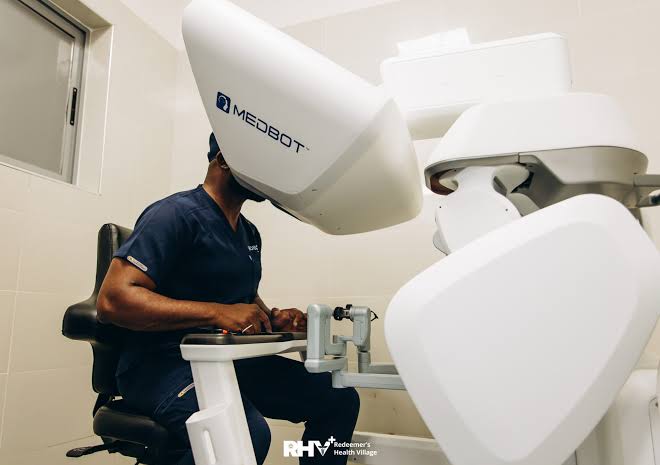
Recent tele-robotic and other robotic surgeries at the facility have placed the hospital at the centre of an emerging conversation about the future of advanced healthcare in Nigeria.
Speaking with Sunday PUNCH during a recent visit to the facility, an orthopaedic surgeon at the hospital, Dr Adedamola Dada said the procedures were not intended to be one-off demonstrations but the beginning of a system in which highly specialised surgery could become part of routine medical practice.
The former Medical Director of the Federal Medical Centre, Ebute Metta, and now Chief Executive Officer of Redeemer’s Health Village, described telerobotic surgery as “the peak of medical services now in the world.”
“We have been able to successfully do it. We just don’t want it to happen only once; we want it to become a routine,” he said.
The development, he explained, could have implications beyond the technology itself.
According to him, if advanced procedures can be performed successfully in Nigeria, patients who might otherwise travel overseas could receive treatment closer to home, surrounded by their families and existing support networks, while potentially reducing the financial burden associated with medical tourism.
The hospital’s ambition is far beyond the church, it goes beyond serving members of the RCCG.
The sugeon said the facility was established as part of a broader vision by the General Overseer of the Redeemed Christian Church of God, Pastor Enoch Adeboye, and his wife, Pastor Folu Adeboye, to provide Nigerians with access to world-class healthcare regardless of their religious or ethnic background.
“The vision is from both Daddy, Papa Enoch Adeboye, and our mother, Mama Folu Adeboye. RHV is an arm of the Redeemed Christian Church of God. They have given us the vision, and they have given us the commission,” he said.
That commission, he explained, rests on four central principles: world-class healthcare, affordability, availability and sustainability.
The intention, he said, is to make quality healthcare accessible not only to members of the church but to Nigerians from different backgrounds.
“If there are credits to be given for the services that are rendered in this institution, it’s actually to the visioner. The vision actually predates our coming in,” he said.
“Our objective basically is to provide affordable healthcare, healthcare that is world-class, yet affordable, and in a sustainable way, for all Nigerians. Not just the members of our church, but all Nigerians, regardless of religion, creed, state of origin or ethnicity, and even beyond.”
While the hospital’s recent robotic procedures have attracted attention, the surgeon stressed that the technology represents only one component of a much larger medical infrastructure.
The heavily equipped facility has five operating theatre suites and handles a broad range of procedures, including joint replacements, neurosurgery and complex orthopaedic operations.
Its radiology department is another area the hospital considers a major strength.
The surgeon described the department as arguably the country’s strongest in terms of equipment, personnel and outcomes.
“If you look at our Radiology Department, it’s, without question, the best in the country, in terms of equipment, in terms of personnel, in terms of outcome,” he said.
The department’s capabilities have also attracted researchers working on projects involving African populations.
According to the surgeon, international organisations and research institutions have partnered with the hospital for studies, particularly in radiology.
One of the projects involves research into the brains of Africans in collaboration with the University of Ibadan.
“As I’m talking to you now, we’re doing research on the brains of Africa, which would involve us capturing maybe about a thousand brains in conjunction with the University of Ibadan,” he said.
He attributed the choice of the hospital as a research partner partly to the capabilities of its MRI equipment.
“The reason why they have chosen us as a partner for that is because our MRI is the only one in the country that can capture those parameters that they want. So, it’s not just about robotics,” he said.
The hospital’s surgical capacity extends across several specialties which support routine and complex procedures, including joint replacement, brain surgery and other complicated orthopaedic operations.
The hospital has also commenced in-vitro fertilisation services, broadening the range of specialised care available within the facility.