
The US Needs To Do Better With its Shabby Visa Policies as World Cup Begins

FIFA’s decision to award the 2026 World Cup to the United States, Canada and Mexico was meant to signal a new era for global football, bigger stadiums, more matches, and a truly expanded tournament featuring 48 nations.
Instead, for many fans, the excitement is being overshadowed by a more uncomfortable question: who will actually be able to attend?
From Africa to the Middle East, supporters are raising concerns that the tournament risks becoming one of the most expensive and administratively restrictive,World Cups in history, particularly because the majority of matches, including the final, will be played in the United States.
For many, the dream of watching their country on football’s biggest stage is already colliding with visa barriers, financial hurdles and political restrictions.
The tension is especially sharp for nations like Iraq, which only recently secured rare qualification, its second appearance in the tournament since 1986. For Iraqi fans hoping to travel, the challenge is not just ticket prices but entry permission itself.
Across several qualified nations, supporters have described the process as exhausting, expensive and uncertain. As one fan told the BBC World Service, the experience feels like “going through the eye of a needle.”
In May, US authorities announced a partial easing of requirements, including the removal of proposed security deposits of up to $15,000 (£11,000) for fans from selected qualifying countries such as Algeria, Cape Verde, Ivory Coast, Senegal and Tunisia, provided they can present valid World Cup tickets. But for many, the relief is limited.
Fans from Senegal and Ivory Coast, for instance, were required to secure visas before December, after which additional restrictions took effect. That timeline, critics argue, leaves little room for the unpredictable realities of qualification and travel planning in international football.
The controversy has also been amplified by wider US immigration policy. Under restrictions linked to President Donald Trump’s administration, some countries including Haiti, Iran, Senegal and Ivory Coast, face heightened visa scrutiny or partial travel bans. Citizens from these nations are not eligible for the same streamlined visitor visa processes recommended for World Cup fans.
For supporters like Julien Kouadio Adonis, who represents Ivory Coast’s fan association, the situation is deeply frustrating.
“It’s a form of segregation that doesn’t dare speak its name, but the proof is there,” he said. “No European country has faced this kind of restriction. Why Africa?”
His organisation has traditionally coordinated supporter travel to World Cups, but this time has opted out entirely, citing what it calls “exorbitant” costs and complex visa hurdles. Even so, Adonis says the issue goes beyond money.
“A country that doesn’t want to welcome supporters from qualifying teams shouldn’t be allowed to host the World Cup,” he added.
At the heart of the frustration is a stark global inequality in mobility.
Around 42 largely wealthier countries benefit from visa-free or simplified entry into the United States through the Electronic System for Travel Authorization (ESTA), which costs about $40 (£30) and can be completed online. No African country is included in this group.
For others, the standard US visitor visa, recommended for World Cup travel, costs $185 (£137) and requires in-person interviews and strict proof of intent to return home after the trip. Applicants must also demonstrate sufficient financial means to cover their stay.
US authorities maintain that the system is necessary for security and border management, particularly given the scale of global travel expected for the tournament.
But critics argue the process creates unequal access to what is supposed to be a universal sporting celebration.
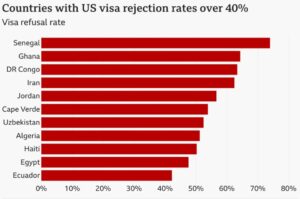
Data on visa approvals adds to the concern. Rejection rates for citizens of 11 of the 48 qualified countries exceed 40 per cent, according to figures cited in reporting, significantly higher than the global average rejection rate for US B1/B2 tourist and business visas, which stands at around 34 per cent.
Even before a ball is kicked, the infrastructure of participation appears uneven.
Previous World Cups have typically introduced special fan visa arrangements or simplified entry systems to ease travel for supporters. While Canada and Mexico, co-hosts of the 2026 tournament, maintain relatively open policies and have not imposed country-specific travel bans, the United States will host 78 of the 104 matches, including the final, placing it at the centre of the controversy.
For fans from affected nations, the comparison with past tournaments is unavoidable. Football, after all, has long marketed itself as the world’s most inclusive sport, one where geography, language and politics dissolve in shared passion.
But in practice, access has always been uneven, shaped by economics, diplomacy and migration policy.
As the countdown to 2026 continues, the tension between sport’s global ideals and the realities of international politics is becoming harder to ignore.
What was meant to be a celebration of global unity risks becoming, for some supporters, a reminder of global division.
And as one fan’s frustration captures it bluntly: “If we qualify, but cannot attend, what exactly is the World Cup for?”