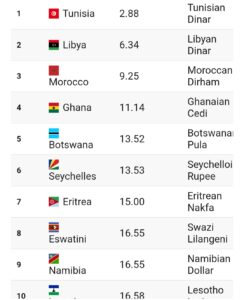

The currency headline in Africa has shown some.signs of improvement but The Nigerian Naira is missing out of the top 10.
While currency performance is increasingly emerging as a key barometer of economic resilience across Africa, recent trends have shown relative stability in some markets despite global financial volatility.
As expected, stronger and more stable currencies help economies manage inflation, reduce the cost of imports, and attract long-term investment, factors critical to sustainable growth on the continent.
For instance, in East Africa, the Kenyan shilling has maintained relative stability, hovering around 129 to the US dollar. Experts attribute this to improved investor confidence and steady foreign exchange inflows, which have helped cushion the currency against external shocks.
Similarly, the Ugandan shilling has traded within a narrow range, supported by increased export earnings, particularly from coffee, as well as reduced pressure on foreign exchange demand.
In West Africa, the Nigerian naira has also shown signs of stabilisation after prolonged volatility. Market observers point to recent capital inflows and efforts to improve foreign exchange liquidity management as key factors behind the currency’s improved outlook.
While structural challenges persist across many African economies, these developments suggest that targeted fiscal and monetary policies, combined with stronger export performance, can help shore up currency stability.
However, economists note that maintaining this momentum will require consistent policy direction, improved investor confidence, and diversification of export bases to reduce vulnerability to global market fluctuations.
Overall, the recent performance of these currencies offers cautious optimism that African economies can build greater resilience, even in the face of ongoing global economic uncertainty.