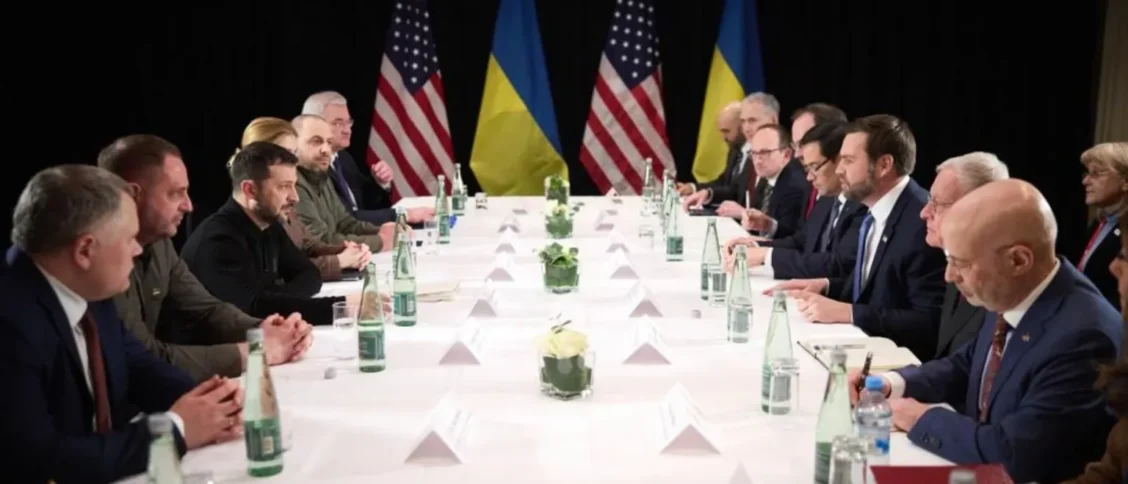

Last week’s Munich Security Conference reverberated with unexpected tensions as US declarations created a rift among European leaders.
As the world watches, a new chapter in the Ukraine conflict is unfolding, but it comes with complexities and contentious discussions. Next week, US and Russian officials will meet in Saudi Arabia to kickstart negotiations aimed at ending the war in Ukraine. However, the notable absence of Ukrainian and European representatives from the talks is fueling concern, despite their insistence on being integral to any credible ceasefire agreement. Instead, European leaders have been summoned to Paris for a separate emergency summit to address the crisis and Europe’s security.
End to an Era?
However, this week’s discussions marked what some are calling the end of an era—one in which NATO’s framework provided a unified defense posture across Europe. Established in 1949 to counter the Soviet Union’s expansion, NATO’s original mission was to ensure that an attack on one member would trigger collective defense from the rest. But with 32 members now, including several Eastern European countries, the dynamics are shifting. This week, US Defense Secretary Pete Hegseth challenged European NATO members to step up military funding for Ukraine, emphasizing that America could no longer shoulder the entire burden. The NATO alliance, once a steadfast security structure for Europe, now faces its own fractures.
As NATO’s commitment to Europe’s security appears to be weakening, a more complex scenario is emerging in the ongoing war in Ukraine. The US and Russia are expected to sit down for talks in Saudi Arabia, bringing an abrupt shift in the diplomatic landscape. These talks come after a three-year hiatus in communication with Vladimir Putin, with the US signaling a willingness to negotiate directly with the Russian leader. Despite Ukraine’s insistence on having a say in any peace deal, Kyiv’s exclusion from the discussions has raised alarm. Ukrainian President Volodymyr Zelensky made it clear that any agreement made without Ukraine’s involvement would be unacceptable, calling the absence a betrayal.
Doubling The Scrutiny
Alongside this, European defense spending is under scrutiny. The war with Russia has brought Europe to a critical juncture, where the old budgetary norms may no longer suffice. NATO’s existing defense spending guideline of 2% of GDP per member is set to rise, with discussions pointing to a 3% target. Russia’s military budget currently dwarfs many NATO members’, emphasizing the need for Europe to bolster its defense capabilities. Even though European nations have already surpassed the US in terms of aid to Ukraine, many believe the continent must do more, particularly as NATO’s future comes into question.
Vance Speech
While the debate over defense spending took center stage in Munich, another storm brewed when US Vice President JD Vance delivered a controversial speech. Aimed at Europe’s approach to migration and free speech, Vance’s comments were met with stunned silence, leaving many European delegates perplexed. His critique painted a picture of a Europe retreating from its values, which stood in stark contrast to the unity the conference sought to promote. Vance’s speech also appealed to some within the US, notably Donald Trump, who hailed it as “brilliant,” highlighting the deepening divisions on both sides of the Atlantic.
Europe’s discontent was further compounded by US trade moves. The announcement of a 25% tariff on steel and aluminum imports, set to take effect in March, underscored the growing discord between Washington and Brussels. The UK, caught between the transatlantic divide, faces a delicate balancing act in maintaining its relationship with both the US and the EU.
Prime Minister Keir Starmer emphasized that Britain’s interests lie in not choosing sides but in fostering strong ties with both entities. However, the evolving US rhetoric, often marked by shifting positions, only adds to the confusion.
With the US questioning its role in NATO, Ukraine excluded from peace talks, and rising defense costs, Europe is being forced to confront the reality that its security architecture may no longer be what it once was.