

Climate change is no longer just a story about melting glaciers, rising sea levels or extreme weather. Scientists are now warning that one of its most overlooked consequences is unfolding every night, in our bedrooms.
Across the world, rising nighttime temperatures are making it increasingly difficult for millions of people to get quality sleep, with growing consequences for physical health, mental well-being and productivity.

Unlike daytime heat, warm nights deny the body one of its most important biological functions. Sleep depends on the body’s ability to cool itself naturally. As nighttime temperatures rise, that cooling process is disrupted, making it harder to fall asleep, stay asleep and achieve the deep restorative sleep the brain and body need.
A new analysis by Climate Central estimates that between 2020 and 2025, the average person worldwide lost nearly 56 hours of sleep annually because of elevated nighttime temperatures. Of that total, about six hours each year, roughly one full night’s sleep, can be directly attributed to human-induced climate change. Although six hours may appear modest, scientists warn that repeated sleep loss accumulates over time, increasing the risk of serious health complications.
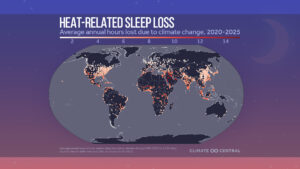
The impact is particularly severe in regions that already experience intense nighttime heat. Cities across the Middle East recorded the greatest climate-related sleep losses during the five-year period. Similar trends were observed in southern India, Southeast Asia and parts of West Africa, where already-hot climates have become even warmer.
In Africa, the findings are particularly concerning. Selected cities across Nigeria, Niger and Burkina Faso lost more than 65 hours of sleep annually because of high nighttime temperatures, with approximately 10 to 11 hours of that loss directly linked to climate change. Researchers believe these figures may actually underestimate the true impact because many African communities have limited access to cooling systems such as air conditioning.
The science behind these findings is becoming increasingly robust. A global team of researchers analyzed 165 million nights of sleep data collected from nearly 318,000 users of wearable devices and under-mattress sleep trackers. Their findings revealed that when nighttime temperatures increase from around 12°C to 27°C, people are about 40 percent more likely to sleep for fewer than six hours.
For health experts, this matters enormously. Adults generally require at least seven hours of sleep each night to maintain optimal brain function, memory, emotional stability and physical health. Chronic sleep deprivation has been associated with poor concentration, weakened immunity, cardiovascular disease, reduced productivity and declining mental health.
Ty Ferguson, a research fellow at Australia’s University of Adelaide who studies the health consequences of climate-driven sleep disruption, warns that humans struggle to maintain cognitive performance and emotional balance when sleep consistently falls below seven hours. As global temperatures continue to climb, disrupted sleep may become one of climate change’s most widespread public health challenges.
Beyond immediate fatigue, scientists are increasingly concerned about what poor sleep means for long-term brain health.
During sleep, the brain performs one of its most important housekeeping functions through a network known as the glymphatic system. This recently discovered system flushes away metabolic waste products that accumulate throughout the day, including proteins known as amyloid and tau, the same toxic deposits strongly associated with Alzheimer’s disease.
Researchers have shown that even one night of insufficient sleep can measurably increase amyloid levels surrounding the brain. When poor sleep becomes chronic over years or decades, scientists fear these proteins may accumulate more rapidly, potentially increasing the risk of neurodegenerative diseases.
Professor Russell Foster, a sleep scientist at the University of Oxford, describes sleep as one of the fundamental pillars of human health.
“Sleep is a pillar of our health in the same way we think about diet and exercise. We have to take control of it,” he says.
Neurologist Professor Hugh Markus of the University of Cambridge adds that while sleep is important, it is only one piece of a much larger picture. Factors such as high blood pressure, smoking and diabetes remain among the biggest modifiable risks for Alzheimer’s disease, yet often receive less public attention than they deserve.
Scientists are also uncovering links between poor sleep and cardiovascular disease. An analysis of 35 separate studies found that restricting sleep to around 4.5 hours per night for three or more consecutive nights significantly increases immune system activity. Although this response helps fight infection, persistent activation can produce chronic inflammation, a known contributor to heart disease and stroke.
Shift workers face some of the greatest risks because their work schedules repeatedly disrupt the body’s internal clock. Night shifts force workers to remain awake when the body naturally expects sleep, reducing opportunities for restorative rest. Researchers are now investigating whether splitting sleep into two shorter periods rather than attempting one long daytime sleep could help reduce some of these harmful effects.
The consequences extend beyond individual health. Poor sleep affects workplace productivity, learning, decision-making and emotional resilience. As nighttime temperatures continue to rise, sleep deprivation could increasingly influence economies, healthcare systems and overall quality of life.
Experts caution that adaptation will become essential even if the world successfully reaches net-zero carbon emissions. Because global temperatures will remain elevated for decades, societies must invest in ways to help people stay cool while sleeping.
Simple household measures can make a meaningful difference. Greater access to fans and air conditioning, where affordable, can reduce nighttime heat exposure. Lightweight, breathable bedding, improved building insulation and better ventilation also help maintain cooler indoor environments.
Urban planning will play an equally important role. Increasing green spaces, reducing heat-absorbing concrete, installing reflective roofing materials and designing buildings that maximize passive cooling can significantly lower nighttime temperatures in densely populated cities.
Ultimately, climate change is affecting far more than weather patterns. It is quietly reshaping one of the most essential human activities, sleep. As hotter nights become increasingly common across the globe, protecting healthy sleep will become not only a personal responsibility but also a growing public health and climate adaptation priority.