

In offices, factories, farms, and construction sites across the globe, a new and relentless form of workplace stress is taking shape.
It is silent, invisible, and intensifying: heat. As the planet warms and extreme temperatures become the new normal, the very act of working particularly for those who labor outdoors or in hot indoor environments, is increasingly hazardous.
A new technical report released in 2025 by the World Health Organization (WHO) and the World Meteorological Organization (WMO) lays bare the scale of this challenge. Titled Climate Change and Workplace Heat Stress: Technical Report and Guidance, it paints a grim picture: billions of workers are already exposed to unsafe levels of heat, with consequences that ripple far beyond individual health. Reduced productivity and rising medical costs continue to widening social inequality while the costs of workplace heat stress are mounting and will only worsen unless urgent action is taken.
Heat Stress: A Climate-Driven Workplace Hazard
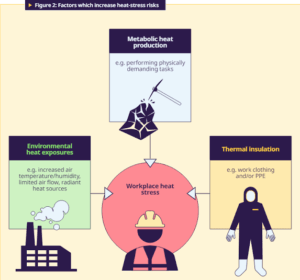
Heat stress occurs when the body absorbs more heat than it can safely release. It is the cumulative effect of environmental conditions, physical exertion, and clothing. In mild cases, it causes fatigue and dehydration; in severe cases, it can lead to organ damage, neurological dysfunction, and even death.
The WHO/WMO report reveals that climate change is amplifying this risk.
Average global temperatures are now 1.45°C above pre-industrial levels, and 2024 was officially the warmest year on record. Every decade since 2015 has been hotter than the last. These rising baselines mean that heatwaves are longer, more frequent, and more intense, creating conditions where workers, especially those in low- and middle-income countries cannot safely sustain normal shifts.
Even under the most optimistic climate scenarios, millions more people will be exposed to dangerous levels of heat stress by the end of the century. If global emissions remain unchecked, the report projects that over one billion people could be living in areas where safe outdoor work will become nearly impossible.
The Global Burden: Health, Productivity, and Inequality
The health consequences of workplace heat stress are already staggering. Workers exposed to high temperatures face an elevated risk of heat stroke, hyperthermia, kidney disease, and cardiovascular strain. For those with pre-existing conditions or limited access to healthcare, the risks are compounded.
But the impacts are not confined to health. Productivity, the backbone of economic stability, suffers dramatically. Research summarized in the WHO/WMO report shows that worker productivity declines by 2–3 percent for every degree rise above 20°C in wet-bulb globe temperature (WBGT), a key measure of heat stress. In industries like agriculture, construction, and fishing, where labor is already physically demanding, this loss can mean the difference between subsistence and poverty.
The economic ripple effects are profound. Reduced labor capacity in primary industries disrupts food supply chains and raises prices, destabilizing entire economies. For countries where agriculture or construction employs a large portion of the population, the losses can erode national income and threaten long-term development goals.
The burden falls heaviest on vulnerable groups. Older adults, women, migrants, and workers in the informal economy, many of whom lack protective equipment, legal safeguards, or access to cooling, are disproportionately at risk. In essence, climate-driven heat stress magnifies existing inequalities, creating a cycle in which the poorest are least able to adapt yet most exposed to harm.
The report also highlights an often-overlooked dimension: mental health. Persistent exposure to high temperatures increases stress, anxiety, and depression. Workers under constant thermal strain report higher levels of fatigue and burnout, eroding morale and concentration.
In workplaces where pay depends on productivity, piece-rate farming, factory shifts, or construction deadlines, the psychological stress is doubled. Workers face an impossible choice: slow down and earn less, or push through and risk their health. This collision of economic pressure and physical limitation is one of the defining workplace dilemmas of the climate era.
While no region is immune, the burden of workplace heat stress is unevenly distributed. The tropics — already the hottest zones of the planet — are at greatest risk, particularly West and Central Africa, South Asia, and Southeast Asia. But the report warns that even temperate regions are no longer safe. Southern Europe, Japan, and the southern United States are projected to experience unprecedented workplace heat stress by the end of the century if emissions continue unchecked.
This shifting geography means that heat stress is no longer a “developing world” problem. Workers in industrialized nations are increasingly vulnerable, especially in urban areas where heat islands amplify ambient temperatures. From warehouse staff in Europe to delivery drivers in North America, climate change is rewriting the map of occupational risk.
Why Traditional Heat Warnings Fall Short
Public heat-health warning systems have been rolled out in many countries to protect vulnerable populations during heatwaves. But as the WHO/WMO report stresses, these systems rarely account for the realities of work.
For the elderly, young children, or those with chronic conditions, the advice is simple: stay indoors, reduce activity, hydrate. For workers, that advice is impossible to follow. Agricultural laborers cannot stop harvesting, construction workers cannot abandon building sites, and factory workers cannot pause production without risking their livelihoods.
In other words, the strategies designed to protect the general public are not fit for workers. Tailored interventions — ones that balance health protection with economic necessity — are urgently required.
The report provides a roadmap. Central to its recommendations is the development of Occupational Heat Action Plans (OHAPs) comprehensive frameworks co-created by employers, workers, trade unions, and local authorities.
These plans should include:
– Hydration and electrolyte replacement: ensuring workers have regular access to clean water and salts.
– Shaded rest breaks: structured pauses in work shifts to prevent heat overload.
– Engineering controls: improved ventilation, cooling systems, and redesigned workspaces.
– Administrative controls: adjusting work hours to cooler parts of the day, rotating shifts, or limiting heavy physical activity during peak heat.
– Training and awareness: teaching workers and managers to recognize early signs of heat illness and respond appropriately.
– Medical and environmental surveillance: monitoring both workers’ health and ambient conditions to anticipate risks.
These measures, while seemingly simple, require investment, political will, and cultural change. For employers, particularly in low-margin industries, the challenge lies in balancing costs with productivity. For governments, the test is integrating occupational health into climate adaptation policies, ensuring that worker welfare is not sidelined.
Inaction is Costlier
Failure to address workplace heat stress is not just a health issue — it is an economic liability. The report ties the problem directly to the Sustainable Development Goals: no poverty (SDG 1), good health and well-being (SDG 3), decent work and economic growth (SDG 8), and climate action (SDG 13).
Without interventions, rising workplace heat will jeopardize poverty reduction, strain healthcare systems, and undermine productivity. Already, the International Labour Organization estimates that excessive heat exposure contributes to over 22 million occupational injuries annually worldwide. These figures are expected to rise sharply if global warming continues unchecked.
Investing in protective measures, by contrast, yields long-term savings. Reduced healthcare costs, higher productivity, and more resilient supply chains all flow from ensuring safe working conditions. Heat action plans, while costly upfront, are ultimately more affordable than the economic toll of mass worker illness and lost labor capacity.