The Grand Inquisitor- A Short Story By Fyodor Dostoyevsky

Thou art right, O Lord, very right,
Thou hast condemned us justly.
“My poem is of the same character.
“In it, it is Christ who appears on the scene. True, He says nothing, but only appears and passes out of sight. Fifteen centuries have elapsed since He left the world with the distinct promise to return ‘with power and great glory’; fifteen long centuries since His prophet cried, ‘Prepare ye the way of the Lord!’ since He Himself had foretold, while yet on earth, ‘Of that day and hour knoweth no man, no, not the angels of heaven but my Father only.’ But Christendom expects Him still. …
“It waits for Him with the same old faith and the same emotion; aye, with a far greater faith, for fifteen centuries have rolled away since the last sign from heaven was sent to man,
“True, again, we have all heard of miracles being wrought ever since the ‘age of miracles’ passed away to return no more. We had, and still have, our saints credited with performing the most miraculous cures; and, if we can believe their biographers, there have been those among them who have been personally visited by the Queen of Heaven. But Satan sleepeth not, and the first germs of doubt, and ever-increasing unbelief in such wonders, already had begun to sprout in Christendom as early as the sixteenth century. It was just at that time that a new and terrible heresy first made its appearance in the north of Germany.*
A great star ‘shining as it were a lamp… fell upon the fountains waters’… and ‘they were made bitter.’ This ‘heresy’ blasphemously denied ‘miracles.’ But those who had remained faithful believed all the more ardently, the tears of mankind ascended to Him as heretofore, and the Christian world was expecting Him as confidently as ever; they loved Him and hoped in Him, thirsted and hungered to suffer and die for Him just as many of them had done before…. So many centuries had weak, trusting humanity implored Him, crying with ardent faith and fervour: ‘How long, O Lord, holy and true, dost Thou not come!’ So many long centuries hath it vainly appealed to Him, that at last, in His inexhaustible compassion, He consenteth to answer the prayer…. He decideth that once more, if it were but for one short hour, the people—His long-suffering, tortured, fatally sinful, his loving and child-like, trusting people—shall behold Him again. The scene of action is placed by me in Spain, at Seville, during that terrible period of the Inquisition, when, for the greater glory of God, stakes were flaming all over the country.
Burning wicked heretics,
In grand auto-da-fes.
“This particular visit has, of course, nothing to do with the promised Advent, when, according to the programme, ‘after the tribulation of those days,’ He will appear ‘coming in the clouds of heaven.’ For, that ‘coming of the Son of Man,’ as we are informed, will take place as suddenly ‘as the lightning cometh out of the east and shineth even unto the west.’ No; this once, He desired to come unknown, and appear among His children, just when the bones of the heretics, sentenced to be burnt alive, had commenced crackling at the flaming stakes. Owing to His limitless mercy, He mixes once more with mortals and in the same form in which He was wont to appear fifteen centuries ago. He descends, just at the very moment when before king, courtiers, knights, cardinals, and the fairest dames of court, before the whole population of Seville, upwards of a hundred wicked heretics are being roasted, in a magnificent auto-da-fe ad majorem Dei gloriam, by the order of the powerful Cardinal Grand Inquisitor.
“He comes silently and unannounced; yet all—how strange—yea, all recognize Him, at once! The population rushes towards Him as if propelled by some irresistible force; it surrounds, throngs, and presses around, it follows Him…. Silently, and with a smile of boundless compassion upon His lips, He crosses the dense crowd, and moves softly on. The Sun of Love burns in His heart, and warm rays of Light, Wisdom and Power beam forth from His eyes, and pour down their waves upon the swarming multitudes of the rabble assembled around, making their hearts vibrate with returning love. He extends His hands over their heads, blesses them, and from mere contact with Him, aye, even with His garments, a healing power goes forth. An old man, blind from his birth, cries, ‘Lord, heal me, that I may see Thee!’ and the scales falling off the closed eyes, the blind man beholds Him… The crowd weeps for joy, and kisses the ground upon which He treads. Children strew flowers along His path and sing to Him, ‘Hosanna!’ It is He, it is Himself, they say to each other, it must be He, it can be none other but He! He pauses at the portal of the old cathedral, just as a wee white coffin is carried in, with tears and great lamentations. The lid is off, and in the coffin lies the body of a fair-child, seven years old, the only child of an eminent citizen of the city. The little corpse lies buried in flowers. ‘He will raise the child to life!’ confidently shouts the crowd to the weeping mother. The officiating priest who had come to meet the funeral procession, looks perplexed, and frowns. A loud cry is suddenly heard, and the bereaved mother prostrates herself at His feet. ‘If it be Thou, then bring back my child to life!’ she cries beseechingly. The procession halts, and the little coffin is gently lowered at his feet. Divine compassion beams forth from His eyes, and as He looks at the child, His lips are heard to whisper once more, ‘Talitha Cumi’—and ‘straightway the damsel arose.’ The child rises in her coffin. Her little hands still hold the nosegay of white roses which after death was placed in them, and, looking round with large astonished eyes she smiles sweetly …. The crowd is violently excited. A terrible commotion rages among them, the populace shouts and loudly weeps, when suddenly, before the cathedral door, appears the Cardinal Grand Inquisitor himself…. He is tall, gaunt-looking old man of nearly four-score years and ten, with a stern, withered face, and deeply sunken eyes, from the cavity of which glitter two fiery sparks.
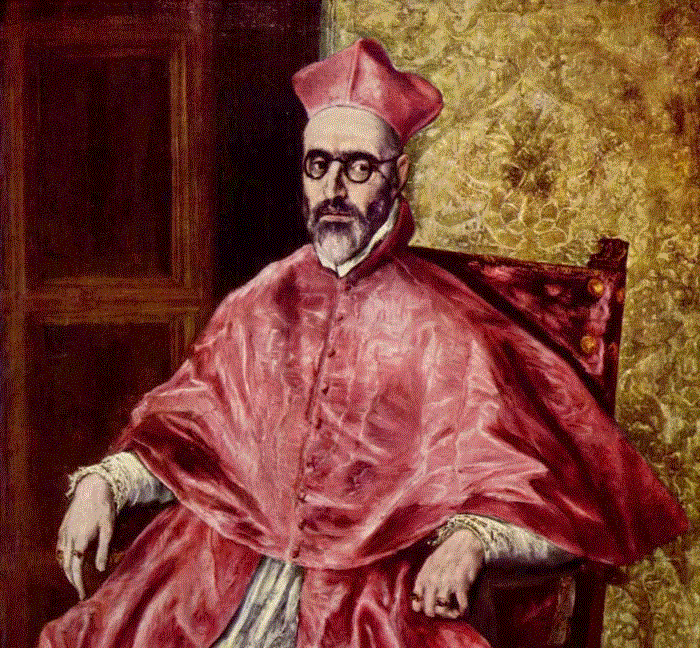
He has laid aside his gorgeous cardinal’s robes in which he had appeared before the people at the auto da-fe of the enemies of the Romish Church, and is now clad in his old, rough, monkish cassock. His sullen assistants and slaves of the ‘holy guard’ are following at a distance. He pauses before the crowd and observes. He has seen all. He has witnessed the placing of the little coffin at His feet, the calling back to life. And now, his dark, grim face has grown still darker; his bushy grey eyebrows nearly meet, and his sunken eye flashes with sinister light. Slowly raising his finger, he commands his minions to arrest Him….
“Such is his power over the well-disciplined, submissive and now trembling people, that the thick crowds immediately give way, and scattering before the guard, amid dead silence and without one breath of protest, allow them to lay their sacrilegious hands upon the stranger and lead Him away…. That same populace, like one man, now bows its head to the ground before the old Inquisitor, who blesses it and slowly moves onward. The guards conduct their prisoner to the ancient building of the Holy Tribunal; pushing Him into a narrow, gloomy, vaulted prison-cell, they lock Him in and retire….
“The day wanes, and night—a dark, hot breathless Spanish night—creeps on and settles upon the city of Seville. The air smells of laurels and orange blossoms. In the Cimmerian darkness of the old Tribunal Hall the iron door of the cell is suddenly thrown open, and the Grand Inquisitor, holding a dark lantern, slowly stalks into the dungeon. He is alone, and, as the heavy door closes behind him, he pauses at the threshold, and, for a minute or two, silently and gloomily scrutinizes the Face before him. At last approaching with measured steps, he sets his lantern down upon the table and addresses Him in these words:
“‘It is Thou! … Thou!’ … Receiving no reply, he rapidly continues: ‘Nay, answer not; be silent! … And what couldst Thou say? … I know but too well Thy answer…. Besides, Thou hast no right to add one syllable to that which was already uttered by Thee before…. Why shouldst Thou now return, to impede us in our work? For Thou hast come but for that only, and Thou knowest it well. But art Thou as well aware of what awaits Thee in the morning? I do not know, nor do I care to know who thou mayest be: be it Thou or only thine image, to-morrow I will condemn and burn Thee on the stake, as the most wicked of all the heretics; and that same people, who to-day were kissing Thy feet, to-morrow at one bend of my finger, will rush to add fuel to Thy funeral pile… Wert Thou aware of this?’ he adds, speaking as if in solemn thought, and never for one instant taking his piercing glance off the meek Face before him.”….