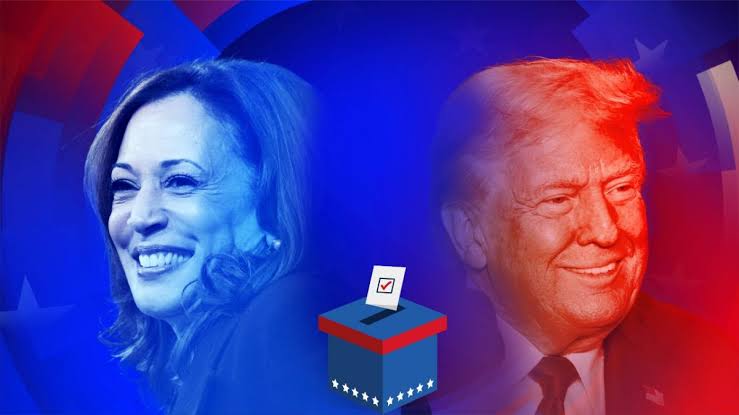

Today, Americans head to the polls to elect their next president in an intensely followed race that pits former President Donald Trump, representing the Republican Party, against Democratic candidate and current Vice President Kamala Harris.
This election will set the stage for U.S. leadership over the next four years, beginning in January 2025, and has implications that ripple far beyond America’s borders.
Candidates and Running Mates
Trump, who has retained a formidable influence over his party, secured his place as the Republican nominee early in the race, selecting Ohio Senator JD Vance as his running mate. Harris, stepping up after President Joe Biden opted not to run, has chosen Minnesota Governor Tim Walz as her vice-presidential candidate.
The dynamics of this matchup offer a stark contrast in leadership style, policy vision, and appeal to voters across the political spectrum.
The U.S. Voting System in a Spin
Unlike many democracies that rely on a direct popular vote to elect leaders, the U.S. employs the Electoral College system. This means that winning the popular vote nationwide doesn’t guarantee a presidential win. Instead, each state is assigned a certain number of electoral votes based on its congressional representation—two votes for each state’s Senators, plus additional votes based on its congressional districts. Winning a state means winning its entire batch of electoral votes, except in Maine and Nebraska, which divide votes by congressional district.
In total, there are 538 electoral votes across all 50 states. To win, a candidate must secure a majority of 270 electoral votes. California, the most populous state, holds the largest share with 54 votes, while smaller states like Alaska and Vermont have just three. This system often leads candidates to concentrate their campaign efforts in populous or swing states, rather than evenly across the country.
Focus on Swing States
Swing states—also known as battleground states—play a pivotal role, as they lack a clear preference for either party and can lean Democratic or Republican depending on the election cycle.
In 2024, battleground states include Arizona, Georgia, Michigan, Nevada, North Carolina, Pennsylvania, and Wisconsin. The candidates have devoted considerable resources to these areas, seeking to capture undecided voters whose decisions could shape the outcome of the election.
The Impact of the Electoral College
One unique feature of the Electoral College is that a candidate can win the presidency without winning the national popular vote, as Trump did in 2016 against Hillary Clinton.
This outcome has only occurred five times in U.S. history, three of which took place in the 19th century. Such results often reignite debates about the Electoral College, with critics arguing it undermines the principle of one-person, on one-vote.
Contingencies and Unusual Scenarios
The 2024 election could bring unusual scenarios into play, such as “faithless electors”—Electoral College members who, in rare cases, vote against the candidate chosen by their state’s popular vote. While these votes rarely change outcomes, they highlight the intricacies of the Electoral College system.
A tie in the Electoral College, where both candidates receive 269 votes, would initiate a “contingent election” decided by the House of Representatives. In such a case, each state delegation in the House would cast a single vote, with a majority of 26 state votes required to elect the president. The Senate, in turn, would choose the vice president, allowing for the unusual possibility of a president and vice president from opposing parties.
This hypothetical outcome would mean, for instance, that Trump could become president alongside Democratic vice-presidential nominee Tim Walz, or Harris could be president with Republican vice-presidential nominee JD Vance. If necessary, this process would unfold on January 6, 2025, adding another layer of complexity to an already intense election.
Broader Implications for the U.S. and Beyond
The election’s outcome will undoubtedly impact the U.S. and have substantial global ramifications. With Trump and Harris representing distinct paths forward on issues like foreign policy, trade, and climate change, the result will shape America’s role on the international stage, affecting alliances and diplomatic engagements across regions. Africa, Europe, and Asia are especially attentive to the trade and security implications of the U.S. election.
For the African continent, the election could mean either a continuation or shift in trade policies and foreign aid, with Africa-US trade, security cooperation, and climate policies particularly susceptible to changes in U.S. leadership. Moreover, both candidates’ views on immigration and foreign relations could influence African expatriates and businesses with ties to the U.S.
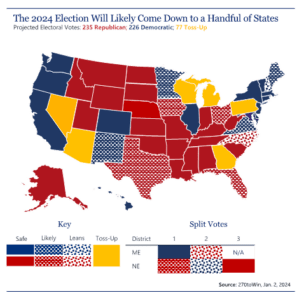
A High-Stakes Vote in 2024
Today’s election will again show the might of the Electoral College and the unique process by which U.S. presidents are chosen. As voters cast their ballots, the country—and the world—waits to see how this pivotal race unfolds and what direction the U.S. will take in 2025 and beyond.
Who will emerge as the 47th?