

Proper integration of digital learning platforms can significantly improve the adaptation and success rate of computer-based examinations in Nigerian secondary schools, according to teachers and students who have benefitted from emerging digital education tools.
Tawakalitu Foluso, a teacher at Army Children High School, Epe, shared this view while recounting her school’s experience with digital learning platforms, including the Nigerian Learning Passport and the growing use of artificial intelligence to support classroom learning.

Foluso spoke during a two-day media dialogue held in Lagos on November 26. The event, organised by the Oyo State Ministry of Information in collaboration with UNICEF, aimed to deepen advocacy for accelerated digital learning for Nigerian youths.
According to her, digital tools have helped students better understand core subjects, revise faster, and build confidence for computer-based tests such as WAEC’s CBT-based components and entrance examinations.
She noted that one of her students recently used artificial intelligence to design a full marketing strategy for his mother’s small business, an example she said shows how digital learning can empower young people beyond the classroom.
“When students learn these tools early, they apply them creatively at home and in school. It gives them a sense of possibility,” she said.
However, Foluso pointed out that the progress comes with obstacles. Many students do not have access to smartphones or reliable internet data, while some parents still resist providing digital devices due to fear, cost, or lack of understanding. Poor punctuality and inconsistent interest from students also limit the full benefits of these platforms.
Also, Fifteen-year-old Adeniyi Busayo, one of the students benefitting from the digital learning integration, said the Nigerian Learning Passport has helped her and her classmates gain confidence navigating different online platforms and understand how to use artificial intelligence responsibly.
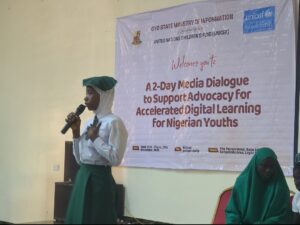
“We have learnt how to use technology the right way, not for distractions, but to study and develop new skills,” she said.
During the dialogue, UNICEF Education Specialist Babagana Aminu stressed that digital incompetence remains a major barrier to employment for young Nigerians.
According to him, “Eighty-five percent of Nigerians remain unemployed or underemployed because they lack the digital competence required to function optimally in the modern workplace.”
Aminu explained that today’s teenagers, Nigeria’s Generation Z, are digital natives whose natural affinity for technology must be guided, strengthened, and supported, rather than restricted.
He urged the media to amplify the importance of digital skills and hold policymakers accountable for bridging digital learning gaps nationwide.
The dialogue brought together education experts, media practitioners, and government officials, all calling for broader investment in digital education to prepare young Nigerians for a rapidly changing labour market.