

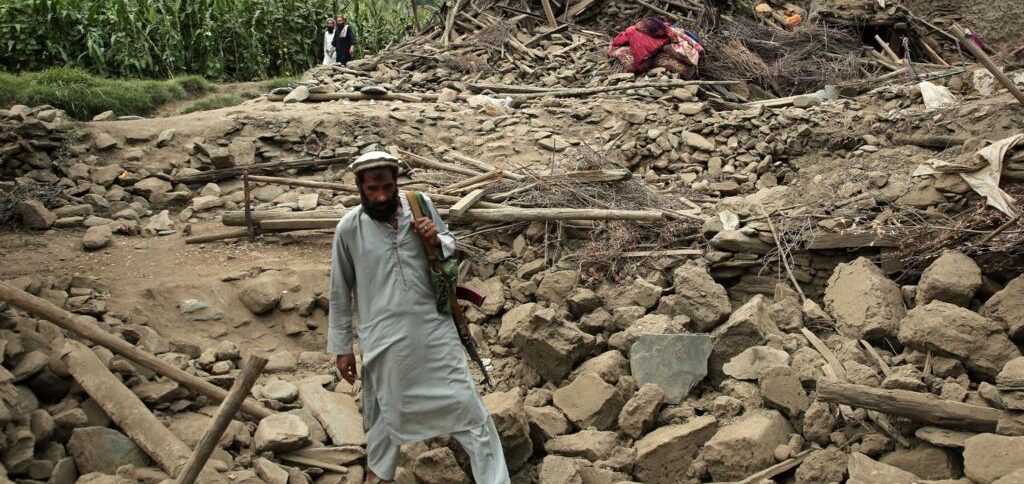

There is a frantic call for help in Afghanistan.
Rescue teams are racing against time in remote villages across Afghanistan after a powerful magnitude 6.0 earthquake struck the mountainous Kunar province on Sunday, killing more than 800 people and leaving entire communities buried under rubble.
The Taliban has issued urgent calls for international assistance, with the United Kingdom pledging £1 million in relief, while stressing the funds would bypass the Taliban’s control.
The quake, which struck at a shallow depth of just 8km (5 miles), unleashed widespread devastation. Buildings swayed as far away as Kabul and Pakistan’s capital Islamabad, while in the epicenter, fragile homes collapsed like paper, flattening villages in seconds. Roads blocked by debris have forced emergency responders to rely on helicopters to reach survivors.

Ehsanullah Ehsan, Kunar’s disaster management chief, told Reuters that search efforts on Monday were concentrated in four villages, with plans to expand into more isolated areas once routes are cleared.
“We cannot accurately predict how many bodies might still be trapped under the rubble,” he admitted.
“Our effort is to complete these operations as soon as possible and to begin distributing aid to the affected families.”

The scale of the destruction is worsening the country’s already fragile humanitarian crisis. Afghanistan sits at the collision point of the Indian and Eurasian tectonic plates, making it one of the world’s most earthquake-prone regions. In recent years, the nation has endured a deadly cycle of quakes: in 2023, a series of tremors near Herat killed over 1,400 people, while a 5.9-magnitude quake in 2022 left at least 1,000 dead and thousands more injured.
The shallow depth of these quakes often amplifies their destructiveness, as seen again in Sunday’s disaster.
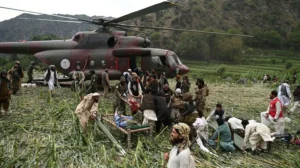
Villagers describe entire families being wiped out, with survivors digging with bare hands in desperate attempts to find loved ones.
At the region’s only major hospital, conditions are described as chaotic. Already overstretched before the quake, the facility is now swamped with injured survivors, many requiring urgent surgeries. Doctors who previously struggled to treat over 1,000 patients daily are now working around the clock, overwhelmed by the surge.
International aid agencies warn that the death toll could rise sharply in the coming days as rescuers reach more remote areas. Heavy machinery has been deployed to clear blocked mountain roads, but time is running out for those still trapped.
For Afghanistan, still reeling from years of conflict, economic collapse, and political isolation, natural disasters like this only deepen the hardship.










Маленький, впрочем удивительный красочный воздушная гавань Геленджика находится в долине, со всех сторон опоясанной горами. Это отнюдь не лишь точка прилета, но полноценное пролог в каникулы. Узкая ВПП, врезающаяся прямо в горные склоны, делает отрыв и посадку остросюжетным представлением с видами на лазурную зеркало Цемесской бухты и центральный Кавказский хребет.
https://gelendzhik-aeroport.ru
Здесь вы найдёте:
Здесь нет шума и беготни громадных центров. крошечный здание аэропорта, похожий на благоустроенную морскую домик, пропитан духом курорта.