

Nigeria may be standing at one of the most consequential crossroads in its democratic history. As the Senate prepares to debate the long-awaited State Police Bill, the country is being forced to confront a difficult reality: the existing security architecture is struggling to cope with the scale and complexity of modern threats.
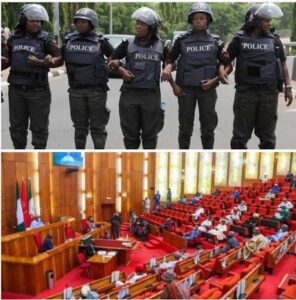
For years, successive governments have relied heavily on a kinetic approach to security, deploying troops, weapons and force to combat terrorism, banditry, kidnapping and violent crime. Yet despite enormous investments in military operations, insecurity continues to spread across many parts of the country, raising questions about whether force alone can deliver lasting peace.
This growing recognition has fueled calls for a fundamental restructuring of Nigeria’s security system through the creation of state police forces. Advocates argue that localised policing would improve intelligence gathering, strengthen community trust and enable faster responses to emerging threats. More importantly, it would bring security closer to the people most affected by crime and violence.
Today, June 24, that debate enters a critical phase. The Senate is expected to take a significant step toward overhauling Nigeria’s security framework as lawmakers deliberate on the State Police Bill transmitted to the National Assembly by President Bola Tinubu. The proposed legislation seeks to amend relevant sections of the 1999 Constitution to allow state governments to establish and operate their own police forces alongside the Nigeria Police Force.
The bill enjoys growing support from governors, security experts and community leaders who believe Nigeria’s highly centralised policing structure has become overstretched in a nation of more than 200 million people. They argue that officers recruited, trained and deployed within their states would possess better local knowledge and stronger ties to the communities they serve.
However, while state policing may be a game-changing reform, it is not a magic wand capable of instantly ending the reign of terror that has haunted many parts of the country. Security experts caution that decentralisation alone will not solve the deeper social, economic and governance issues that often fuel violence.
That is where another often-overlooked institution enters the conversation: traditional leadership. Long before modern policing structures emerged, traditional rulers played central roles in maintaining order, resolving disputes and gathering intelligence within their communities. During Nigeria’s pre-independence era and the early years after independence, these institutions formed an important layer of governance and social stability.
As a matter of fact, many monarchs remain deeply embedded within their communities, enjoying levels of trust and access that government institutions sometimes struggle to achieve. Their understanding of local dynamics, family networks and communal relationships often makes them effective mediators in conflicts before they escalate into violence.
While agencies such as the Police and the Department of State Services (DSS) must continue to lead armed security operations, traditional rulers can complement these efforts through non-kinetic approaches that focus on dialogue, intelligence gathering, conflict prevention and community engagement. In many rural areas, they are often the first to sense tensions before security agencies become aware of them.
The importance of this balance cannot be overstated. One of the clearest lessons from Nigeria’s prolonged security crisis is that military-driven solutions, though necessary in certain situations, have not been sufficient on their own. Sustainable peace requires a combination of force and trust, enforcement and prevention, state authority and community participation.
The Senate’s consideration of the State Police Bill is a test of whether Nigeria is prepared to rethink how security is delivered and whether it can build a system that reflects the realities of its diverse communities.
Recall that proceedings on the bill were briefly delayed after the Senate suspended legislative business following the announcement of the death of Hon. Yaya Tongo, who represented the Kwami/Funakaye Federal Constituency of Gombe State. Senate President Godswill Akpabio led lawmakers in paying tribute to the late legislator before adjourning plenary until Wednesday.
Before the adjournment, Akpabio described the State Police Bill as a transformative piece of legislation capable of redefining Nigeria’s security architecture. If passed, the reform could usher in the most significant change to policing since the return to democratic rule in 1999.
Whether state police ultimately succeeds will depend on implementation, safeguards against political abuse, adequate funding and professional oversight.