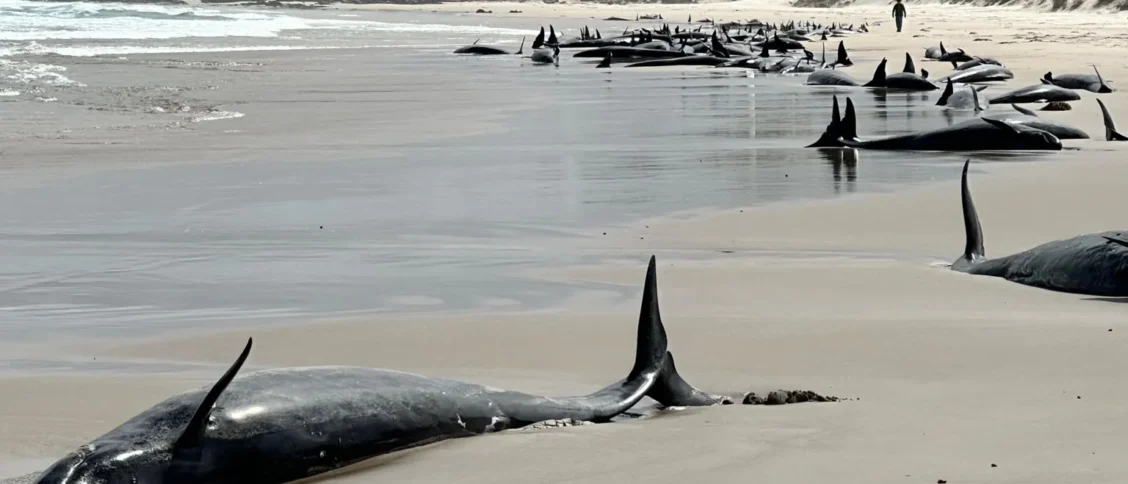

A desperate rescue operation is underway in Tasmania after a massive pod of false killer whales stranded on a remote beach, leaving more than 60 dead and dozens more fighting for survival.
The heartbreaking scene unfolded near Arthur River, where 157 of these rarely stranded marine mammals found themselves trapped on the island’s rugged northwest coast.
Reports day conservationists and veterinarians are now working against the clock to assess whether any of the remaining 90 whales can be returned to the ocean. The situation is particularly dire, as some of the animals, including juveniles, have been stranded for as long as two days.
Also, experts warn that prolonged exposure on land severely weakens whales, making rescue efforts even more challenging.
False killer whales, though named for their resemblance to orcas, are actually one of the largest dolphin species. They can grow up to six meters in length and weigh as much as 1.5 tonnes. Despite their size and strength, the odds of survival diminish rapidly once beached, especially in an isolated area like this.
Mass strandings are not uncommon in Tasmania, which has witnessed several large-scale incidents in recent years. However, this event is particularly unusual, as false killer whales have not been involved in a mass stranding in the region for over half a century. The reasons behind their sudden beaching remain unclear, but scientists believe factors such as disorientation, environmental changes, or distress signals within the pod could have played a role.
The remoteness of the site, located about 300 kilometers from Launceston, further complicates rescue efforts. Harsh ocean conditions and limited access to specialized equipment make it difficult to refloat the surviving whales. Authorities fear that without immediate intervention, many more could perish in the coming hours.
Despite the grim outlook, rescuers remain determined to do whatever they can. Previous whale strandings on Tasmania’s west coast have seen some success in returning animals to the sea, but experts caution that the complexity of each event means there is no one-size-fits-all approach.
For now, the fate of these stranded false killer whales rests on a delicate balance between human intervention and nature’s unpredictability. Whether any will make it back to the ocean remains uncertain, but the rescue teams are giving them every possible chance.