Three scientists, John Clarke of the United Kingdom, Michel Devoret of France, and John Martinis of the United States — have been awarded the 2025 Nobel Prize in Physics for their groundbreaking work on quantum mechanical tunnelling. The Royal Swedish Academy of Sciences announced this on Tuesday in Stockholm.
The trio was recognised for their discovery of “macroscopic quantum mechanical tunnelling and energy quantisation in an electric circuit,” a finding that has deepened scientific understanding of quantum behaviour and opened new frontiers in emerging technologies.
According to the Academy, the discovery has “provided opportunities for developing the next generation of quantum technology, including quantum cryptography, quantum computers, and quantum sensors.”
The researchers’ work successfully extended quantum mechanical effects from the microscopic world of atoms to the macroscopic scale, enabling the practical development of quantum-based devices.
John Clarke, who led the collaborative research, described the announcement as “the surprise of my life,” while praising his fellow laureates for their “overwhelming contributions” to a discovery that underpins modern technological systems, including the mechanisms behind today’s smartphones.
The Nobel Committee said their achievement marks a defining step in the evolution of quantum physics, bridging theoretical principles with real-world applications.
Last year’s Physics Prize went to artificial intelligence researchers John Hopfield and Geoffrey Hinton, who helped lay the foundations of modern machine learning. The Nobel tradition, which has honoured legendary figures like Albert Einstein, Marie and Pierre Curie, Max Planck, and Niels Bohr, continues to celebrate discoveries that reshape scientific understanding and advance human innovation.
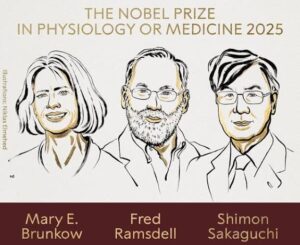
The 2025 announcement comes a day after the Nobel Assembly at Karolinska Institutet awarded the Nobel Prize in Physiology or Medicine to American scientists Mary E. Brunkow and Fred Ramsdell, along with Japan’s Shimon Sakaguchi, for their pioneering research on immune regulation.
Over the past decade, the Nobel Prize in Medicine has celebrated transformative scientific achievements across a wide range of fields.
In 2024, American scientists Victor Ambros and Gary Ruvkun won for their discovery of microRNA and its role in gene regulation. In 2023, Hungarian biochemist Katalin Karikó and American immunologist Drew Weissman were honoured for their development of mRNA technology, which revolutionised vaccine production during the COVID-19 pandemic.
The 2022 prize went to Swedish geneticist Svante Pääbo for his pioneering work on ancient human genomes, while in 2021, American researchers David Julius and Ardem Patapoutian were recognised for uncovering how humans sense temperature and touch.
In previous years, winners included Harvey Alter, Charles Rice and Michael Houghton (2020) for the discovery of the Hepatitis C virus; William Kaelin, Gregg Semenza and Peter Ratcliffe (2019) for research on how cells adapt to oxygen; and James Allison and Tasuku Honjo (2018) for their groundbreaking cancer immunotherapy discoveries.
The Nobel Prizes, established through the 1895 will of Swedish inventor Alfred Nobel the creator of dynamite remain the world’s most prestigious scientific and humanitarian honours. First awarded in 1901, they celebrate exceptional contributions to physics, chemistry, medicine, literature and peace.
In 1968, Sweden’s central bank, Sveriges Riksbank, added a sixth category: the Nobel Prize in Economic Sciences, awarded in memory of Alfred Nobel.
 The 2025 Medicine laureates join a long list of scientists whose discoveries have changed how humanity understands and treats disease reaffirming the Nobel tradition of honouring research that saves lives and shapes the future of global health.