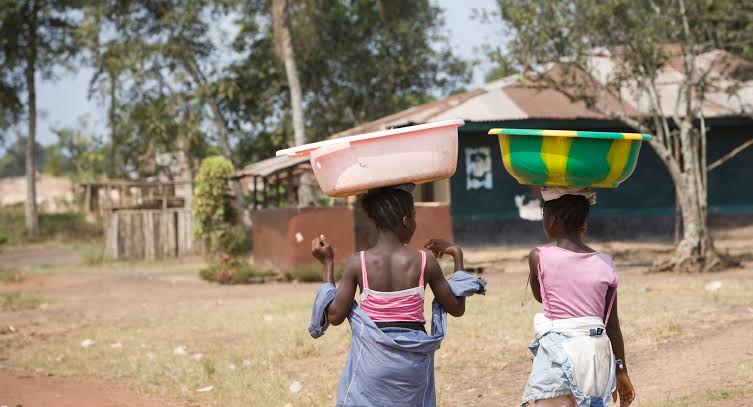

Omodo, thats what its called in the popular parlance. For context “househelp“, an anglicized way to morph the hideous trend behind this domestic misnormer.
A few years ago when Nigerian author Adaobi Tricia Nwaubani published her personal recollections of growing up with omodo — live-in domestic workers — in The New York Times, her reflections reignited a debate that, for many Nigerians, is both deeply personal and socially uncomfortable. While Nwaubani’s focus was on adult house helps, her words echoed strongly with those who have witnessed the more troubling side of the practice: children caught in an unacknowledged system of inequality.
For some, the story is all too familiar.
“I grew up in the United States,” recalls a Nigerian-American researcher who spent her formative years shuttling between America and Lagos. “But whenever I visited Nigeria, I felt this mix of confusion, irritation, and reluctant acceptance of what I was seeing – young children cleaning, cooking, and caring for other people’s children, often under strict and sometimes harsh conditions.”
Years later, as an undergraduate, she returned to Lagos with a research grant to study child domestic labor. Her findings were unsettling. “Everywhere I turned, someone would say, ‘You can’t understand, you grew up in the West.’ They told me it used to be different ‘back in the day.’ That abuse was rare. But I had already seen it — the verbal scolding, the physical punishments, the impossible expectations placed on children barely into their teens.”
The numbers are hard to pin down, but the evidence is in plain sight. In some homes, children as young as 10 are tasked with caring for toddlers, cleaning expansive houses, and cooking meals. In wealthier neighborhoods, they may wear neatly pressed uniforms; in poorer homes, they may share a thin mattress in a corner. Either way, the expectations rarely align with their age or capacity.
During her research, the young scholar spoke to a Lagos government official who insisted that keeping child domestic workers was illegal and punishable by arrest. Yet, in a telling contradiction, another official who arranged the interview had three house helps aged 14, 15, and 17. “That’s the problem,” she explains. “Even the people responsible for enforcing the law participate in the practice. When they speak to a Western researcher, they perform outrage. But in private, it’s business as usual.”
The deeper concern is not simply the work itself, but the way it shapes society’s perception of personhood. Nwaubani’s recollection of her father scolding house helps for singing struck a nerve. “I once heard my aunt express disbelief that her 12-year-old *omodo* thought going to school was a God-given right,” the researcher recalls. “It was a moment that revealed how normalised it is to deny certain rights to children in these roles.”
There is, she says, “a madness” in this, one that mirrors other contradictions in Nigerian society. On one hand, these children are treated as dependents; on the other, they are held to adult standards and punished for failing to meet them. Even their hunger, both literal and figurative is pathologised, framed as insatiable rather than as a symptom of deprivation.
And yet, challenging the system is complicated. When Western platforms like The New York Times spotlight the issue, it can create tension. “The U.S. is far from perfect when it comes to equality,” she says. “So, when Nigerian inequality is framed for a primarily Western audience, it risks reinforcing a narrative of Western superiority, rather than fostering internal change.”
Still, the fact remains: Nigeria’s reluctance to acknowledge domestic servitude as a pressing human rights issue only deepens the country’s broader inequalities. The defensive arguments, tradition, necessity, parental consent, obscure the reality that the practice thrives on economic desperation and social hierarchy.
Has it changed? What can change?
“There’s no simple fix,” the researcher admits. “But maybe the first step is to stop defending the system and start reflecting on it. We can’t even begin to address it until we’re willing to admit it exists in the form it does today.”
As Lagos and the hinterlands hums on, the voices of these children remain faint, often drowned out by the daily noise. Yet their silence is not emptiness; it is the quiet space where questions linger questions about dignity, opportunity, and the future of a society that still expects some of its youngest to serve, unseen.



Those scoldings, enforced servitude, shaped the successful lives of most of us who went through the system. It not only engendered in us the value of the dignity of Labour, and the value of perseverance. The practice represented a crucible wherein one was forged to face the vicissitudes of life in latter years.