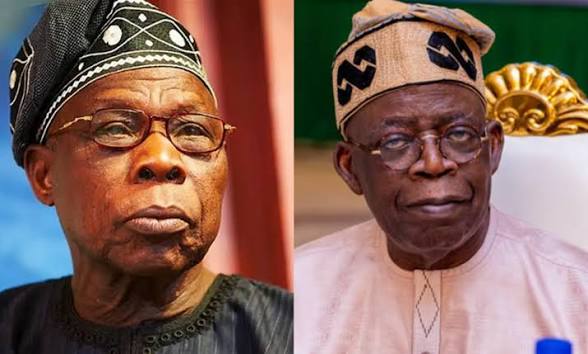

Nigerians are going through their worst. Its a pin line by former President Olusegun Obasanjo who criticised President Bola Tinubu’s economic policies, arguing that the sharp devaluation of the naira has eroded Nigerians’ purchasing power and worsened the country’s poverty situation.
Obasanjo who spoke recently at the Financial Times Africa Summit 2026 in London, United Kingdom, questioned the impact of economic reforms introduced by the Tinubu administration in 2023.
According to the former president, the naira’s depreciation from about N500 to the dollar to approximately N1,500 significantly reduced the value of Nigerians’ earnings and savings.
“We do not live in isolation as a country. We interact with the rest of the world. And overnight, you devalue the currency by 300 per cent. The naira went from N500 to a dollar to N1,500 to a dollar. What that meant was that every Nigerian is made poor by 300 per cent,” he said.
Obasanjo described Nigeria as “the poverty capital of the world,” arguing that the country’s economic situation had deteriorated under the weight of rising living costs and the effects of currency depreciation.
He insisted that the programmes introduced by Tinubu were “not in the best interest of Nigerians,” adding, “Nobody can deny that.”
The former president also rejected arguments that the administration should be given more time to deliver on its economic agenda, saying he had yet to see convincing signs of improvement.
On the removal of petrol subsidy, Obasanjo acknowledged the widespread impact of fuel prices on households and businesses, noting that petrol affected “everybody and everything.”
However, he argued that corruption accounted for a significant portion of what Nigeria had described as fuel subsidy and should have been addressed before implementing sweeping changes.
He maintained that a country facing severe economic difficulties must prioritise tackling corruption, reducing wasteful spending and curbing unnecessary luxury while increasing domestic production.
Before the Central Bank of Nigeria unified the official and parallel foreign exchange windows on June 14, 2023, the official exchange rate stood at approximately N460.8 to the dollar.
The naira subsequently weakened on the official market, with the exchange rate reaching about N1,333.54 to the dollar on October 19, according to the figures cited in the report. It had fallen to a low of approximately N1,607.05 in early May 2025.
The currency’s depreciation has increased the naira cost of imported goods and services, adding to inflationary pressures and reducing the purchasing power of households.