
Every society is often judged not by the strength of its present, but by the wellbeing of its children. In Nigeria, that verdict is increasingly shaped by a troubling paradox, a nation rich in youthful population, yet burdened by one of the highest rates of out-of-school children in the world.
According to the United Nations Children’s Fund (UNICEF), one in every five out-of-school children globally is Nigerian. Despite the constitutional promise of free and compulsory primary education, approximately 10.5 million children aged between five and 14 remain outside the classroom. Only about 61 per cent of children aged 6–11 attend primary school regularly, while early childhood education coverage stands at a modest 35.6 per cent.
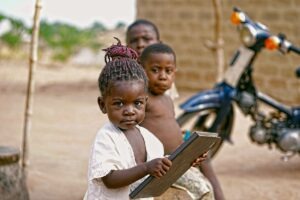
Behind these figures lies a deeper national inequality that is sharply regional. In the northern part of the country, where insecurity, poverty and cultural barriers intersect, the situation is significantly worse. UNICEF reports a net attendance rate of just 53 per cent in the North, with female primary school attendance dropping to 47.7 per cent in the North-East and 47.3 per cent in the North-West l, which means that more than half of girls in these regions are not in school.
The crisis is even more severe for children living with disabilities. An estimated 95.5 per cent of them are out of school, effectively shutting between five and seven million Nigerian children out of basic education entirely. For many, exclusion begins early and persists throughout life, limiting access to opportunity and reinforcing cycles of poverty.
Education, however, is only one layer of a broader humanitarian challenge.
Also, recent data also highlights a worsening nutrition crisis among the youngest Nigerians. Approximately 11 million children under five live in severe food poverty, surviving on two or fewer of the eight essential food groups required for healthy development. For these children, hunger is not episodic, it is a daily condition that shapes growth, learning capacity and long-term health outcomes.
Displacement further compounds these vulnerabilities. Globally, the number of displaced children reportedly rose by 46 per cent in 2025, with tens of thousands forced from their homes each day due to conflict and climate-related disasters. Nigeria remains one of the most affected countries in Africa, with more than seven million children displaced as a result of armed conflict, banditry and flooding. Children make up around 60 per cent of all internally displaced persons in the country, particularly in the North-East, North-West and parts of the North-Central region.
These overlapping crises, education exclusion, hunger and displacement have created a generation navigating uncertainty from childhood.
Yet amid these sobering realities, government and international partners continue to project renewed commitments toward reversing the trend.
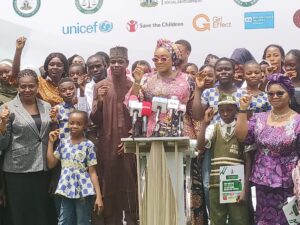
Marking the 2026 National Children’s Day at Eagle Square, Abuja, the Nigerian government reaffirmed its pledge to build a country where every child can “dream boldly, grow safely, and thrive without discrimination.” The celebration, themed “Future Now: Promoting Inclusion for Every Nigerian Child,” was attended by representatives of President Bola Ahmed Tinubu, GCFR, through the Minister of Women Affairs and Social Development, Hajiya Imaan Sulaiman-Ibrahim.
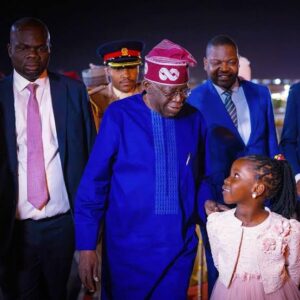
In his address, the President described Nigerian children as “the pride of the Republic” and the nation’s most valuable investment. He emphasised that the future is not distant but already unfolding in classrooms, rural communities, displacement camps and every space where children strive to be seen and heard.
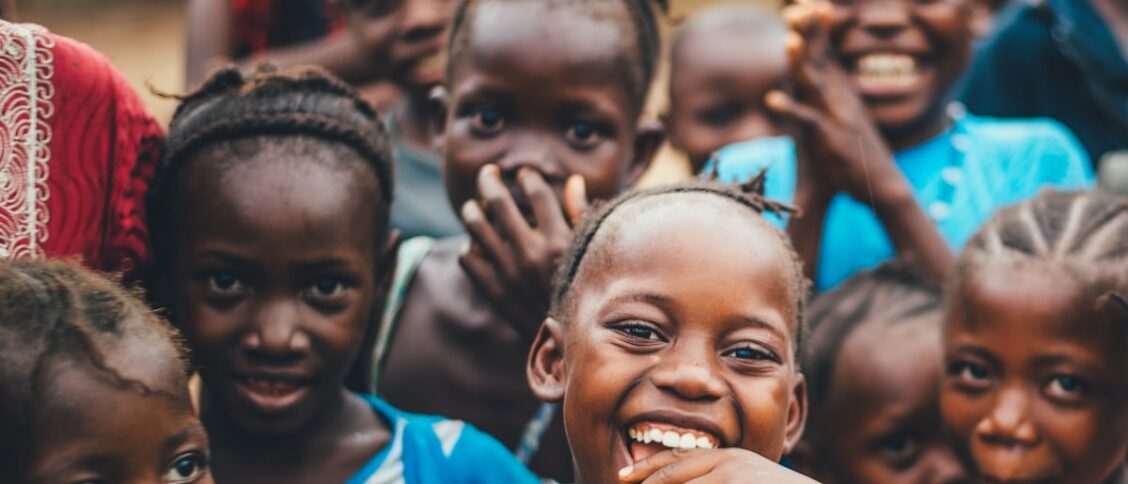
“There is a timeless beauty in the laughter of children,” the President said. “In the eyes of every Nigerian child lives the story of our collective tomorrow.”
He stressed that inclusion must remain central to national development, insisting that no child should feel invisible or excluded regardless of geography, disability or background. The administration pointed to ongoing initiatives such as the Renewed Hope Social Impact Intervention–774, the Nutrition 774 Initiative, ANRiN 2.0, targeted STEM investments, the Nigerian Education Loan Fund (NELFUND), and the Nigeria Youth Investment Fund (NYIF) as interventions designed to strengthen child wellbeing and expand opportunity.
Alongside government efforts, the National Orientation Agency (NOA) urged children to embrace patriotism, discipline and moral responsibility, describing them as the “hope, strength and future of the nation.” It encouraged young Nigerians to remain committed to learning and civic values as they prepare for leadership roles in adulthood.
From the international community, UNICEF has continued to push for deeper accountability. Mona Aika, Acting Chief of Child Protection at UNICEF Nigeria, called for the day to serve not merely as ceremony but as a moment of national reflection and responsibility. She urged stronger protections for children and greater inclusion of adolescent girls in policy formulation, stressing that young voices must help shape decisions that affect their lives.
Since its first observance in 1964, Nigeria’s Children’s Day has served as a symbolic reminder of the country’s obligations to its youngest citizens, a platform for advocacy, awareness and reflection on children’s rights and welfare.
This year’s theme embodies what is crucial to the policy mappings of governments in helping to redirect the lives of millions of children whose potential is either being nurtured or neglected depending on where they are born, their gender, or their circumstances.