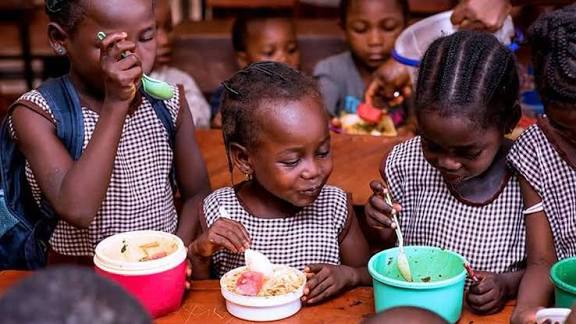

Global investment in school meals has more than doubled in recent years, rising from $43 billion in 2020 to $84 billion in 2024, according to the World Food Programme (WFP).
Africa is at the forefront of this expansion, with 20 million additional children now benefiting from national school feeding programmes.
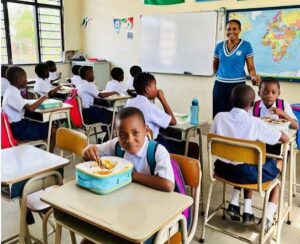
Yet, experts warn that while progress is evident, domestic funding remains insufficient in low-income countries, leaving gaps in sustainability.
Nigeria is seeking to change this narrative. The federal government has announced plans to expand the National Home-Grown School Feeding Programme (NHGSFP) to reach as many as 50 million primary school pupils by 2026.
This ambitious target was disclosed by the National Programme Manager of the National Social Investment Programme Agency (NSIPA), Aderemi Adebowale, during an interview with the News Agency of Nigeria (NAN).
According to Adebowale, the expansion will cover children in early years, Primary 1 to 3—as well as those in Primary 4 to 6, and will gradually extend to out-of-school children. “By the year 2026, we are looking at feeding close to 50 million pupils in primary school in Nigeria,” she said, describing the initiative as a critical step in combating child hunger and boosting educational outcomes.
The project builds on the Alternate Education and Renewed Hope National Home-Grown School Feeding Project launched on May 27, 2025, which initially targeted 20 million underserved children. Inaugurated by then Minister of Humanitarian Affairs and Poverty Reduction, Nentawe Yilwatda—now the National Chairman of the All Progressives Congress—the scheme is being rolled out in partnership with the National Commission for Almajiri and Out-of-School Children Education and the National Identity Management Commission.
One of the programme’s innovations is its pricing strategy. Adebowale explained that meals would be kept within N500 to N1,000 per child daily, while ensuring quality and nutrition.
To achieve this, NSIPA is aligning smallholder farmers, aggregators, suppliers, and development partners to stabilise food costs. “We are not going to be doing market prices. We have to agree on prices from our suppliers and farmers to arrive at a reasonable cost per plate,” she said.
Globally, the WFP estimates that 466 million children now receive school meals, an increase of 80 million since 2020. Its executive director, Cindy McCain, described this surge as a major milestone, noting that school feeding remains “one of the most effective ways to improve both nutrition and learning outcomes.”
The report posited that providing meals at school can be more impactful than technology investments or even teacher training in improving classroom engagement.
However, stakeholders in Nigeria’s education sector caution that feeding programmes alone cannot fix the system’s deep-rooted challenges. They warn that without stronger policies to prioritise teacher welfare, professional training, and retention, the country risks worsening its education crisis despite improvements in access.
“Meals may attract children to school, but if the teachers are underpaid, undertrained, and overburdened, learning outcomes will remain weak,” one education analyst noted.
The Nigerian government’s expansion plan reflects a broader continental effort to use school meals as both a social protection measure and an educational incentive. If successful, the scheme could become the largest school feeding programme in Africa. But its sustainability will depend on balancing the hunger fight with urgent reforms in teacher development and wider educational investment.