
Nigeria has again stressed on its determination to lead Africa’s transition toward a greener future.
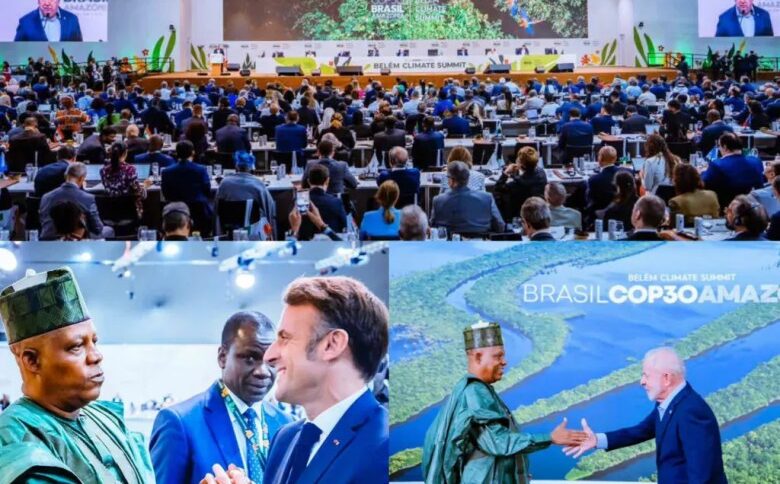
During the Leaders’ Climate Summit in Belém, Brazil, held from November 6 to 7, the Nigerian delegation, led by Vice President Kashim Shettima, reaffirmed the country’s role as a driving force in Africa’s climate diplomacy.
Representing President Bola Tinubu, Shettima highlighted Nigeria’s pledge to pursue climate resilience not as a mere policy goal but as “a solemn national commitment to preserve the planet for future generations.”
The two-day summit, hosted by Brazil’s President Luiz Inácio Lula da Silva in collaboration with the United Nations and global climate stakeholders, brought together world leaders, scientists, and investors seeking new ways to finance the planet’s green transition.
Nigeria’s message captured that time has come for Africa’s most populous nation to translate its vast natural potential into measurable climate action. During a high-level dialogue titled “Climate and Nature: Forests and Oceans,” Shettima unveiled Nigeria’s position paper, “The Rational Soul of Nature,” which outlines the country’s plan to balance economic development with environmental sustainability.
Part of that vision hinges on unlocking global carbon markets, a strategy expected to generate between $2.5 billion and $3 billion annually in carbon finance over the next decade. Those funds, Shettima said, will be key to advancing Nigeria’s climate agenda, from renewable energy expansion to forest preservation and sustainable agriculture.
In Belém, the Vice President also held a series of bilateral meetings with development partners, carbon market players, and multilateral financiers to deepen Nigeria’s role in international carbon trading. The talks, insiders say, focused on creating frameworks that ensure transparency and equitable benefit-sharing for local communities engaged in carbon offset projects.
“The world is watching Nigeria,” said Rukaiya El-Rufai, Special Adviser to the President on NEC and Climate Change. “Africa’s climate success depends on our ability to lead, to galvanize both public and private-sector action that turns our Nationally Determined Contributions into real outcomes.”
El-Rufai pointed out Nigeria’s strategic advantage: its diverse natural wealth, from oil and natural gas to abundant sunlight and vast arable land, this offers a rare opportunity to pursue a just transition that safeguards livelihoods while reducing emissions.
“Nature and climate are the very foundation of our economy and way of life,” she noted. “If we fail to use our resources responsibly, we risk undermining the very systems that sustain us.”
Nigeria’s strong presence in Brazil marks more than just diplomatic posturing. It signals an evolving vision — one where Africa’s largest economy is not merely responding to global climate pressures but setting its own agenda for sustainable growth.
As the world edges closer to the crucial COP30 summit, also set to be hosted in Belém next year, Nigeria’s renewed climate posture positions it as a pivotal player in shaping how the Global South redefines progress in the age of climate uncertainty.