
The end of an era.
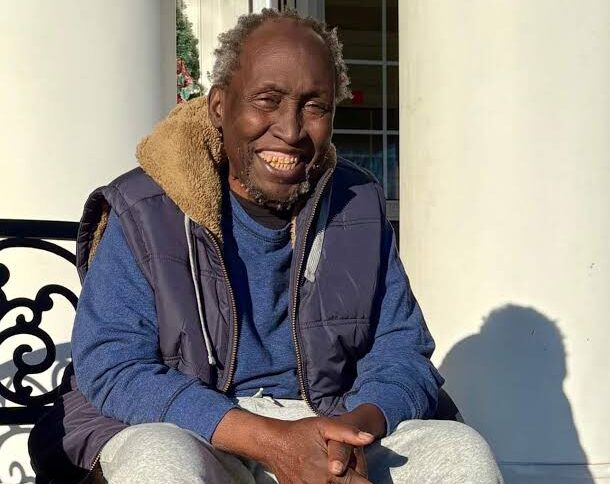
Ngũgĩ wa Thiong’o, the towering Kenyan novelist, essayist, playwright, and unapologetic crusader for African identity, has died at the age of 87.
His daughter, Wanjiku wa Ngugi, broke the news in a heartfelt Facebook post on Wednesday, May 28, 2025. “It is with a heavy heart that we announce the passing of our dad… He lived a full life and fought a good fight.” Her words echoed the dignity with which he lived, a man whose life’s mission was to dismantle the cultural chains left behind by colonial rule.
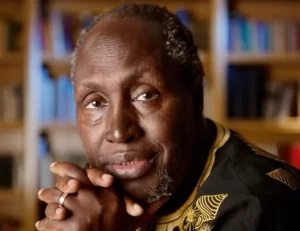
Born on January 5, 1938, in the small town of Limuru, Ngũgĩ came into the world when Kenya was still under British control. His early years were marked by hardship and upheaval. His parents were subsistence farmers struggling to make ends meet, yet they managed to send him to Alliance High School, a mission-run institution known for producing many of Kenya’s first generation of intellectuals.
But education didn’t shield him from the brutal realities of colonialism. One school holiday, he returned home to find his village in ruins, razed by British forces amid their brutal crackdown on the Mau Mau independence movement. His family, like so many others, had been scattered into detention camps. These experiences of injustice and erasure would shape the man he became.
Ngũgĩ emerged from that trauma with a pen in hand—and fury in his heart. He would go on to become one of Africa’s most influential literary figures, writing novels like A Grain of Wheat, The River Between, and Petals of Blood, which examined Kenya’s transition from colonial rule to independence. But Ngũgĩ did more than document history; he confronted it. And he challenged Africa to find its voice, not in the language of its colonisers, but in its own mother tongues.
That belief became his life’s battle. In a literary world still dominated by English and French, Ngũgĩ broke ranks, switching from English to Kikuyu in his fiction and plays. For him, language was more than a tool—it was a weapon, a battleground for liberation. His 1986 book Decolonising the Mind remains a blistering manifesto, calling on African writers to reclaim their linguistic and cultural sovereignty.
He didn’t mince words. In that collection, he openly criticised fellow literary legend Chinua Achebe for continuing to write in English. The two giants, once close, fell out over the issue. For Ngũgĩ, writing in European languages was not just a choice, but a political concession he could no longer accept.
His defiance came at a cost. In the 1970s, his political plays landed him in prison without trial. From behind bars, he famously wrote Devil on the Cross on toilet paper using a smuggled pen. Even exile couldn’t silence him. He lived in the United States for decades, teaching at Yale, NYU, and the University of California, Irvine, while continuing to write and speak on issues of identity, justice, and the future of African literature.
Though many expected him to win the Nobel Prize for Literature, the accolade remained elusive. Each year his name surfaced as a frontrunner, only for the honour to go elsewhere. Still, for his readers and followers, Ngũgĩ didn’t need a Nobel to validate his legacy. He had already reshaped the literary map of Africa—and, indeed, the world.
Away from the spotlight, Ngũgĩ led a rich and complex personal life. He was married and divorced twice and was the proud father of nine children, four of whom became authors themselves. “My own family has become one of my literary rivals,” he joked during a 2020 interview with the Los Angeles Times.
Ngũgĩ wasn’t just a writer. He was a visionary who believed literature could be a tool of resistance, a mirror of identity, and a bridge between generations. Through his words, he restored dignity to stories that had long been told from the outside looking in. He gave voice to the colonised, the dispossessed, and the hopeful. And he did so without apology.
As Kenya—and the world—reflects on his legacy, one thing is clear: Ngũgĩ wa Thiong’o didn’t just write books. He rewrote the rules. He inspired countless writers to pick up the pen in their own languages, to trust in their own stories, and to speak truth to power.