

Questions need answers, that’s why NASA is on this mission.
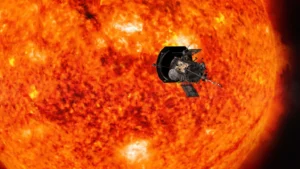
NASA’s Parker Solar Probe is set to make history this Christmas Eve by flying closer to the Sun than any spacecraft has ever dared. Plunging into the star’s outer atmosphere, or corona, the probe faces scorching temperatures of up to 1,400°C and intense radiation, pushing the boundaries of human engineering and scientific ambition.
Launched in 2018, the probe has already completed 21 flybys, inching closer to the Sun with each pass. However, this latest approach breaks all records, bringing the spacecraft to within 3.8 million miles (6.2 million kilometers) of the Sun’s surface. To put this into perspective, NASA’s Dr. Nicola Fox explained: “If the Sun and Earth were one meter apart, Parker Solar Probe would be just four centimeters from the Sun.”
According to The BBC, the probe’s daring journey is protected by an 11.5cm-thick carbon-composite shield, designed to withstand the Sun’s ferocious heat. Yet its survival depends on speed as much as shielding; it hurtles through space at 430,000 mph, faster than any human-made object, completing a trip from London to New York in less than 30 seconds.
Cracking the Sun’s Mysteries
The mission’s primary goal is to unravel one of the Sun’s greatest mysteries: why the corona, its outer atmosphere, is millions of degrees hotter than its surface. Dr. Jenifer Millard of Fifth Star Labs explained, “The surface of the Sun is about 6,000°C, but the corona can reach millions of degrees. It’s counterintuitive, and we still don’t understand how it gets hotter as you move further from the Sun.”
The probe also seeks to deepen our understanding of solar wind—streams of charged particles ejected from the corona that interact with Earth’s magnetic field, creating stunning auroras but also disrupting power grids, communication systems, and satellites.
“Understanding the Sun, its activity, space weather, and the solar wind is crucial for our everyday lives on Earth”
A Nervous Wait
As the probe storms into the Sun’s atmosphere, it will lose communication with Earth for several days. Scientists anxiously await a signal, expected on December 27, to confirm its survival. Dr. Fox shared how the team plans to notify her once contact is restored: “They’ll text me a green heart to let me know the probe is OK.”
Despite the challenges, Dr. Fox expressed confidence in the spacecraft’s design: “It’s a tough little spacecraft, built to endure these brutal conditions. But of course, I’ll still worry.”
Why It Matters
Beyond advancing our knowledge of the Sun, the Parker Solar Probe’s findings could have practical implications for protecting Earth from the effects of space weather.
By uncovering the secrets of the Sun’s corona and solar wind, scientists hope to improve forecasting of geomagnetic storms, ensuring better preparation for potential disruptions to technology and infrastructure.