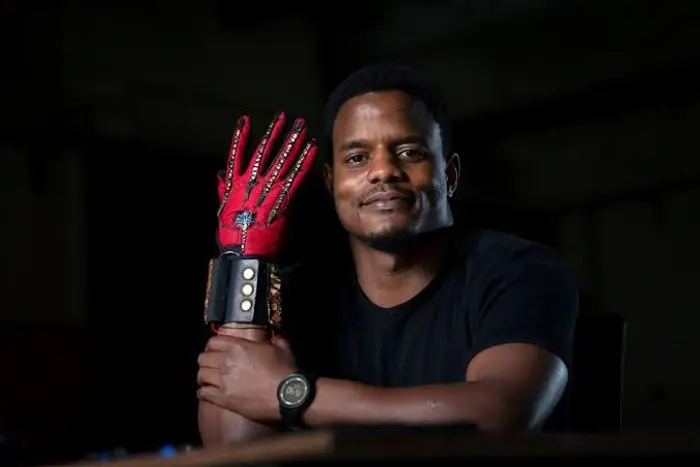

A Kenyan technology innovator, Roy Allela, has developed smart gloves that convert sign language movements into audible speech, inspired by the communication difficulties his deaf niece faced with family members who could not understand her signs.
The invention, known as Sign-IO, uses sensors fitted to the fingers of a pair of gloves to detect hand movements and translate recognised signs into speech through a mobile phone application.
According to the Kenya National Innovation Agency, Allela began developing the technology after observing his six-year-old niece struggle to communicate with relatives unfamiliar with sign language.
The device was designed to bridge that communication gap and help deaf people express themselves more easily in everyday interactions.
The gloves contain flexible sensors that capture finger movements and transmit the data via Bluetooth to a connected smartphone. The accompanying application processes the recognised signs and produces audible speech, allowing people who do not understand sign language to follow the conversation.
“My niece wears the gloves, pairs them to her phone or mine, then starts signing and I’m able to understand what she’s saying,” Allela said, according to the agency.
The application also allows users to customise the spoken output, including the language, voice gender and pitch. The system was designed to accommodate differences in signing speed, making it more adaptable to individual users.
The Kenya National Innovation Agency reported that Sign-IO achieved an average accuracy rate of 93 per cent during testing. However, the figure does not necessarily mean the device can accurately interpret every sign, sentence or conversation in all circumstances.
Allela’s work has attracted international recognition. In 2019, Sign-IO was shortlisted for the Royal Academy of Engineering’s Africa Prize for Engineering Innovation. He also received the Hardware Trailblazer Award from the American Society of Mechanical Engineers.
In October 2020, former Kenyan President Uhuru Kenyatta recognised Allela during the country’s Mashujaa Day celebrations, which honour individuals who have made notable contributions to Kenya.
The innovator also tested the technology at a special-needs school in Migori County, where feedback from users helped inform further improvements.
Beyond the technology itself, Allela’s work reflects a broader effort to make communication more accessible to deaf people, particularly children who may depend on relatives, teachers or interpreters when interacting with people unfamiliar with sign language.
Sign-IO offers a practical example of how personal experiences can inspire technological solutions to everyday challenges. By combining wearable sensors, wireless connectivity and speech-generation software, the invention seeks to reduce communication barriers between deaf people and the wider hearing community.
Its wider impact will depend on continued development, affordability and how effectively the technology accommodates different sign languages and the complexities of natural signing.