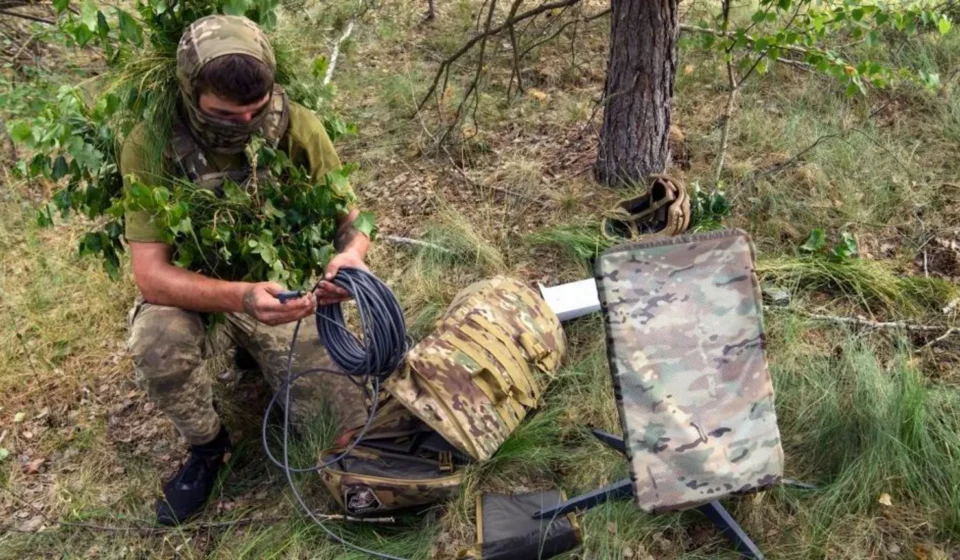

Starlink, the satellite internet service operated by Elon Musk’s SpaceX, has become a crucial part of Ukraine’s military communications, helping troops coordinate operations and enabling drones to strike targets over long distances. However, new speed restrictions imposed on devices connected to the network have raised concerns about their impact on Kyiv’s battlefield capabilities.
For instance, a sudden restriction limiting the speed of Starlink-connected drones to 100mph (160km/h) has disrupted some Ukrainian military missions, according to a senior Ukrainian official, Serhiy Beskrestnov.
Beskrestnov, an adviser to President Volodymyr Zelensky, said Ukrainian officials had not been informed in advance of the restrictions, which SpaceX introduced overnight on Tuesday.
The move has drawn attention to Ukraine’s dependence on a commercial satellite network for military operations and the potential consequences when access or technical capabilities change.
Starlink provides high-speed internet through a network of satellites orbiting the Earth. Unlike conventional mobile networks, it does not depend on extensive ground-based infrastructure, making it particularly useful in areas where communications systems have been destroyed or disrupted by war.
Ukraine has adopted the technology across its armed forces, using it to connect troops, command posts, artillery units and drone operators.
The Institute for the Study of War (ISW) says the network has become the backbone of Ukraine’s military communications.
George Barros, the institute’s director of innovation and open-source tradecraft, told the BBC that Starlink allows drones, artillery and command posts to operate as an integrated, real-time network, reducing the time between detecting a target and engaging it.
The technology has also strengthened Ukraine’s drone operations by enabling operators to maintain connections over longer distances than some conventional radio systems allow. Satellite links can be more difficult to disrupt through traditional electronic jamming, although they are not immune to interference or other forms of disruption.
Starlink-connected drones have become particularly important in Ukraine’s efforts to intercept Russian drones, including jet-powered Shahed models.
According to the ISW, the new speed restriction could seriously undermine these operations. Shahed drones can travel at speeds exceeding 198mph, making it difficult for Ukrainian interceptors restricted to 100mph to pursue them effectively.
The restrictions have implications beyond the speed of individual drones.
Tom Whittington, an electronic warfare expert and associate fellow at the Royal United Services Institute, told BBC Radio 4’s PM programme that Starlink enables the transmission of large volumes of data, including video, text and voice communications, without relying on conventional telecommunications infrastructure.
Limiting the speed of connected platforms could affect how drones navigate and carry out missions in Ukrainian-controlled territory and Russian-occupied parts of Ukraine.
The reported restrictions have therefore raised concerns about whether a technical change to a commercial internet service could have immediate consequences for military operations.
Starlink does not operate inside Russia, according to the report, but Ukrainian drones can use the network to communicate with their operators during strikes. Ukraine has no straightforward replacement for the system on a comparable scale, adding to concerns about its continued reliance on the service.
The dispute has also exposed questions about the relationship between Starlink, its military counterpart Starshield and the governments that use the technology.
Starshield is a military-grade satellite communications system developed by SpaceX for the US government. Although Musk says Starlink and Starshield are separate services, they share underlying satellite technology.
Beskrestnov suggested that the restrictions were not coincidental and could be linked to recent tensions between Kyiv and Washington.
US President Donald Trump has criticised Ukraine’s long-range attacks on Russian oil refineries and called for a change in Ukrainian leadership. Musk has also criticised aspects of Ukraine’s military strategy.
However, the circumstances surrounding the speed restrictions do not, on their own, establish that they were politically motivated.
In a post on X, Musk said Starshield was owned and controlled by the US government, with restrictions on its speed or use determined by the US military and ultimately the president.
He distinguished it from Starlink, which he described as a commercial service operated by SpaceX. Musk said Starlink was intended for civilian or defensive activities and should not be used for offensive military action.
His comments raise questions about how the rules governing satellite communications are determined, particularly when a commercial network becomes deeply embedded in a country’s war effort.
Russia launched its full-scale invasion of Ukraine in February 2022 and continues to occupy about a fifth of Ukrainian territory.
Since the invasion, Starlink has helped Ukraine maintain communications in areas where conventional infrastructure has been damaged, while also supporting a military increasingly reliant on drones and real-time battlefield information.
That dependence presents a strategic challenge. A service designed and operated by a private company can become essential to national defence, yet decisions about its availability, technical limits and permitted uses may lie beyond the direct control of the military relying on it.