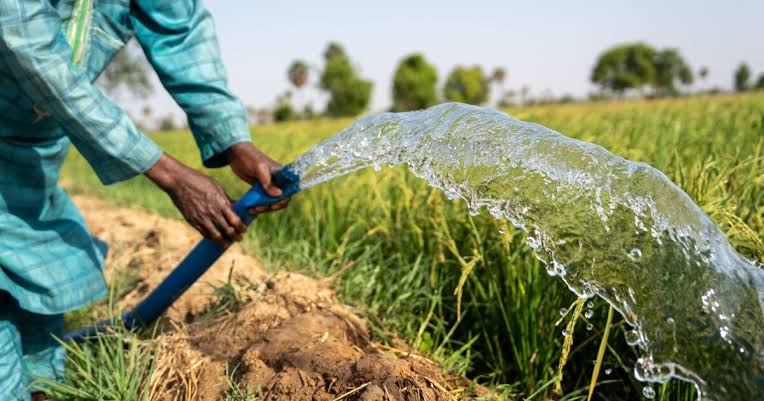

Climate change, erratic rainfall patterns and rising food prices is a continuous threat to agricultural productivity. However, irrigation is increasingly being viewed as a critical strategy for strengthening food security and improving crop yields across developing economies.
According to the Food and Agriculture Organization of the United Nations, irrigated agriculture contributes about 40 per cent of the world’s food supply despite accounting for only 20 per cent of cultivated land globally.
The figures show the significant role irrigation plays in agricultural output, although experts caution that the benefits must be balanced against concerns surrounding water use.
Jippe Hoogeveen, a senior technical officer in the FAO Land and Water Division, noted that agriculture remains the largest consumer of freshwater resources worldwide.
“Agriculture is the biggest water-using sector, with agriculture using globally about 70 per cent of all water withdrawals for human use,” he said.
“Industry uses 20 per cent and domestic use is about 10 per cent.”
While such levels of consumption may appear alarming, Hoogeveen argued that irrigation also offers considerable advantages, particularly in terms of reliability and productivity.
“There is also the other side of irrigation, and that is that it gives much higher yields and much more reliable yields,” he added.
The importance of irrigation is becoming increasingly evident in Nigeria, where government authorities are investing in infrastructure aimed at reducing dependence on rainfall and strengthening year-round farming activities.
In Jigawa State, authorities have intensified efforts to increase agricultural output through the rehabilitation of dams in the Kazaure and Yankwashi local government areas.
The Director-General of the Jigawa State Agricultural Transformation Agency, Saifullahi Umar, disclosed this while inspecting ongoing rehabilitation works at Dambo and Kuda dams.
According to him, the projects were initiated under the administration of Governor Umar Namadi as part of broader efforts to expand irrigation farming in the state.
He explained that the projects are expected to open irrigation opportunities across approximately 500 hectares of farmland upon completion, increasing dry-season agricultural activities in the affected communities.
No fewer than 15,000 people are expected to benefit directly from the initiative, with officials expressing optimism that it will boost food production and strengthen local food security.
The state-level intervention aligns with broader national efforts to improve irrigation infrastructure.
Earlier this year, the Federal Government launched the Sustainable Power and Irrigation for Nigeria Project, a $500 million programme supported by the World Bank aimed at improving dam safety, strengthening hydropower generation and expanding irrigation systems nationwide.
Officials say the initiative is intended to improve agricultural productivity and support economic growth while reducing the vulnerabilities associated with rain-dependent farming.
Agricultural experts note that limited access to water frequently disrupts farming during dry seasons, forcing many farmers to depend heavily on food reserves or market purchases until rainfall returns.
This challenge has become more pressing as climate variability increasingly affects traditional farming patterns.
Across Africa, efforts to expand irrigation systems are gaining momentum amid growing concerns over food insecurity and climate-related disruptions.
According to FAO data, countries including Egypt, Morocco, South Africa, Nigeria, Sudan and Madagascar account for roughly three-quarters of irrigated land on the continent.
In a 2025 assessment, the FAO reported that irrigated land generates productivity values about 3.2 times greater than rain-fed farmland, with average yields approximately 76 per cent higher.
For policymakers and agricultural stakeholders, the figures reinforce an increasingly important reality: feeding growing populations may depend not only on expanding farmland, but also on ensuring water reaches it when nature does not.