
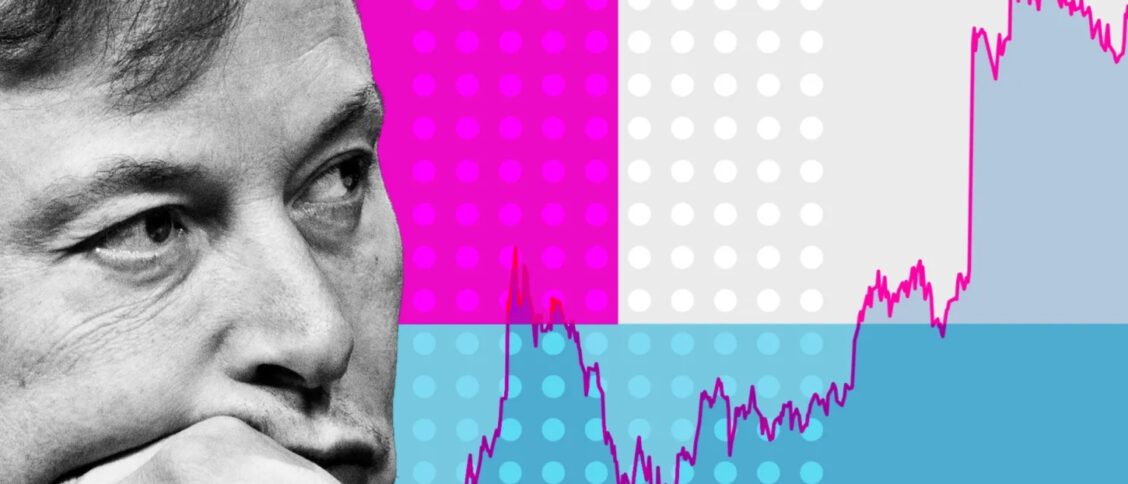

History has been made in the world of wealth and technology.
Nearly six years after ranking only 35th among the world’s richest people, Elon Musk has crossed a threshold once thought unimaginable, becoming the first person in history to amass a fortune exceeding $1 trillion.
This new history follows the blockbuster stock market debut of SpaceX, whose listing on the Nasdaq catapulted the billionaire entrepreneur into a financial league of his own and further widened the gap between him and the world’s other wealth titans.
According to the Bloomberg Billionaires Index, Musk’s net worth surged to an estimated $1.11 trillion after investors enthusiastically embraced shares of SpaceX, the rocket, telecommunications and artificial intelligence company that has become the latest jewel in his sprawling business empire.
The company’s debut proved nothing short of spectacular. Although shares were priced at $135, trading opened at $150 and climbed to as high as $176.50 before closing at about $161, giving SpaceX a market valuation of roughly $2.2 trillion. The initial public offering reportedly raised about $75 billion from investors and underwriters, making it one of the most significant listings in recent history.
The listing transformed Musk’s balance sheet overnight. Bloomberg estimates that his 42 per cent stake in SpaceX is now worth approximately $767.1 billion, while options tied to the company add another $53.8 billion. His holdings in electric vehicle giant Tesla are valued at about $168 billion, with Tesla stock options accounting for an additional $116.4 billion.
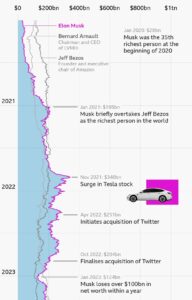
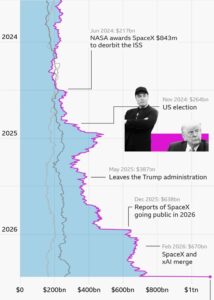
The achievement places Musk comfortably ahead of other familiar names atop global wealth rankings, including Google co-founders Larry Page and Sergey Brin, Amazon founder Jeff Bezos and LVMH chairman Bernard Arnault. Combined, their fortunes still fail to eclipse the symbolic significance of the trillion-dollar barrier Musk has now crossed.
Yet the journey hasn’t been anything linear. In January 2020, Musk’s fortune stood at approximately $28 billion, ranking him 35th among the world’s wealthiest individuals. Few could have predicted that within six years, he would become the first person to achieve trillionaire status.
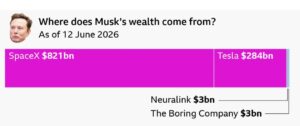
The meteoric rise was driven largely by the explosive growth of Tesla and the expansion of SpaceX from a rocket company into a diversified technology powerhouse encompassing satellite communications and artificial intelligence.
Investor optimism surrounding SpaceX’s future extends beyond its launch business and Starlink satellite network. The company’s expansion into artificial intelligence, strengthened by its acquisition of xAI, has further boosted confidence that it could dominate multiple industries in the years ahead.
But the unprecedented wealth explosion has also reignited concerns over inequality and the concentration of economic power.
Prominent Democratic lawmakers, including Senators Bernie Sanders and Elizabeth Warren, have seized upon the development as evidence that modern capitalism increasingly concentrates vast resources in the hands of a few individuals.
However, there is a caution that much of Musk’s wealth exists only on paper. The bulk of his fortune is tied to stock holdings rather than liquid cash, and he is prohibited from selling SpaceX shares for at least one year following the listing. Moreover, despite its extraordinary valuation, SpaceX remains unprofitable, having reportedly recorded losses exceeding $9 billion across 2025 and 2026 due to heavy spending on artificial intelligence projects and infrastructure expansion.
Yet such concerns have done little to dampen investor enthusiasm or diminish the symbolism of the moment.
From co-founding internet companies in the late 1990s to revolutionising electric vehicles, commercial space exploration and artificial intelligence, Musk has repeatedly defied sceptics and reshaped industries.
Now, by becoming the world’s first trillionaire, he has achieved another milestone that once belonged only to the realm of speculation.