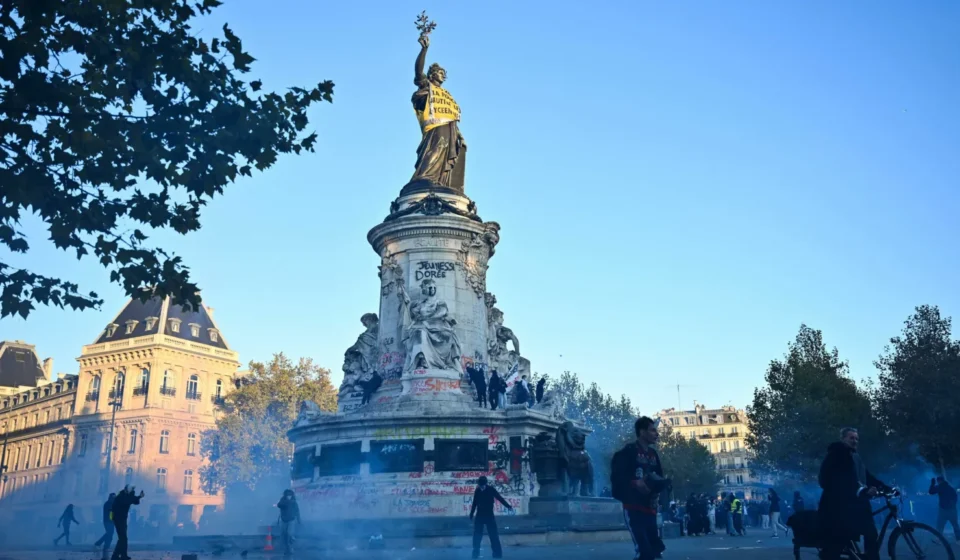

Prime Minister in France, Sébastien Lecornu is holding a crisis cabinet meeting on Monday to assess a weekend of violence and looting that authorities are struggling to contain, amid growing questions over public security, political divisions and the government’s response.
More than 500,000 people took to the streets on Saturday, with most demonstrating peacefully against rising living costs and declining access to essential public services, including quality state education. However, the protests descended into violence after groups of masked activists and vandals dressed in black joined the demonstrations.
An estimated 1,500 shops and businesses were looted or destroyed as unrest spread across the country. Riot police deployed tear gas and water cannon to disperse crowds, while officers were seen striking people with batons in several locations.
The country’s Interior Ministry said about 1,000 police officers were injured during Saturday’s unrest, seven of them seriously.
The scale of the destruction has intensified pressure on the government to establish what happened, identify those responsible and prevent further violence.
However, president of France’s lower house of parliament, Yaël Braun-Pivet, has called for an inquiry into the events, including the circumstances that allowed the demonstrations to deteriorate into widespread disorder.
Amid growing concerns, speculation emerged that President Emmanuel Macron might impose temporary curfews in some areas or declare a state of emergency to restore calm.
Macron instead addressed the nation in a televised speech on Sunday, calling for national unity and promising that those responsible for the violence would be punished.
His address attracted criticism on social media and from political opponents, who accused him of failing to offer concrete measures to resolve the crisis.
The destruction was still evident in Paris on Sunday night, with shattered shopfronts and damaged businesses marking the aftermath of the unrest. Red graffiti on a wall beside a row of wrecked shops captured the mood in the French capital: “Things are dark in the city of light.”
The crisis is unfolding against a tense political backdrop, with Macron widely regarded by critics as a lame-duck president nearing the end of his tenure. France is preparing for a fiercely contested presidential election scheduled in about six months, with political figures on both the nationalist right and anti-capitalist left seeking to capitalise on public discontent.
Marine Le Pen, a leading figure on the anti-immigration nationalist right, and Jean-Luc Mélenchon, a prominent voice on the radical left, are among the politicians competing for influence as the country confronts mounting social and economic pressures.
The political climate is further complicated by a deeply divided parliament, where three rival political blocs have struggled to find common ground, leaving the legislature effectively paralysed on key issues.
The divisions have added to uncertainty over how the government will respond to the unrest and address the grievances that brought hundreds of thousands of people onto the streets.
Several critical questions remain unanswered, including how those responsible for looting and vandalism will be prosecuted, how affected businesses will be compensated and what measures will be introduced to protect towns and cities from further attacks.