
Ethiopia is preparing to host the second edition of the Africa Climate Summit (ACS2), scheduled for September 8 to 10, in Addis Ababa, in partnership with the African Union Commission (AUC).
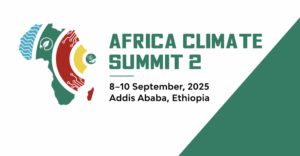
Themed “Accelerating Global Climate Solutions: Financing for Africa’s Resilient and Green Development,” the summit is set to become a milestone in Africa’s climate journey. This event is expected to highlight the continent’s climate challenges and assert its place as a leader in sustainable solutions.
Speaking during a virtual media briefing recently, Ethiopia’s State Minister for Planning and Development, Seyoum Mekonnen, framed the upcoming summit as a critical opportunity for the continent. “This summit is Africa’s moment to lead,” he said, reiterating that while Africa is often seen as a victim of climate change, it must now be recognized as a “continent of solutions.”
Key Goals
The summit will spotlight homegrown climate innovations and emphasize the urgent need for fairer global climate financing mechanisms. It comes at a time when Africa continues to bear the brunt of climate impacts despite contributing the least to global greenhouse gas emissions.
Mekonnen also cited Ethiopia’s own progress as evidence of the power of African-led initiatives. The country’s flagship Green Legacy Initiative, launched in 2019, has resulted in the planting of over 40 billion seedlings in six years, helping to boost national forest cover from 17.2% in 2019 to 23.6% by 2023. “We are not just hosting a summit, we are building a movement,” Mekonnen said. “And every movement needs voices that amplify, challenge, and inform.”
The summit also intends to challenge and reform global financial systems that have long marginalized Africa. According to Moses Vilakati, AU Commissioner for Agriculture, Rural Development, Blue Economy and Sustainable Environment, the climate finance deficit is a threat to the continent’s future.
“Africa needs over $3 trillion to meet its climate goals, yet received only $30 billion between 2021 and 2022,” Vilakati revealed.
He stressed that this gap is an existential issue. “Bridging Africa’s climate finance gap is a necessity to ensure our resilience and future,” he said. Despite receiving only a fraction of global climate finance, Africa remains the most vulnerable continent due to its geographic exposure, weak adaptive capacity, and systemic inequalities.
Africa, however, also holds immense potential for renewable energy, particularly solar power. Vilakati highlighted that the continent has the highest solar potential globally, with many regions receiving more than 2,000 kWh/m² annually. It was noted that one of the outcomes of the first Africa Climate Summit (ACS1) was the ambition to triple renewable energy capacity to 300 GW by 2030, a goal that will require massive investments and public-private cooperation.
“Climate change, and what we do about it, will define our era, our continent, and the global legacy we leave for future generations,” Vilakati said. He added that only 18% of Africa’s mitigation needs and just 20% of its adaptation needs are currently funded, underlining the scale of the challenge ahead.
The summit will also serve as a launchpad for implementing climate policies, supporting the growth of sustainable industries, and embedding climate resilience into national development plans.