
Climate Change Is Becoming Africa’s Biggest Education Crisis, Leaving Teachers to Carry the Burden

Across classrooms in eastern, western and southern Africa, climate change is no longer a distant scientific theory discussed in textbooks. It has become an everyday reality shaping how children learn and how teachers teach.
From prolonged droughts that leave students hungry to floods that wash away school buildings and heatwaves that force lessons outdoors, educators are increasingly battling climate-related disruptions while trying to keep learning on track.
According to recent global estimates, at least 242 million students in 85 countries experienced disruptions to their education in 2024 due to climate-related disasters. Storms ripped roofs off classrooms, floods cut off access to schools, while extreme heat forced temporary closures, showing the growing threat climate change poses to education systems worldwide.
The figures suggest that education now faces a climate crisis long before concerns over artificial intelligence or digital transformation.
Climate-induced disasters are affecting schools in ways that extend far beyond temporary closures.
Extreme weather destroys classrooms, libraries, laboratories and sanitation facilities built over decades. Floodwaters often sweep away textbooks, learning materials, generators and water infrastructure, leaving schools struggling to recover long after the rains have stopped.
Heatwaves also pose less visible but equally damaging consequences. Research has linked prolonged exposure to high temperatures with reduced concentration, lower academic performance and increased anxiety among students, particularly younger learners.
For many African education systems already grappling with overcrowded classrooms, inadequate infrastructure and limited funding, climate change has opened what experts describe as a “second front”, one that education budgets were never designed to fight.
Rather than focusing solely on curriculum reforms or technology integration, policymakers are increasingly confronting a more immediate question: whether schools themselves can remain safe, accessible and functional amid worsening climate extremes.
Nigeria’s Growing Vulnerability
The challenge is particularly acute in Nigeria and across West and Central Africa.
Recent assessments place Nigeria’s education service resilience at 4.33 out of 10, reflecting only a moderate capacity to withstand major disruptions to schooling. Yet the country’s climate exposure remains significantly higher, with a drought vulnerability score of 10 out of 10 and an extreme heat score of 9.88.
The combination paints a troubling picture of an education system expected to function under environmental pressures it is only partially equipped to manage.
The situation extends beyond Nigeria. Across West and Central Africa, millions of children live in communities exposed to multiple overlapping climate hazards, while education infrastructure remains fragile. The region also accounts for one of the world’s highest populations of out-of-school children, leaving little room for prolonged school closures or repeated disruptions.
Education experts argue that climate resilience should no longer be treated as a post-disaster response but as a core component of education planning.
Building climate-resilient classrooms capable of withstanding floods and extreme heat, developing alternative learning plans for periods when schools cannot operate, and strengthening emergency preparedness are increasingly viewed as essential investments rather than optional interventions.
Keeping children in school, they argue, is no longer simply an issue of access or affordability. It is becoming equally dependent on infrastructure, environmental planning and climate adaptation.
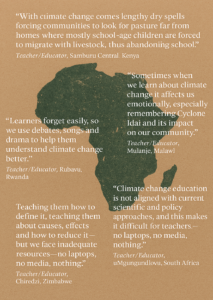
While schools face mounting physical threats, teachers remain at the centre of the crisis, often working under extremely difficult conditions.
Many educators report teaching without reliable electricity, internet access, radios, televisions, projectors, laptops or updated textbooks. In some schools, even basic teaching materials such as chalk are in short supply.
Teachers also face overcrowded classrooms, high teacher-to-student ratios and increasing expectations to teach multiple subjects simultaneously. Despite the growing urgency of climate education, many have received little or no specialised training to explain complex environmental issues or integrate climate literacy into existing lessons.
The result is mounting pressure on educators already coping with burnout, limited professional development opportunities and rigid academic timetables.
Experts say teachers are expected to deliver accurate, relevant climate education while lacking the resources and institutional support needed to do so effectively.
Preparing Schools for a Changing Climate
As climate change continues to reshape communities across Africa, education specialists say protecting learning will require more than rebuilding damaged classrooms after disasters strike.
Future investments, they argue, must focus on strengthening school infrastructure, improving teacher training, expanding access to teaching resources and embedding climate resilience into education policies.
Without those measures, the continent risks not only losing classrooms to climate disasters but also undermining the learning opportunities and future prospects of millions of children.


