
Nigeria is staring at an education emergency of staggering proportions.
Nearly 20 million children, roughly one in every three school-age children in the country, are currently out of school, giving Nigeria one of the highest out-of-school populations in the world. Yet perhaps even more alarming is the reality that many of those who make it into classrooms are not acquiring the skills needed to thrive in a rapidly changing world shaped by artificial intelligence, automation and digital technology.

Against this backdrop, education experts, policymakers and development partners gathered in Osun State for a two-day Media Dialogue on Digital Learning, Artificial Intelligence and Skills Development for Out-of-School Children, where a sobering question dominated discussions: Can technology help rescue millions of Nigerian children from educational exclusion?
Leading the conversation was UNICEF’s Chief of Lagos Field Office, Celine Lafoucriere, who painted a troubling picture of the country’s learning crisis.

“Think about that for a second. Of all the children in Nigeria who actually go to school, only one in four can read properly and do basic mathematics at age 14. And we are only talking about children who make it to school. There are millions more who never get to school at all,” she said.
The figures enumerate the challenge that goes beyond access to classrooms. For Lafoucriere, the crisis is ultimately about the future prospects of millions of children whose opportunities are shrinking in an increasingly digital economy.
“These statistics are not just numbers. They represent real children whose futures are being compromised,” she noted.
Her concern warned about a growing global anxiety:
“The children who understand how to use these technologies will have a chance to thrive. Those who do not will be left behind. Right now, many out-of-school children in Nigeria are among those being left behind, and girls remain the most disadvantaged,” Lafoucriere warned.
She however challenged journalists to become active participants in the fight against educational exclusion, stressing that sustained media attention can influence policy and attract investment in solutions.
“When journalists continue to tell important stories week after week, policymakers listen, politicians listen, and stakeholders pay attention. A story that does not go away is a story that eventually gets acted upon.”
While the statistics may appear daunting, stakeholders at the dialogue argued that digital learning and artificial intelligence could provide a pathway to reaching children who have historically been excluded from formal education.
Meanwhile, the Permanent Secretary of the Osun State Ministry of Education, Muritala Jimoh, described education as society’s most powerful tool for transformation and called for intensified collaboration to ensure that every child has access to quality learning opportunities.
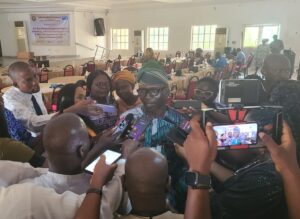
“I extend our sincere appreciation to UNICEF for its continuous support and commitment to improving access to quality education for every child. This collaboration demonstrates our shared determination to address one of the most pressing educational challenges of our time, the issue of out-of-school children,” he said.
According to him, millions of children remain outside the education system due to poverty, insecurity, geographical barriers and socio-cultural constraints. However, he believes technology offers a unique opportunity to bridge those gaps.
“Digital learning platforms are transforming the way knowledge is delivered, making education more accessible, flexible, inclusive and engaging. When responsibly deployed, artificial intelligence can personalise learning experiences, identify learning gaps, support teachers and improve educational planning,” Jimoh stated.
“As we embrace technological advancement, it is imperative that no child is left behind in the digital transformation.”
The scale of the challenge was further highlighted by UNICEF Education Specialist, Harold Kpojime, who described Nigeria’s out-of-school situation as one of the most severe globally.
“Nigeria has one of the highest numbers of out-of-school children in the world. Approximately 20 million children are out of school, which means nearly one in every three school-age children is not in the classroom,” he said.
Beyond enrolment, Kpojime revealed a worrying trend in school retention and completion rates across the country.
“What we observed is that as children progress from primary school to junior secondary and then senior secondary school, completion rates continue to decline. The dropout rate becomes more significant at the higher levels, which is very alarming.”

According to him, poverty, cultural practices and socio-economic pressures continue to push children out of classrooms, even in regions with relatively strong education indicators.
“Although the South-West records relatively strong figures at the primary school level, there is still a major challenge with teenagers at the secondary school level, where we see higher dropout rates and lower completion rates,” he explained.
The education specialist also linked the country’s education challenges to a growing skills crisis among young people.
“We reviewed data showing that over 70 per cent of Nigerian youths are unemployed or lack the skills required for available jobs. Even where employers are willing to hire, many young people do not possess the necessary competencies. This is a serious concern.”
To address the widening learning and skills gap, UNICEF and its partners have introduced digital platforms designed to reach learners beyond conventional classrooms.
Among them is the Nigeria Learning Passport, a curriculum-aligned digital platform that provides educational resources for students while also supporting teacher development. According to Kpojime, the platform has already been deployed in 24 states and currently serves more than 2.34 million users.
“The platform contains curriculum-aligned resources for learners across different grade levels. It also includes a dedicated section for teacher professional development because improving learning outcomes requires investing in both learners and teachers,” he explained.
He mentioned that support from partners including IHS Towers, Airtel, Sony and Tecno has also facilitated teacher training in digital literacy, blended learning methodologies and artificial intelligence applications. According to him, more than 2,300 schools have been connected to internet services, while approximately 14,700 tablets have been distributed nationwide to support learning.
Yet stakeholders acknowledge that these interventions, while significant, barely scratch the surface of the challenge.
“The tablets distributed so far are still only a drop in the ocean considering the number of public schools in Nigeria,” Kpojime admitted. “We need more support from governments, private sector organisations and development partners if we are to scale up these interventions.”
For many participants, the dialogue reinforced a simple but urgent reality: Nigeria’s education crisis can no longer be addressed through traditional methods alone.
Other partners who supported the media dialogue include the Federal Ministry of Education, Universal Basic Education Commission (UBEC), National Commission for Almajiri and Out-of-School Children Education (NCAOOSCE), State Universal Basic Education Boards (SUBEBs), the World Bank, Education Cannot Wait (ECW) and the Global Partnership for Education (GPE).