
Thirty-five years after Nigeria signed on to the United Nations Convention on the Rights of the Child, the nation’s children remain trapped in cycles of poverty, neglect, and unmet promises.
The real crisis, experts say, lies not only in underfunding but in the chronic failure to track and effectively utilise public spending.
At a recent media dialogue in Lagos marking the 2025 Day of the African Child, UNICEF’s Chief of Field Office for Southwest Nigeria, Celine Lafoucriere, challenged the illusion of progress.
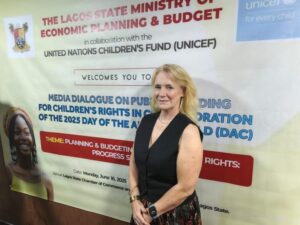
According to her, budget lines have expanded slightly over the years, but what matters is not what’s written on paper, it’s what reaches the child.
Lafoucriere pointed to persistent inefficiencies and the absence of disaggregated data as key reasons children continue to be left behind in crucial sectors like health, education, water, sanitation, and protection.
In reality, budget allocations for child-related services are often buried in bureaucratic complexity, leaving little room for transparency or impact.
“Without child-specific tracking, public investments are made in the dark,” Lafoucriere said. “The result is that children’s needs are routinely sidelined.”
This concern was also echoed by Mr. Olufemi Orojimi, Director of Budget at the Lagos State Ministry of Economic Planning & Budget. He highlighted how Lagos has attempted to change the narrative through the adoption of Program Code 916; a budgeting tool that explicitly monitors child-focused expenditure across ministries.
“We’ve moved away from the fragmented system of the past. Now, every naira allocated for children is followed to its destination,” he said.
Yet these efforts remain the exception, not the norm. Nationwide, child development continues to play second fiddle to other political and economic interests.
Meanwhile, Mr. Muhammad Okorie, UNICEF’s social policy specialist in Lagos, warned that investments in children, especially in early childhood development, yield the highest returns but remain underappreciated in Nigeria’s fiscal priorities.
“Investing early is not just social, it’s smart economics,”
Okorie maintained that child-sensitive budgeting must be nondiscriminatory and uphold children’s right to survival, education, and development.
“The federal government must lead with clear policy directions; states should intensify budget reforms; local governments must localise child spending, and civil society and the media must act as watchdogs,” he advised.
As the nation marks the Day of the African Child, it must also reckon with the haunting question: when will every Nigerian child finally count?