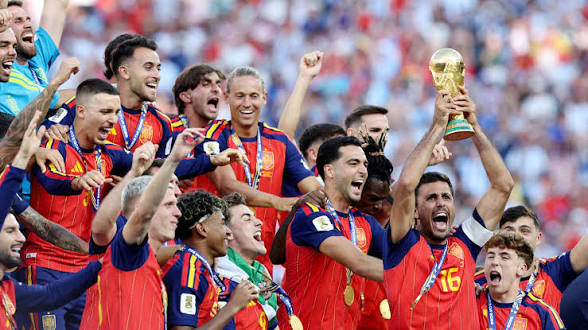

They are the gold standard of football – Spain.
Spain’s reign over world football is no longer a fleeting golden generation but one that has become a sustained era of excellence.
La Roja completed another chapter of their remarkable rise by defeating defending champions Argentina 1-0 in the 2026 FIFA World Cup final, confirming what many had suspected throughout the tournament: this is now the benchmark in international football.
Against an Argentina side renowned for its resilience and streetwise “dark arts,” Spain never abandoned their philosophy. They monopolised possession, controlled the tempo and eventually found the breakthrough through Ferran Torres, whose extra-time winner crowned a campaign built on technical brilliance, tactical intelligence and unwavering belief.

For Torres, the triumph belonged to an entire nation.
“I think in the end the goal came from 47 million people, not just those of us that are here. Today destiny was written; it was made for us to win. We’re far from our people today but we tried to be as close as possible to them.
“Finals are hard. When you have Messi on the opposing team you do get worried but we always backed ourselves and tried to show our football, and I think we managed to do it once again.”
One of the tournament’s defining images came after the final whistle.

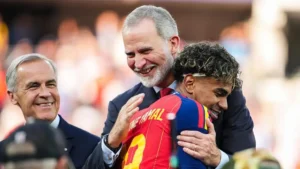
As Lionel Messi stood absorbing the applause of Argentina’s supporters—perhaps for the final time on football’s biggest stage, it was Spain’s teenage sensation Lamine Yamal who walked over to console him.
The embrace between Barcelona’s current number 10 and arguably the club’s greatest-ever number 10 felt like football history folding into itself.
Messi leaves the World Cup as one of the game’s greatest icons while Yamal appears ready to carry football into its next era.
The numbers already hint at something extraordinary.
The teenager has now remained unbeaten in all 28 competitive appearances for Spain and has won every one of the 13 major tournament matches he has started, the longest perfect record by any European player in major international competitions.
Spain’s latest success is no accident. Two years after lifting Euro 2024, they have now added the World Cup, mirroring their historic achievement of winning Euro 2008 before conquering the world in 2010.
But this generation has gone even further. Spain have become the first nation to simultaneously hold both the men’s and women’s World Cup titles after the women’s triumph over England in Sydney in 2023.
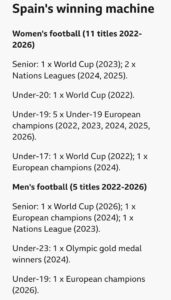
Their collection of honours is staggering:
● FIFA Men’s World Cup (2026)
● UEFA European Championship (2024)
● UEFA Nations League (2023)
● Olympic Gold Medal (2024)
● UEFA Women’s Nations League (2024, 2025)
● FIFA Women’s World Cup (2023)
Across all age groups, from Under-17 to senior level, Spain have captured 16 European and world titles in just five years, an unprecedented demonstration of footballing depth.
The De La Fuente Effect
When Luis de la Fuente replaced Luis Enrique following Spain’s disappointing exit to Morocco at the 2022 World Cup, many questioned the appointment.
He had never managed one of Europe’s elite clubs. Instead, he arrived after years developing Spain’s youth teams, understanding every layer of the country’s footballing identity.
His reward has been extraordinary. Within four years he has guided Spain to the Nations League, the European Championship and now the FIFA World Cup.
According to Spanish football expert Guillem Balagué, Spain simply trusted someone who understood the country’s footballing DNA.
Rather than revolutionising the system, De la Fuente refined it. He built a culture centred on patience, humility, tactical discipline and respect.
Before the final, the veteran coach revealed the mentality driving his players.
“Once we finished the game, there were footballers who said, ‘Coach, what else is there to win? We’ve won everything in every category.’
“We came to the conclusion that what remains is the next match in September because this team are relentless.”
That relentless mentality has become Spain’s greatest strength.
More Than Tiki-Taka
The Spain of 2026 are not simply recycling the possession football that defined Xavi, Andrés Iniesta and Sergio Busquets. They remain technically superior, but they are now quicker, more direct and considerably more flexible.
With Rodri orchestrating midfield, Nico Williams stretching defences, Pedri controlling rhythm, Yamal producing moments of magic and Ferran Torres delivering decisive goals, Spain possess perhaps the most complete squad in world football.
They dominate possession without becoming predictable.
They attack without sacrificing control.
And unlike previous Spanish teams, they have added physicality and defensive resilience to their technical brilliance.
Football’s New Standard
The success of Spain’s national teams has mirrored the continued influence of Spanish coaching across European club football, reinforcing the country’s reputation as football’s most sophisticated development system.
What began with youth development has evolved into complete institutional dominance.
Spain are not merely winning tournaments. They are setting the tactical, technical and cultural standards by which international football is now judged.
With a new generation led by Lamine Yamal already flourishing, the rest of the football world faces an uncomfortable reality.
Spain are no longer chasing greatness.