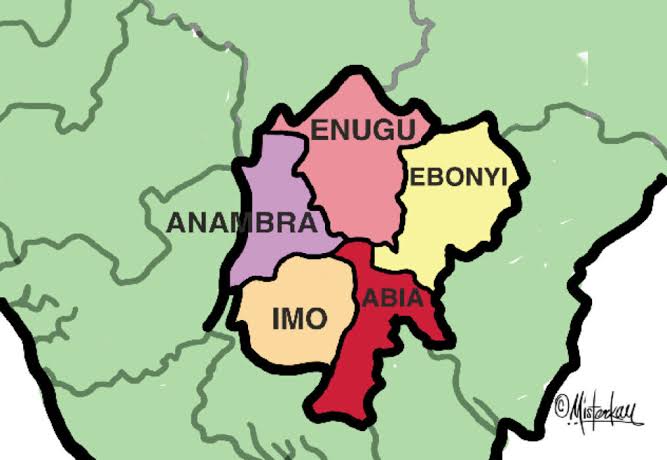

Abia was a bottom ranked State before now but thanks to Alex “LeeKwangYu” Otti, things have seemingly turned a corner.

The South-East state has emerged as Nigeria’s most improved state in the 2025 State Performance Index (pSPI), recording a dramatic rise of 26 places to secure 10th position nationally. The achievement marks one of the most significant turnarounds in recent assessments of subnational governance and development performance.
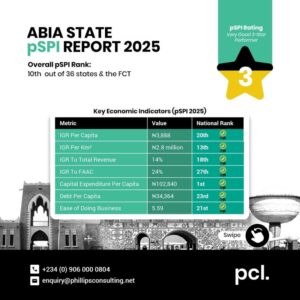
Released by Phillips Consulting, the latest index paints a picture of shifting fortunes across Nigeria’s states, rewarding those that have demonstrated stronger outcomes in governance, fiscal management, service delivery and economic performance.
For Abia, the recognition represents a remarkable transformation. Just a year earlier, the state occupied 36th position in the 2024 rankings. Its leap into the national top ten stands as the largest upward movement recorded in the 2025 assessment.
The improvement has inevitably drawn attention to the state’s ongoing efforts to reposition governance, infrastructure and public service delivery, particularly at a time when citizens increasingly demand measurable results rather than political promises.
While Abia emerged as the biggest mover, Lagos State retained its position as Nigeria’s best-performing state for the second consecutive year.
The commercial hub continued to dominate the rankings due to its strong performance across key indicators measuring governance effectiveness, economic vitality, public service delivery and institutional capacity.
Joining Lagos at the top were Ogun State in second place and Kaduna State in third.
Perhaps equally noteworthy were the impressive gains made by Adamawa State and Niger State. Adamawa climbed from 26th place in 2024 to fourth position, while Niger surged from 29th to fifth, making both states standout performers in this year’s assessment.

The remaining positions in the top ten were occupied by Nasarawa State, Gombe State, Jigawa State, Plateau State and Abia.
Winners and Losers
The latest rankings also reveal that progress is not guaranteed.
Some states that previously occupied enviable positions experienced sharp declines. Among the most dramatic was Bayelsa State, which dropped from sixth position in 2024 to 29th place.
Similarly, Kano State fell from seventh to 30th position, highlighting how rapidly performance assessments can change when governance indicators are measured more rigorously.
According to Phillips Consulting, part of the movement reflects methodological adjustments introduced in the 2025 edition of the index.
The revised framework places greater emphasis on measurable outcomes, transparency, fiscal sustainability, governance effectiveness, service delivery and economic performance rather than broad policy intentions.
In essence, states are increasingly being assessed not on what they promise to do, but on what they can demonstrably show they have achieved.
Phillips Consulting insists that the State Performance Index is not merely a league table designed to celebrate winners and shame laggards.
Rather, the firm describes it as a governance diagnostic tool intended to help policymakers identify weaknesses, replicate successful strategies and implement reforms that improve citizens’ quality of life.
“The pSPI is not merely a ranking exercise; it is a strategic tool for diagnosing performance gaps, identifying best practices, and guiding reforms that improve citizens’ quality of life,” the report noted.
That philosophy reflects a broader trend in public administration where governance assessments increasingly focus on outcomes, accountability and citizen experience rather than political rhetoric.
What is certain, however, is that the 2025 rankings have redrawn the map of state performance in Nigeria, proving that today’s underperformer can become tomorrow’s success story and that governance, when properly measured, remains one of the most powerful determinants of development.
Where is Ekiti?