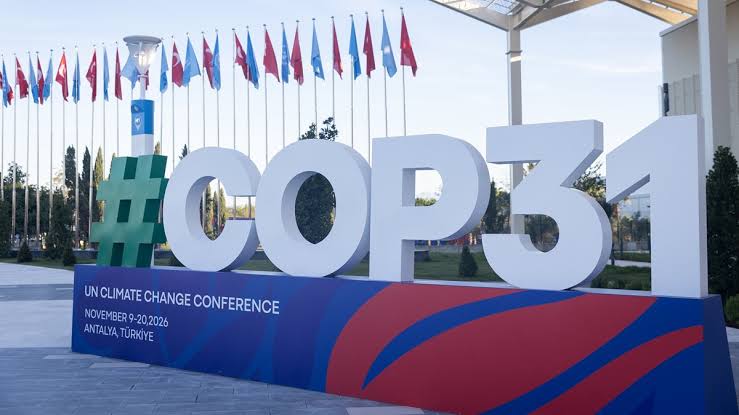
Is the World Reaching a Melting Point? COP31 Confronts the Cost of a Warming Planet

The warning from the President of the Marshall Islands, Hilda Heine, captures the urgency of the moment. Addressing world leaders on Wednesday, she said failure to mount an overwhelming response to the climate crisis could mean the end of the world as vulnerable island communities know it.
Heine warned that exceeding the 1.5 degrees Celsius temperature threshold set under the Paris Agreement would expose her country and other low-lying island nations to worsening coastal erosion, rising seas and floods capable of destroying homes, schools and hospitals.
She recalled witnessing the devastating speed of ecological change in her home country, describing how coral reefs that appeared bright and healthy beneath the water in July had turned white just months later.
“It’s time to wake up,” she told delegates. “Our response to the threat of overshoot must be overwhelming, or the world we know is over.”
Her warning reflects the growing concern among climate-vulnerable countries that the international community is failing to match the scale of the crisis with the speed and resources required to address it.
The 1.5°C target and the cost of inaction
The 1.5°C threshold has become one of the defining benchmarks of international climate negotiations since the adoption of the Paris Agreement in 2015.
The agreement seeks to hold the increase in global average temperatures to well below 2°C above pre-industrial levels while pursuing efforts to limit the rise to 1.5°C.
However, current global emissions trajectories suggest that the world is falling short of that ambition.
Barbados Prime Minister Mia Mottley criticised governments for failing to do enough to reduce emissions since the Paris Agreement was adopted.
She cited United Nations projections indicating that even if countries fulfil their existing climate pledges, global warming could reach approximately 2.6°C. Under current policies, the figure could rise to 2.8°C.
Mottley described the prospect of temperature overshoot as a debt being transferred to future generations.
“Overshoot is not a new target. It is a debt, a debt of heat, borrowed against our children’s future. And it must be repaid,” she said.
The distinction is important. A temporary rise above 1.5°C does not mean the world has permanently abandoned efforts to limit warming. However, every additional fraction of a degree increases the risks of more severe heatwaves, ecosystem destruction, water stress and extreme weather.
For countries with limited resources to adapt, the consequences could be particularly devastating.
Glaciers, coral reefs and the disappearing natural barriers
One of the most visible consequences of rising global temperatures is the accelerated melting of glaciers and ice sheets.
Glaciers act as important freshwater reserves, supporting rivers, agriculture and communities across several regions. Their retreat threatens water availability, increases the risk of glacial lake outburst floods and contributes to rising sea levels.
The loss of ice from Greenland and Antarctica also adds to the volume of water entering the oceans, increasing the long-term threat to coastal settlements and island nations.
Coral reefs face a different but equally serious threat. Rising ocean temperatures can trigger coral bleaching, a process in which corals expel the algae that provide much of their colour and energy.
Although some corals can recover if temperatures fall and conditions improve, prolonged or repeated heat stress can cause widespread mortality.
For the Marshall Islands, where communities depend on coastal ecosystems for food, livelihoods and protection against waves, the deterioration of coral reefs is more than an environmental concern. It threatens the foundations of everyday life.
Fossil fuels remain at the centre of the argument
United Nations Secretary-General António Guterres used his address at COP31 to criticise governments that continue expanding fossil fuel production while publicly committing to the 1.5°C goal.
He accused sections of the fossil fuel industry of distorting scientific evidence and delaying climate action, calling for a faster transition away from coal, oil and gas.
“Fossil fuels must go the way of the dinosaurs,” Guterres said, arguing that governments must take stronger action to end dependence on polluting energy sources.
He also called for a windfall tax on exceptional profits earned by oil and gas companies during the Iran war, with the proceeds directed towards helping vulnerable countries recover from climate-related disasters.
His intervention comes amid continuing disagreements over how quickly countries should phase out fossil fuels, particularly as many developing economies argue that they still need affordable and reliable energy to support industrialisation and development.
The debate is complicated by the fact that some countries making strong climate commitments remain major producers and exporters of fossil fuels.
Türkiye’s President, Recep Tayyip Erdoğan, called for COP31 to become a turning point in global climate action. Yet his address came days after he celebrated the discovery of two new oilfields with an estimated in-situ potential of 135 million barrels.
Marshall Islands President Heine warned against celebrating new fossil fuel discoveries, arguing that every additional oil well and coal extraction project poses a threat to vulnerable communities.
Australian Prime Minister Anthony Albanese also described the summit as a historic moment for his country, although Australia remains one of the world’s major coal and liquefied natural gas exporters.
His failure to mention fossil fuels directly in his speech drew criticism.
A climate summit without some of the world’s biggest powers
Despite the urgency of the discussions, the gathering of world leaders has been relatively limited.
According to the United Nations, 91 national leaders attended the summit. Notable absentees included United States President Donald Trump and Chinese President Xi Jinping.
The absence of major political and economic powers raises questions about the ability of the negotiations to secure commitments that reflect the scale of global emissions and the resources required for climate action.
Scientists and climate campaigners have also expressed concern that the negotiations may fail to deliver further progress on phasing out fossil fuels.
Bill Hare, a climate scientist and chief executive of Climate Analytics, described growing anxiety among researchers studying tropical forests and the cryosphere, the frozen parts of the Earth system.
He said conversations within the scientific community suggested that confidence in the direction of international climate action was weakening.
The concern is that while climate impacts are accelerating, political commitments and financing arrangements are not advancing at the same pace.
The $88m push to protect tropical forests
Amid the difficult negotiations, a coalition of philanthropic organisations has pledged $88m to the Tropical Forest Forever Facility (TFFF), a financing mechanism designed to provide long-term funding for countries that protect their tropical forests.
The commitment was announced at the World Leaders’ Summit on Forests during COP31 in Antalya.
The facility is seeking to raise $10bn in sponsor capital by the end of 2026. Its model is designed to generate sustained financial support for countries that conserve tropical forests, recognising their importance in storing carbon, regulating rainfall and protecting biodiversity.
The coalition includes the Bacon Foundation, Children’s Investment Fund Foundation, Conservation International, David and Lucile Packard Foundation, Gordon and Betty Moore Foundation, Minderoo Foundation, Quadrature Charitable Foundation, The Nature Conservancy and a private family office.
The contribution is expected to support the facility’s sponsor tranche, which forms part of the capital base used to generate long-term financing.
The initiative offers another approach to climate finance: rewarding countries for protecting ecosystems that provide benefits extending far beyond their national borders.
However, its eventual impact will depend on how the funding is mobilised, distributed and monitored, as well as whether forest-protecting countries receive reliable and sufficient payments.
Is the world reaching a melting point?
The warnings from COP31 point to a climate crisis that is no longer confined to scientific projections or distant environmental concerns.
For island nations, rising seas are already threatening homes and infrastructure. For communities dependent on glaciers, changing ice patterns could undermine water security. For coastal populations, coral bleaching and ocean warming threaten livelihoods and natural protection.
Extreme heat, wildfires, droughts and flooding are also exposing the economic and social costs of a warming planet.
Yet the challenge extends beyond reducing emissions. Countries must also invest in adaptation, disaster preparedness, resilient infrastructure, sustainable agriculture and accessible climate finance.
Developing nations, many of which have contributed relatively little to historical greenhouse gas emissions, continue to demand greater financial support from wealthier countries to manage climate impacts and transition towards cleaner energy systems.
The central question at COP31 is whether governments can turn repeated warnings into measurable action.
The world may not have reached an irreversible melting point, but the window for limiting the most dangerous consequences of global warming is narrowing.