
Nearly a decade ago, I wrote about the gradual drift from Ọmọlúwàbí to Owónikókó. I warned my Yoruba compatriots that the foundational ethos of good character must not be sacrificed in the pursuit of wealth. I did not mean that money is evil. I meant that a people who trade character for cash destroy the moral foundation on which enduring prosperity must stand.
Yet, as time passes and the arrogance of the wealthy grows louder, I sometimes feel tempted to reconsider that warning. Economic hardship exerts enormous pressure. Rent is due, school fees remain unpaid, hospital bills accumulate, and inherited property may appear to be the only available lifeline. Under such conditions, honour can begin to look like a luxury and compromise like common sense. The broad road appears reasonable.
How many family compounds have been sold? How many ancestral lands have been signed away? How many heirlooms, names, stories, and sacred trusts have been exchanged for a brief season of comfort? How many people have swallowed their convictions in pursuit of contracts, appointments, favours, or social acceptance?
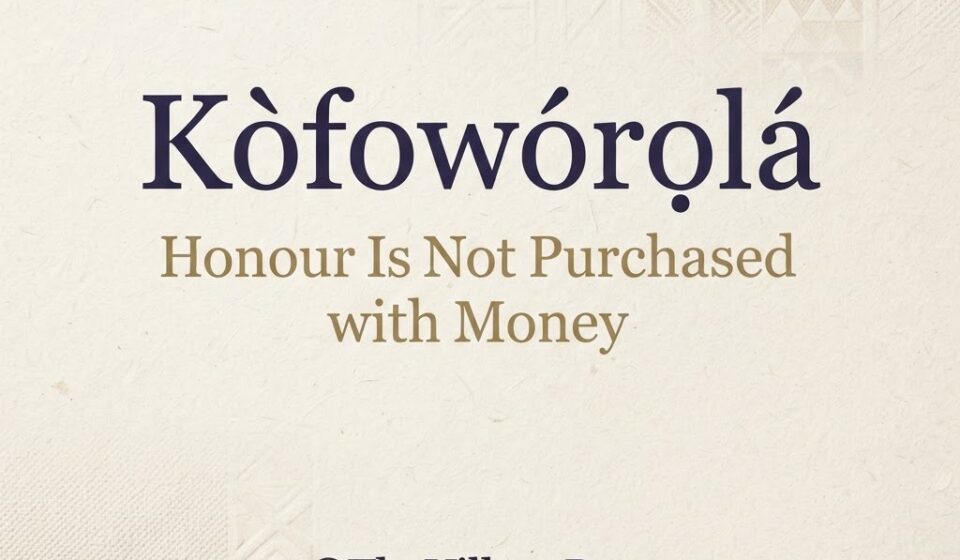
The pressure is real, but not everything can be priced. Kòfowórọlá, beyond its use as a personal name, calls our attention to a kind of goodwill that no amount of money can buy. In accounting, goodwill is an intangible asset: valuable, yet vulnerable to impairment. In society, honour functions similarly. It grows through trust, consistency, service, and worthy conduct, but it can be destroyed by greed, deception, scandal, and betrayal.
I therefore return to my earlier position: we must preserve the collective ethos of Ọmọlúwàbí, even when doing so is costly. At the same time, we must resist the financial pressures that drive families to surrender their inherited assets for immediate relief. Not everything can be priced.
Among the Yoruba, names are not mere labels. They are compressed arguments, prayers, memories, and moral instructions. Kòfowórọlá is one such argument. It reminds us that honour is not a commodity to be ordered, auctioned, or automatically inherited. It is earned through conduct, inherited as the legacy of worthy living, or bestowed by a community that has observed a person over time and found that person worthy of trust. It is social capital of the highest order. Once earned, it must be guarded, sustained, and passed on, because when it is lost, it is rarely recovered in full.
Ecclesiastes observes that “money answereth all things,” yet experience teaches that there are doors money cannot open. Money can pay for a house, but it cannot make a home. It can buy a title, but it cannot buy the quiet reverence of a community. It can purchase applause, but it cannot purchase esteem. It can command compliance, but it cannot command trust. At the gate of true respect, money may knock and not be heard. At the door of legacy, money may arrive and be turned away. Honour is the key.
This is not an argument against making money. Poverty is not a virtue; it is a wound. It strips people of dignity, limits their choices, and forces compromises that no one should have to make. Legitimately earned money can confer honour because there is dignity in genuine labour. Wealth built through patience, skill, service, innovation, and honest trade is not Owónikókó in its negative sense. It is a blessing that can be used to serve.
The problem is not money itself but the worship of money. When money becomes the chief end of life, it turns from servant to master. It demands sacrifices that no human being should make: truth, friendship, family, faith, and self-respect.
Yoruba philosophy reminds us that Àlejò l’ówó: money is a visitor. It comes and goes. It may spend the night, but it does not belong to the household forever. Honour, by contrast, is not a visitor. It is a member of the family. It sits at the table, carries the family name, and speaks for the dead and the unborn. That is why we say, A kì í fi owó ra iyì: honour, dignity, and respect cannot be bought with money. Pursue wealth, but do so legitimately, because honour is earned, not purchased.
When a society reverses this order, the consequences are severe. Public offices become markets. Justice goes to the highest bidder. Traditional titles are sold to the largest donor. Family lands are exchanged for immediate cash. Young people learn that character is for fools and that wealth is the only proof of worth. Fraud is celebrated as cleverness. Corruption is defended as politics. Ritual killing is contemplated as a shortcut.
The result is not development but decay. Trust collapses. Institutions weaken. Future generations inherit suspicion, cynicism, and a diminished name. We lose not only what our ancestors left us but also the moral capital that would have enabled us to build something better.
What, then, must we do? Individuals must first decide that honour is non-negotiable. Some doors should remain closed even if money can open them. Families must treat their name as an asset and teach their children that a good name is better than silver and gold. A family name is a trust held on behalf of those not yet born.
Leaders and institutions must reward integrity. A society that promotes only the wealthy, regardless of how they acquired their wealth, teaches its young to worship the wrong god. Communities must celebrate legitimate success: those who build quietly, pay their debts, treat workers fairly, preserve inherited trusts, and serve without constantly seeking applause. Those who possess wealth must use it to create honour rather than attempt to replace honour with it. Philanthropy, scholarships, mentorship, fair employment, and the preservation of heritage are ways of converting money into lasting goodwill.
I therefore return to my earlier position, not as a naïve traditionalist but as a realist. The detour I was tempted to consider is a trap. It promises quick relief but delivers lasting shame. The narrow path of Ọmọlúwàbí may be difficult, but it leads to life, legacy, and a name that cannot be bought.
Kòfowórọlá. Honour is not purchased with money. It is earned, guarded, and passed on. Money can answer many things, but it cannot answer for you when your name is called. Let yours be a name that answers with dignity.
©TheVillageBoy.
(The figure man who loves alphabets)