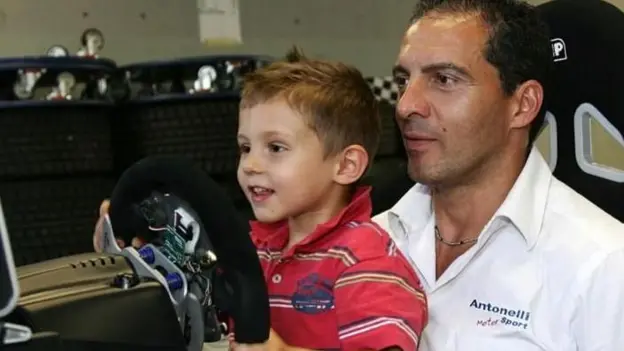

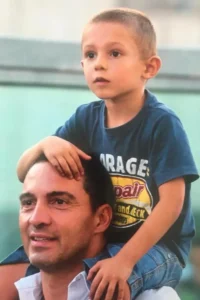
 Long before Kimi Antonelli became one of Formula 1’s brightest young stars, he was a little boy sitting on his father’s lap, learning the language of speed from inside a racing garage.
Today, at just 19, Antonelli is dominating the 2026 Formula 1 championship. But behind the poles, victories and growing reputation is a story deeply rooted in family, sacrifice, setbacks and a father who recognised something extraordinary in his son long before the rest of the world did.
Marco Antonelli first suspected Kimi had an exceptional talent when the boy was just 10.
As per BBC, yhe pair were at the Adria circuit in north-eastern Italy. Marco, a former racing driver, was there with his Lamborghini sports car team, while Kimi had been competing in a karting race.
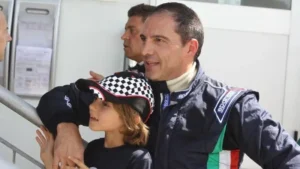
At the end of the day, Marco asked his son a simple question: did he want to try the Lamborghini? Kimi, naturally, said yes.
Marco strapped both of them into the car. He controlled the accelerator and brakes while Kimi took responsibility for steering and gear changes.
What happened next left his father stunned.
As the Lamborghini accelerated towards the end of the straight, Marco pushed the car to around 320km/h before braking hard. The car began to oversteer, but Kimi calmly controlled it.
“He controlled the oversteer perfectly,” Marco recalled.
When Marco later watched a video of the run, he saw something he could not ignore.
His 10-year-old son had demonstrated remarkable car control, instinct and composure.
“I said: ‘Maybe he has something special.’”
Kimi’s relationship with motorsport began almost from birth. Marco jokes that his son was “born in a garage”. From the age of just 15 days, Kimi was around racing cars, surrounded by the noise of engines and the smell of exhaust.
When he was about three, Marco brought home a racing simulator during the Christmas holidays. Kimi quickly became fascinated.
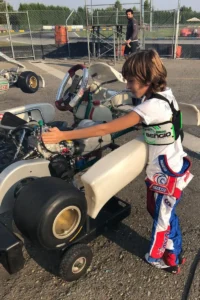
Every evening, he wanted to drive. Just as he would later do in the Lamborghini, Kimi sat on his father’s lap while the controls were divided between them.
On one occasion, Marco was so exhausted after work that he began falling asleep while they were driving. They crashed because he failed to brake.
Kimi’s response was revealing. “Dad, dad, no sleep, no sleep. I have to drive,” he told him.
The passion was already unmistakable.
Ironically, Marco was initially reluctant to see his son pursue professional motorsport.
He knew how unforgiving the sport could be because he had experienced it himself.
During the 1990s, Marco was close to securing a works drive in the highly competitive DTM touring car series. He tested for Alfa Romeo, but a change in the team’s management ended the opportunity.
Another chance emerged with BMW, alongside established stars such as Roberto Ravaglia and Steve Soper. Again, circumstances beyond his control prevented the deal from materialising.
The disappointment stayed with him.
“I suffered a lot for it,” he said. Marco therefore feared that Kimi might experience the same frustrations.
But by the time Kimi was five, it was becoming increasingly difficult to ignore his talent.
He began karting and immediately displayed an unusual understanding of racing lines, braking points and car control.
The Antonellis were, as Marco describes them, a normal family. They did not have the enormous financial resources required to fund every stage of a young driver’s journey to Formula 1.
Marco decided he could support Kimi through karting and perhaps one season in Formula 4. After that, he imagined his son might join one of his GT racing programmes.
But Kimi kept winning.
By the time Kimi was 11, his name had begun circulating among people in international motorsport. Mercedes took notice.
Gwen Lagrue, a scout for the Mercedes driver development programme, travelled to Italy to watch him.
Kimi was competing in a kart that had less power than those of many of his rivals. Marco had deliberately encouraged him to focus less on the result and more on improving his driving. Lagrue was impressed.
Mercedes eventually brought Kimi into its young-driver programme, changing the family’s circumstances and giving the teenager access to the resources needed to pursue a professional career.
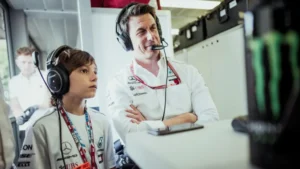
Mercedes team principal Toto Wolff was also watching. At just 11, Kimi had already been identified as a potential future Formula 1 driver.
Four-time world champion Max Verstappen was among those who noticed his talent.
“When he was in karting, you could already see he was one of the stand-out talents,” Verstappen said.
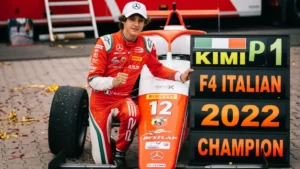
Kimi’s progression was rapid. At 15, he moved into cars after dominating karting. He then swept through Formula 4 in 2022 and continued his winning run in Formula Regional in 2023.
The question was no longer whether Kimi was talented. It was whether he was ready for Formula 1.
The opportunity arrived sooner than expected.
When Lewis Hamilton decided to leave Mercedes for Ferrari, Wolff had to identify his replacement.
The team considered its options and ultimately chose Antonelli, despite the enormous risk involved.
Kimi had not even driven a Formula 1 car when Mercedes made the decision. Marco remembers receiving a phone call from Wolff.
“We put Kimi in Formula 1. What do you think?” Marco was excited but cautious.
“Of course I’m happy that you think about Kimi but are you sure he’s ready?”
Mercedes then designed an extensive testing programme for the teenager, giving him more than 20 days in older Formula 1 cars at circuits around the world. The results impressed the engineers.
Andrew Shovlin, Mercedes’ trackside engineering director, said what stood out was how quickly Kimi adapted. After only a few runs, Antonelli was already approaching the limit.
His car control was equally impressive. He could feel the car beginning to break away and control it without immediately losing it.
His mistakes, Shovlin observed, were generally caused by judgement or lack of experience rather than a lack of driving ability.
Antonelli’s first official Formula 1 weekend came at his home Italian Grand Prix at Monza in 2024. His debut was spectacular for all the wrong reasons. He set the fastest time on his opening lap before going even faster on his next attempt.
Then he crashed heavily at the final corner.
It was an error of judgement, not a lack of talent. Toto Wolff reassured him, but the incident left a psychological mark.
The pressure of being labelled Mercedes’ next great hope began to weigh on him.
His rookie season produced flashes of brilliance. He out-qualified teammate George Russell on the high-speed Jeddah street circuit and took pole position for the sprint in Miami. But there were also difficult stretches.
A change to the rear suspension made the Mercedes more difficult to drive, while Antonelli’s confidence appeared to suffer. Mistakes increased and his pace became inconsistent. Mercedes had expected more.
Wolff later described a nine-race period that was particularly difficult.
Then came another crash at Monza. This time, Wolff confronted him directly.
“Kimi, you’ve got to turn this around. This is just not good enough.” Antonelli knew it.
“I know,” he replied.
Marco and Kimi spoke extensively during the difficult period. The younger Antonelli gradually understood that a bad period did not have to define his career. He began rebuilding his confidence.
By the end of the season, Mercedes engineers were seeing encouraging signs.
The driver who had struggled under pressure was beginning to understand how to manage it. Then came 2026.
And everything changed. Antonelli has taken the championship by storm, establishing himself as Mercedes’ leading driver and one of the most formidable competitors on the grid.
After 11 races, he has six pole positions and six victories and leads the championship by 50 points.
His transformation has surprised even those who believed in him from the beginning.
Wolff admits that Mercedes expected progress, but not necessarily the level of dominance Antonelli has produced.
The difference, he believes, is experience. Kimi now knows the circuits. He understands the pressure. He understands what it means to perform under intense media attention.
Most importantly, his confidence has grown without turning into entitlement. Marco sees the current success as part of a pattern that has followed his son throughout his career. Kimi has faced difficult starts before and found a way to turn them around.
“In F4 and Freca, he started with not good results, and he was able to remake everything and, at the end, work hard and win the championship,” Marco said.
“I don’t know what the spark is in his brain, but Kimi in the past did the same.”
For Verstappen, there was never much doubt that Antonelli would make a significant leap forward after his rookie season.
For Mercedes, the gamble is beginning to look inspired.
For Marco, however, the story is much simpler.
He has watched his son grow from a three-year-old who refused to let his father fall asleep behind the wheel into a Formula 1 championship leader.
Kimi himself has described his father as his “rock”.
And perhaps that is the most important part of the story.
Before Mercedes, before Formula 1, before the trophies and the championship points, there was a father who took his son to the garage, put him on his lap and let him discover speed.


