The World’s Deepest Places: Five Ocean Depths That Push the Limits of Exploration

They humans have only explored 5 percent of the world’s oceans depth. Isn’t that something?
Far beneath the ocean surface, beyond the reach of sunlight and ordinary submarines, lies a world of extraordinary pressure, near-freezing temperatures and landscapes that remain largely unexplored.
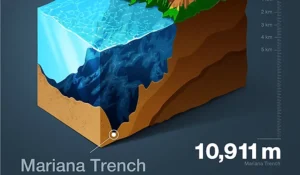
The deepest known point on Earth is Challenger Deep, located within the Mariana Trench in the Pacific Ocean. It plunges roughly seven miles below sea level, where pressure exceeds 1,000 times that experienced at the surface.
But Challenger Deep is only one of several extraordinary places hidden in the deepest parts of the world’s five oceans.
Each ocean has its own extreme low point. Some were accurately mapped only in recent years, while others have been visited by only a handful of people. Together, they offer a glimpse into one of Earth’s least understood environments.
1. Pacific Ocean — Challenger Deep
The Pacific Ocean is home to the deepest known point on Earth.
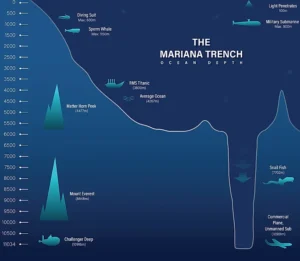
Challenger Deep located within the Mariana Trench, reaches approximately 35,876 feet (10,935 metres) below sea level.
The Mariana Trench was formed where the Pacific Plate bends and sinks beneath the Mariana Plate. As the older and denser oceanic crust descends into Earth’s mantle, it pulls the seafloor downward, creating a vast underwater trench stretching more than 1,500 miles.
Challenger Deep sits near the southern end of the trench and consists of several deep basins separated by underwater ridges.
Its scale is difficult to imagine. If Mount Everest were placed at the bottom, its summit would still be submerged beneath more than a mile of water.
The pressure at the bottom is more than 1,000 times atmospheric pressure at sea level, enough to destroy equipment not specifically designed for extreme-depth exploration.
The first humans to reach Challenger Deep were Swiss oceanographer Jacques Piccard and United States Navy Lieutenant Don Walsh, who descended in the bathyscaphe Trieste in 1960.
Filmmaker James Cameron made a solo descent in 2012, while explorer Victor Vescovo and the Five Deeps Expedition conducted further crewed dives in 2019.
Although Challenger Deep itself lies southwest of Guam, parts of the wider Mariana Trench and surrounding underwater features are protected under the Mariana Trench Marine National Monument.
2. Atlantic Ocean — Brownson Deep
The deepest point in the Atlantic Ocean lies within the Puerto Rico Trench, north of the Caribbean.
At Brownson Deep, the seafloor drops to approximately 27,480 feet (8,378 metres) below sea level.
The Puerto Rico Trench extends for roughly 500 miles along the boundary between the Caribbean Sea and the Atlantic Ocean. The region exists along a complex tectonic boundary involving the North American and Caribbean plates, where movement has fractured and deformed the seafloor.
There has historically been some confusion over the name of the Atlantic’s deepest point. Brownson Deep generally refers to the broad, flat-bottomed basin, while Milwaukee Deep has also been used to describe the deepest area. Because the two locations are not clearly separated by a physical barrier, some sources use the names interchangeably.
In December 2018, American explorer Victor Vescovo became the first person to reach the deepest known point of the Atlantic Ocean, descending aboard the two-person submersible Limiting Factor.
The trench is not only extraordinarily deep but also situated in a geologically active region vulnerable to earthquakes and tsunamis.
3. Indian Ocean — Java Trench
For years, scientists disagreed about where the Indian Ocean reached its greatest depth.
Some measurements pointed to the Java Trench, south of Indonesia, while others suggested the Diamantina Fracture Zone off Western Australia.
The Five Deeps Expedition surveyed both areas in 2019 and determined that the deepest point lies in the Java Trench.
An unnamed depression there reaches approximately 23,579 feet (7,187 metres) below sea level.
Also known as the Sunda Trench, the Java Trench stretches along the southern edge of Indonesia. It was formed as the Indo-Australian Plate moves beneath the Sunda Plate, forcing the seafloor downward.
The same tectonic system extends toward Sumatra and was responsible for the enormous undersea earthquake that triggered the devastating 2004 Indian Ocean tsunami.
Vescovo reached the Indian Ocean’s deepest known point in April 2019. Cameras recorded snailfish and other organisms living in complete darkness, demonstrating that even extreme pressure and the absence of sunlight do not make these depths lifeless.
Unlike Challenger Deep and several other famous ocean depths, the Indian Ocean’s deepest point does not have a widely accepted individual name and is primarily identified by its location within the Java Trench.
4. Southern Ocean — Factorian Deep
The Southern Ocean’s deepest point is Factorian Deep, located within the South Sandwich Trench in the remote waters between South America and Antarctica.
It reaches approximately 24,383 feet (7,432 metres) below sea level.
Determining the precise location of the Southern Ocean’s deepest point was complicated by the boundaries used to distinguish the Southern Ocean from the Atlantic.
Modern multibeam sonar surveys conducted during the Five Deeps Expedition helped establish Factorian Deep as the deepest known point south of the 60th parallel.
The South Sandwich Trench was created by subduction, with one tectonic plate being forced beneath another. The resulting hadal zone contains some of the coldest seawater on Earth.
Despite temperatures hovering around freezing, the extreme salinity of seawater allows it to remain liquid under conditions where freshwater would freeze.
In February 2019, Vescovo completed the first crewed descent to Factorian Deep aboard Limiting Factor. The site was named after the submersible, following the expedition’s practice of associating newly explored deep-sea locations with the vessels involved in their exploration.
5. Arctic Ocean — Molloy Deep
The Arctic Ocean’s deepest point is Molloy Deep, also known as the Molloy Hole, located in the Fram Strait between Greenland and Norway’s Svalbard archipelago.
At approximately 18,209 feet (5,550 metres) below sea level, it is the shallowest of the five deepest ocean points, but it is still more than three miles beneath the surface.
Unlike the other major oceanic deeps, Molloy Deep was not created by a conventional long subduction trench.
It lies in a tectonically active region near the Molloy Ridge and Molloy Fracture Zone, where movements in Earth’s crust have helped create an isolated basin.
The surrounding Fram Strait is particularly important because it provides the principal deep-water connection between the Arctic and Atlantic oceans, allowing water to move between the two.
Vescovo reached Molloy Deep in August 2019, completing the Five Deeps Expedition.
The descent presented unique challenges, including freezing temperatures, severe weather, remoteness and the proximity of Arctic sea ice.
Why Are These Depths So Difficult to Measure?
Determining the depth of an ocean trench is far more complicated than simply measuring the distance from the surface to the seafloor.
Scientists commonly use sonar, which calculates depth by measuring how long sound takes to travel through the water and return from the seafloor.
But sound does not travel through water at a constant speed. Temperature, pressure and salinity all affect its movement.
Researchers must therefore account for conditions throughout the water column. Tides, waves, ship movement and instrument calibration can also influence measurements.
Submersibles use pressure sensors during dives, but these measurements also require corrections based on water density and atmospheric pressure.
There is another major problem: scientists have not mapped every section of the deep ocean in high resolution.
A trench can contain several depressions separated by underwater ridges. A survey ship travelling along one route could therefore miss a deeper depression just a few kilometres away.
Modern multibeam sonar systems are helping researchers build increasingly detailed three-dimensional maps of the seafloor, raising the possibility that future surveys could identify deeper points that have not yet been discovered.
Knowing the location of the deepest points in the five oceans does not mean scientists fully understand them.
Only a very small number of people have physically visited these environments, while even sophisticated expeditions can examine only tiny portions of the enormous deep-sea landscape.
The depths are almost completely dark, intensely pressurised and often extremely cold. Yet life exists there, adapted to conditions that would be impossible for most surface organisms to tolerate.
From Challenger Deep in the Pacific to Molloy Deep in the Arctic, these locations represent some of Earth’s most extreme environments—and some of its last great frontiers.
As sonar technology improves and submersibles become more capable, scientists will undoubtedly discover more about the world beneath the waves.
For now, the deepest ocean remains a reminder that much of our own planet is still unexplored.