Scientists Create ‘Optical Tornadoes’ in Breakthrough for Next-Generation Photonics

Researchers from University of Warsaw, Military University of Technology, and Institut Pascal CNRS at Université Clermont Auvergne have developed a novel way to generate swirling beams of light, described as “optical tornadoes” within a small structure.

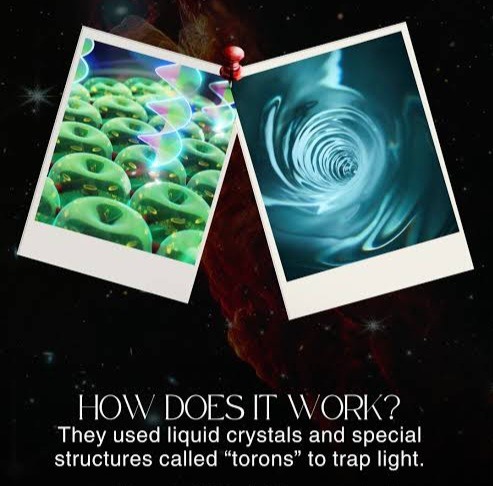
According to an article, The team succeeded in producing these miniature whirlwinds of light using an unexpectedly simple approach based on liquid crystals. Unlike conventional methods that depend on sophisticated nanotechnology, the researchers harnessed self-organising formations known as torons to trap and manipulate light, causing it to twist and rotate in complex patterns.
The Lead researcher, Marcin Muszyński explained that the phenomenon resembles an optical vortex. According to him, the light wave spirals around its axis, with its phase shifting in a helical pattern. Even its polarisation, the direction in which the electric field oscillates, undergoes a corresponding rotation.
Such structured light states are considered highly valuable in emerging fields like quantum communication and the manipulation of microscopic particles. However, their production has traditionally required either intricate nanostructures or large-scale experimental systems, limiting their practical application.
The breakthrough lies in the use of liquid crystals embedded with microscopic defects called torons. These formations, described by researcher Mędrzycka as tightly wound spirals akin to DNA, can be shaped into closed loops resembling doughnuts. Within these loops, light becomes confined and guided.
To enhance the effect, the scientists placed the torons inside an optical microcavity, a mirrored structure that repeatedly reflects light, allowing it to remain trapped for longer durations. This confinement significantly amplifies the intensity of the light field.
Crucially, the researchers demonstrated that the properties of the trapped light can be controlled externally. By applying an electric voltage, they were able to adjust the size of the toron “trap,” thereby influencing how the light behaves within it.
“This approach shows that complex light structures do not necessarily require complex fabrication techniques,” said Wiktor Piecek. “By relying on self-organising materials, we open the door to simpler and more scalable photonic devices.”
The discovery offers promising implications for the future of optical communication systems and quantum technologies, where compact and efficient light sources are essential. It also signals a shift toward more accessible methods of engineering advanced photonic systems, potentially accelerating innovation in the field.