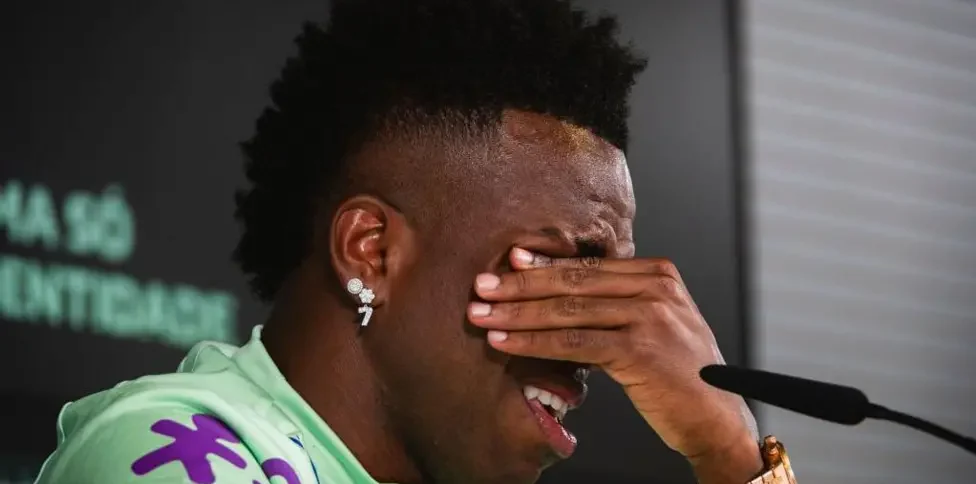

Vini, why him always?
Its a simply question that exposes a major Achilles heel in football – Racism. For all its worth Vinicius is not the only black player in the world, but he seems to carry much of the weight of ‘slurs’ hurled at footballers whose racial coloura differ from those who see themselves as gods on the pitch.

The goal was extraordinary. Controlling a difficult pass on the edge of the area, Vinicius Junior shifted his weight, wrong-footed two, and dispatched the ball into the net with the casual precision that marks the game’s true artists. For a moment, the Estadio da Luz fell silent. For a moment, football was simply football.
Then the moment passed. Within minutes, the Champions League play-off first leg between Benfica and Real Madrid had been halted for ten minutes, players leaving the pitch, the referee surrounded by protesting figures, and Vinicius again at the centre of something no player should ever have to experience.
The allegation is straightforward: Benfica’s Argentine midfielder Gianluca Prestianni, twenty years old, allegedly called Vinicius a monkey. Prestianni denies it, having covered his mouth with his shirt as he appeared to speak. His teammate Florentino Luis backed him publicly. But Vinicius’s teammates, particularly Kylian Mbappe, insist they heard the term used multiple times.
Another match. Another allegation. Another pause. Another investigation that may or may not produce consequences.
This is the twentieth such incident involving Vinicius since his arrival in Europe. Twenty times he has been subjected to racist abuse, most often in Spain, most often with cameras rolling and officials watching and the football world tutting before moving on to the next fixture. Twenty times he has been expected to absorb, to endure, to continue performing at the highest level while carrying a burden no athlete should carry.
The question follows like a shadow. Why always Vini?
Jose Mourinho, now managing Benfica, offered his answer after the match. The Portuguese coach, one of the most decorated and influential figures in modern football, did not dispute that abuse occurred. Instead, he suggested that Vinicius bore some responsibility for provoking it.
“These talents are able to do these beautiful things, but unfortunately was not just happy to score that astonishing goal,” Mourinho told Amazon Prime Video Sport. “When you score a goal like that, you celebrate in a respectful way.”
He then offered what he presumably considered a defence of his club: Benfica could not possibly be racist, he argued, because its greatest-ever player Eusebio was black. Many see this excuse as lame and one marinating a ‘victim’ mentality.
The logic is breathtaking in its poverty. By this reasoning, no club with a black legend could ever harbour racism. Manchester United would be absolved by the memory of a dozen black greats. Real Madrid would be immune because of the Brazilian Ronaldo, the French Thuram, the countless others. The argument collapses under the weight of its own absurdity, yet it persists because it serves a function: it deflects, it excuses, it allows those who make it to feel absolved without having to examine anything.
Ostensibly, Mourinho’s comments mark a new low, but they are also depressingly familiar. They follow a pattern that has become standard in discussions of Vinicius. Yes, they insult him, but he should behave better. Yes, he faces abuse, but his celebrations are provocative. Yes, it is wrong, but he makes it worse.
As if one thing could be separated from the other. As if the abuse and the reaction were not part of the same process, the same relentless cycle of provocation and response.
When Vinicius confronts the stands, when he gestures to opposing fans or responds to insults with defiant celebration, his attitude is interpreted as arrogant. Inappropriate. Excessive. The Spanish press, in particular, has built a narrative around his behaviour, suggesting that if he simply played and kept quiet, the problems would stop.
This framing assumes what it purports to describe. It assumes that the abuse is a reaction to his behaviour, rather than his behaviour being a reaction to abuse. It assumes that the appropriate response to racism is stoic endurance, that the victim’s duty is to absorb without responding, to suffer without disturbing the peace.
Frantz Fanon, the psychiatrist and philosopher whose 1952 book Black Skin, White Masks remains essential reading for understanding these dynamics, wrote of the burden carried by the Black man forced to prove himself constantly, to fight twice as hard to be accepted as a man. For Vinicius, that burden manifests as anger, as tension, as gestures that from the outside seem excessive. But from within, from the perspective of someone who has endured twenty incidents of racist abuse in less than seven years, they could be viewed as pure survival.
The American sociologist Eduardo Bonilla-Silva coined the phrase “racism without racists” to describe cultural frameworks that don’t directly insult but nonetheless blame the affected person for their reaction. When the media demands that Vinicius limit himself to playing and keeping quiet, when coaches suggest his celebrations invite abuse, they participate in this framework. They locate the problem in his response rather than in the abuse that provokes it.
An alternative interpretation exists. Perhaps Vinicius is targeted so frequently because he is visible, because he is brilliant, because he is Black and successful and unapologetic in a sport that has never fully confronted its relationship with race. Perhaps he is targeted because he refuses to be invisible, because he celebrates with joy, because he responds to abuse with defiance rather than submission. Perhaps he is targeted because the abusers know that even when they are caught, even when the cameras capture their gestures and their chants, the consequences will be minimal and the conversation will quickly move on.
Vinicius has become a global symbol of resistance against discrimination, not because he sought the role but because it was forced upon him. He has used his platform to demand that authorities toughen their protocols, that punishments become meaningful, that the sport finally treat racist abuse as the crisis it is rather than the nuisance it has been dismissed as.
But symbols carry burdens. They are expected to represent perfectly, to behave impeccably, to absorb endlessly without breaking. When they fail to meet these impossible standards, when they show anger or frustration or the simple human response to sustained cruelty, the framework that blames them for their own victimisation snaps into place.
Twenty incidents. Twenty times he has been targeted. Twenty times he has been expected to continue as if nothing happened, to perform at the highest level while carrying a weight that would crush most people. And still the question is asked, as if the answer were not obvious, as if the problem were not the abusers but the abused.