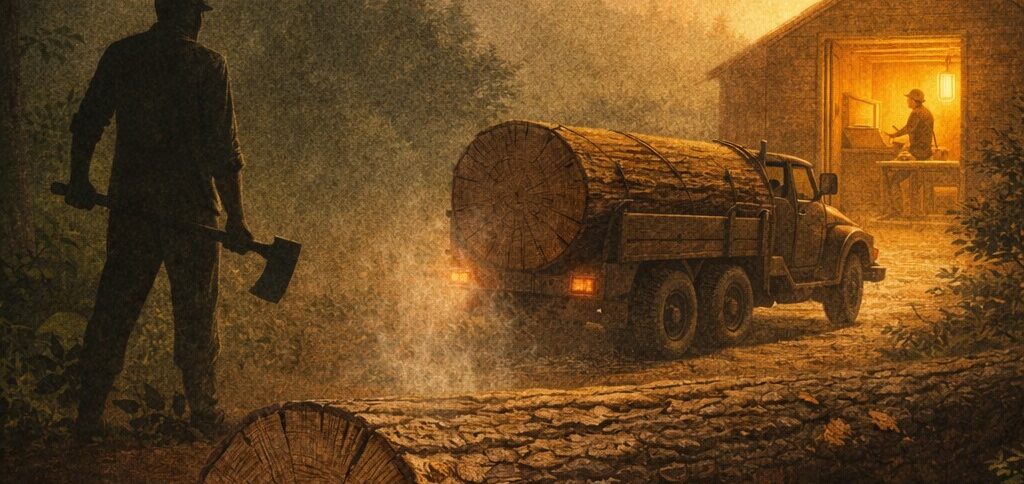

I. The Standing Tree
In the beginning, the tree stood.
Roots drinking deep of ancestral earth,
branches held high as offerings to the sun,
its leaves a language whispering to the wind.
It stood, and standing, was enough.
It did not know it was waiting.
It did not know it was meant for more
than the slow rot of a natural death,
more than the quiet dignity of standing still
until the earth reclaimed what it had lent.
The tree knew only the now.
But the forest knows what the tree cannot:
that some trees are born to travel,
that some must fall to find their purpose.
II. Dìgbòlugi: The Pulling Down
Then came Dìgbòlugi.
It did not ask permission.
It did not admire the shade,
or count the rings of patient years.
It came with tooth and tremor,
with the madness of purpose,
and pulled the giant down.
The forest shuddered.
Birds fled their hymns.
The earth bore a fresh wound
a king laid low,
his crown of leaves now dust.
Dìgbòlugi looked upon its work
and was satisfied.
It knew only the falling.
It could not see beyond the crash,
could not imagine that the falling
was only the first page
of a story it would never read.
You intended it for harm, Dìgbòlugi.
You did not know you were the beginning of blessing.
III. Agbégilódò: The Carrying
For days the log lay silent.
Rain wept on its bark.
Ants traced the geography of its length.
It was becoming something else,
though it did not yet know what.
Then came Agbégilódò.
It groaned on ancient wheels,
its body scarred from a thousand journeys.
It did not ask the log’s name,
or mourn its fallen majesty.
It only said: Come. There is a place for you.
The log, heavy with dying,
surrendered to the lifting.
It rode the red dust roads,
past markets and children and women pounding yam,
past life continuing,
toward something it could not imagine.
Agbégilódò knew only the carrying.
It could not see the sawmill’s mouth,
the teeth that would remake its passenger.
It was a bridge that did not know it was a bridge.
You carried what you did not understand, Agbégilódò.
You were the second prayer, though no one told you.
IV. The Sawmill: The Transformation
At the sawmill, the log met its destiny.
Steel sang through bark,
through heartwood,
through the memory of leaves.
The violence of refinement,
the dust of what it had been,
the surrender of old form
And from the dying, the becoming.
Planks for the table where children learn to write.
Beams for the roof that shelters a new family.
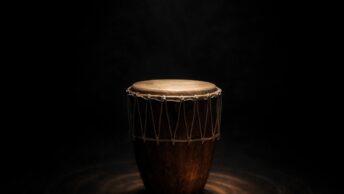
Wood for the drum that calls the village to dance.
Slats for the cradle rocking tomorrow awake.
The drum that beats for festivals.
The mortar where yam is pounded into community.
The mask that dances between worlds.
The stool where the elder sits to judge.
The tree did not die.
It only changed address.
It only traded one kind of standing
for another.
V. The Brothers and the Pit
A Story from Ancient Lands
Joseph stood before his brothers
the very ones who had looked upon him
with eyes of Dìgbòlugi.
They had pulled him down into a pit.
They had sold him into slavery.
They had, in their intent,
killed his youth and buried his future.
The earth had swallowed him,
and they walked away satisfied.
They were Dìgbòlugi,
and they knew only the falling.
Then came the conveyor
the Ishmaelite traders,
their camels swaying across desert sands,
carrying spices and myrrh
and a boy they did not know.
They were Agbégilódò,
blind to the cargo’s destiny,
groaning under a weight
they could not comprehend.
And in Egypt, Joseph entered the sawmill.
Prison for a crime he did not commit.
Temptation in his master’s house.
Years of waiting for dreams to come true.
The teeth of suffering cut away
his pride, his bitterness, his boyhood dreams.
Until what remained was a man
fit to stand before Pharaoh.
Fit to interpret what the future held.
Fit to store grain against the famine.
Fit to save nations he had never seen.
When famine came and his brothers stood before him,
trembling, not recognizing the boy they had sold,
Joseph looked upon them
and saw the whole cycle at last.
You are Dìgbòlugi. You meant to destroy me.
You were the pit, the chains, the silence of years.
But there was a Carpenter working through the night,
receiving what you sent
and building from it a harvest.
You intended it for evil.
But the Unseen Hand intended it for good
the saving of many lives,
the keeping of many futures,
the carrying of many through the famine.
VI. The Unseen Synergy
Dìgbòlugi, blind destroyer,
you thought you ended something.
You were only the first prayer.
Agbégilódò, blind carrier,
you thought you merely moved dead weight.
You were only the second prayer.
Neither saw the Carpenter’s hands.
Neither heard the baby’s first cry
beneath the roof they helped to raise.
Neither knew they worked together,
back to back,
centuries apart,
serving a purpose greater than their own.
The feller does not know the builder.
The carrier does not meet the carpenter.
But the wood remembers every hand
that brought it to its purpose.
VII. So It Is with Us
So it is with us.
We are the fellers and the carriers,
the breakers and the movers,
each blind to the full shape of things.
We pull down what we cannot yet see rebuilt.
We carry what we cannot yet see transformed.
We mourn what we cannot yet see reborn.
But somewhere,
in the sawmill of tomorrow,
hands we will never meet
are waiting for the wood.
The tree you fell today
is someone’s roof tomorrow.
The weight you carry now
is someone’s freedom later.
The pit they threw you in
is the foundation of a well
from which nations will drink.
VIII. The Carpenter’s Truth
“You intended to harm me,
but God intended it for good
to accomplish what is now being done,
the saving of many lives.”
Genesis 50:20
This is the truth Joseph knew.
This is the truth the wood learns
as it surrenders to the saw.
This is the truth we cannot see
from where we stand:
There is a Carpenter.
There is always a Carpenter.
Working through the night.
Planning through the pain.
Building through the breaking.
Dìgbòlugi brings the tree down.
Agbégilódò carries what remains.
The sawmill cuts and shapes and sands.
But the Carpenter
the Carpenter sees the finished house
before the first tree falls.
IX. Benediction
For the tree does not die.
It only changes address.
For the pit is not the end.
It is only the beginning of the well.
For the falling is not the final word.
The final word is the roof
that shelters the child
born long after the forest
forgot the giant that once stood there.
The final word is the drum
that beats for the festival
of a people who never knew
the tree’s name,
but dance upon its wood.
The final word is the table
where strangers break bread
and become family,
never knowing
that their togetherness
was carried on wheels
they never saw,
from a forest
they will never visit,
by a feller
who meant only harm.
And still, the Carpenter smiled.
And still, the house stood.
And still, the children danced.
Amen.
In gratitude to the forest that grew the thought, the feller that brought it down, the conveyor that carried it, and the Carpenter who saw the house before the first tree fell.
(The figure man who loves alphabets)